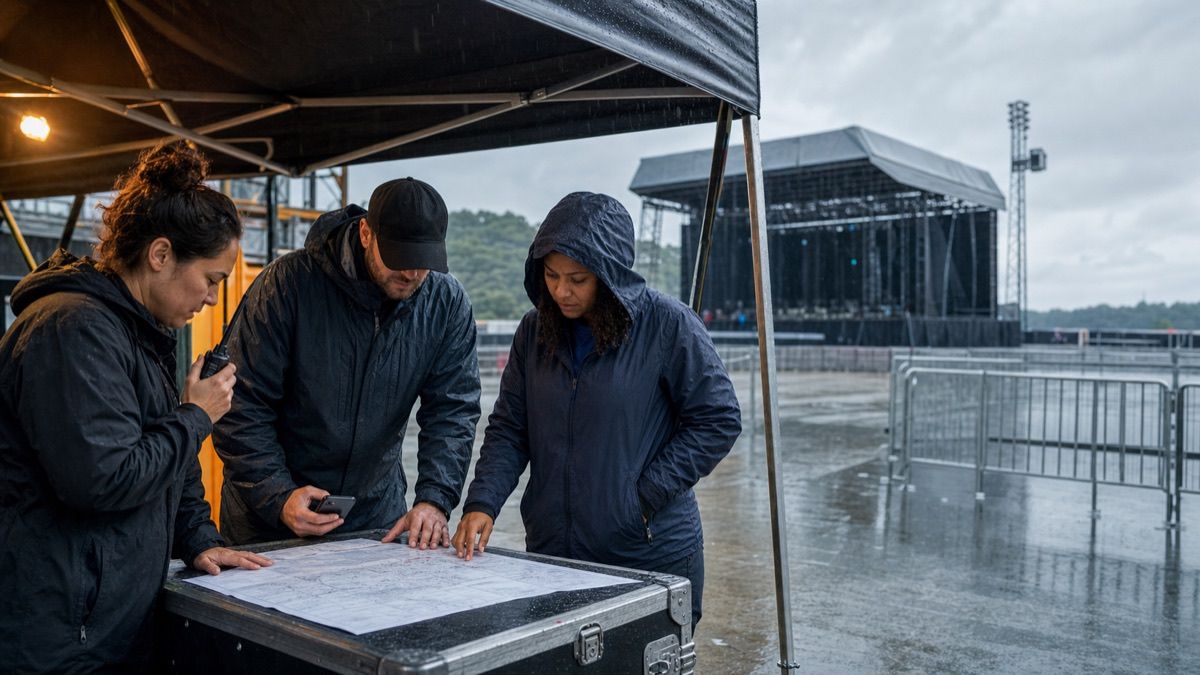
Concert cancellation communications must align the event decision, ticket remedy, channel sequence and fan support. Use this response plan for cancellations and postponements.
Concert cancellation communications are the coordinated messages, service actions and records used to tell affected people that a live event will not proceed as advertised. They connect the decision and reason to ticket status, timing, travel, accessibility, partner activity, customer support and the next confirmed update.
The announcement is only the visible layer. A clear post with an unavailable refund route is not a clear response. Neither is an email that says “postponed” while the venue says “cancelled,” a sponsor continues scheduled promotion, or customer support cannot answer whether the original ticket remains valid.
This guide is an operating framework, not legal or insurance advice. Ticket remedies, consumer rights, force-majeure terms, artist agreements and disclosure duties vary by market and circumstance. Confirm the applicable rules and contract positions before promising an outcome.
What should a concert cancellation message say?
The first confirmed message should answer seven questions in plain language:
- What is the event and which date, city, venue or performance is affected?
- Is it cancelled, postponed, relocated, delayed or materially changed?
- What should ticket holders do now?
- Does the existing ticket remain valid?
- What is confirmed about refunds, exchanges or a new date?
- Where is the authoritative information page and support route?
- When will the next update arrive if decisions remain open?
Say only what has been approved and can be executed. “Refund details will be confirmed by 17:00 local time on 22 July” is more useful than “more information soon.” A specific update time reduces uncertainty without inventing a resolution.
The World Health Organization's 2025 mass-gathering risk-communication toolkit emphasises readiness, evidence-informed communication, early and transparent updates, and systems for listening during mass-gathering emergencies. It is public-health guidance, not a ticketing rule. The operating lesson is broader: communication capacity must exist before the incident.
A disruption message is trustworthy when every sentence has an owner, an operational consequence and a time for the next decision.
Cancellation, postponement and change are different statuses
Use a controlled vocabulary. A cancellation means the advertised performance will not take place. A postponement means the organiser intends to move it but may not yet have a confirmed replacement date. A relocation changes the venue. A delay changes timing within a defined operating window. A material change alters an element that may affect the value or practicality of attending.
These labels can produce different ticket, travel, supplier and insurance consequences. Do not select the softer-sounding word for reputation management. Select the status that operations, the contract position and the evidence support.
When the final status is not known, announce the immediate fact rather than guessing: doors are not opening as scheduled; the show is paused; a decision is under review; the next update will be issued at a named time. Separate safety instructions from commercial resolution.
Pass the decision gate before publishing
The decision group should reconcile five records before the first public message:
- Event record: exact performance, inventory, venue, programme and affected audience.
- Decision record: authority, time, reason category, advice received and current status.
- Ticket record: sellers, terms, payment flows, retained validity and possible remedies.
- Operational record: site state, workforce, travel, accessibility, suppliers and partner activity.
- Communication record: approved facts, unknowns, spokesperson, support capacity and update time.
Not every detail must be settled. The team must know which details are unsettled and who owns them. Legal, safety, artist, venue, ticketing and communications stakeholders should not edit one public paragraph by committee; appoint a decision owner and a message owner, then require factual sign-off from the people who control each promise.
WENOTIFT's artist booking contract checklist shows why cancellation, postponement, notice and payment architecture should be agreed before show week. The festival heat-safety playbook explains how observable conditions should connect to decision authority rather than improvisation.
The eight-part concert disruption response
Together these controls form the Decision-to-Resolution Chain, a WENOTIFT operating framework. It is not a legal standard. Its purpose is to reveal the handoff most likely to break before fans discover it.
Build a message stack, not one perfect post
Prepare messages in layers because different facts mature at different speeds.
Layer 1: immediate operational notice
Protect people and stop unnecessary travel. State the event, current status, immediate action, official source and next update time. If fans are already travelling or on site, include transport, shelter, queue and accessibility instructions before promotional language.
Layer 2: confirmed event decision
Name the status and scope. Say whether the decision applies to one show, a city, a venue, a tour leg or the full event. Explain the reason at the level that is accurate, approved and respectful. Avoid blame, speculation and unnecessary personal or medical detail.
Layer 3: ticket and service instructions
Explain whether tickets remain valid, who processes the remedy, whether action is automatic, what payment method is used, what deadlines apply, and which fees or extras require separate treatment. Give an accessible alternative to self-service.
Layer 4: resolution and closure
Confirm the new date or final cancellation, summarise completed actions, keep the help route open for exceptions, correct persistent misinformation and state when routine programming will resume.
Every layer should link to one canonical event-status page. Social posts, artist accounts, sponsor accounts and venue notices should summarise and link rather than create competing versions of the policy.
Coordinate ticket remedies by market and seller
Do not publish a universal refund statement based on remembered practice. Identify the buyer's seller, governing terms, jurisdiction, cause and materiality of the change.
Australia's competition regulator says in its event-ticket guidance updated in June 2026 that where an organiser chooses to cancel or makes a major change, consumers are entitled to a refund under Australian consumer rights; other causes can produce different outcomes. New Zealand's official event-ticket guidance similarly distinguishes cancellation, postponement, authorised sellers, terms and force-majeure situations. These are jurisdiction-specific examples, not global rules.
In the United States, the Federal Trade Commission's April 2026 StubHub settlement concerned upfront price disclosure, not concert cancellations. It is still a useful warning for communication teams: refundability and other material ticket facts cannot be described loosely or contradicted by the transaction flow.
| Decision | Primary owner | Public answer required | Evidence before release |
|---|---|---|---|
| Event status | Event director with authorised advisers | Cancelled, postponed, relocated, delayed or changed | Signed decision log and affected-event list |
| Ticket validity | Ticketing and promoter leads | Whether the original ticket remains usable | Inventory rule and tested customer record |
| Refund or exchange route | Finance, ticketing and legal | Automatic or requested, channel, deadline and scope | Processor approval, terms review and test case |
| Travel and venue access | Venue and guest operations | Whether to travel, where to go and available support | Live site and transport confirmation |
| Accessible support | Access and customer-service leads | Alternative formats and assisted route | Tested phone, email or form with trained staff |
| Partner activity | Partnership lead | Which promotions, hospitality and content stop or change | Partner acknowledgement and channel hold |
| Next update | Communications owner | Exact date, time and official source | Named approvers available for the update |
The public message should not exceed the capability behind it. If a payment processor needs time to configure automatic refunds, say when the process will begin and when the next instruction will be confirmed.
Design for travellers, disabled fans and incomplete records
A cancellation affects more than the ticket. Some fans have accommodation, flights, visas, rail bookings, childcare, access assistants, medication plans, merchandise collection or sponsor hospitality. Do not promise reimbursement for consequential costs unless the responsible party has approved it. Do acknowledge the disruption and provide verified contacts or documents that may support insurance or supplier claims.
Use local time and include the time zone for international audiences. Translate essential instructions where the audience requires it. Provide a text version of image-led social updates, captions for video statements and a support route that does not depend on one inaccessible form.
WENOTIFT's concert accessibility guide maps the full journey from discovery to exit. During a disruption, preserve confirmed access requests and explain whether they transfer to a new date. The music-tourism strategy guide helps destination partners understand why off-site information belongs in the response.
Control artists, sponsors, venues and resellers as one network
Create a release sequence and embargo. The ticketing page and operational notice should be live before high-reach partner posts drive people toward an empty help centre. Give each partner approved short copy, the canonical link, prohibited claims and the next-update time.
Pause scheduled promotion, paid media, countdown posts, automated emails and influencer content. Check local pages and language accounts, not only the global calendar. Sponsors should support practical information only when their role is real; a branded sympathy message is not a substitute for customer service.
Monitor impersonation, fake refund links and resale confusion. State which domains and accounts are authorised. Never ask fans to publish order numbers, addresses or payment details in public comments.
Measure resolution, not sentiment alone
Track whether the response worked across four layers:
- Reach: delivery rates, status-page visits, ticket-account views and affected records contacted.
- Understanding: repeated questions, wrong-date arrivals, conflicting partner posts and misinformation themes.
- Service: wait time, unresolved cases, accessible-route usage, exceptions and escalations.
- Resolution: refunds or exchanges completed, failed payments, complaints closed and final notices delivered.
Do not invent a universal response-time benchmark. Set internal deadlines from the event's risk, audience location, on-sale system and decision cadence, then report actual performance against those commitments.
End with a short after-action review. Record which fact was slowest to confirm, which handoff created repeated questions, which groups were missed and what must be pre-approved before the next event.
Sources
- WHO — Risk communication and community engagement readiness and response toolkit: mass gatherings (2025)
- Australian Competition and Consumer Commission — Buying tickets to events
- New Zealand Consumer Protection — Event tickets
- US Federal Trade Commission — StubHub ticket-pricing settlement, April 2026
Related reading: Artist Security Advance: Build a Safer Venue Handoff.
Make the difficult announcement operationally true.
Talk to WENOTIFT about decision authority, fan messaging, ticketing handoffs, partner coordination and measurable resolution for your next live event.