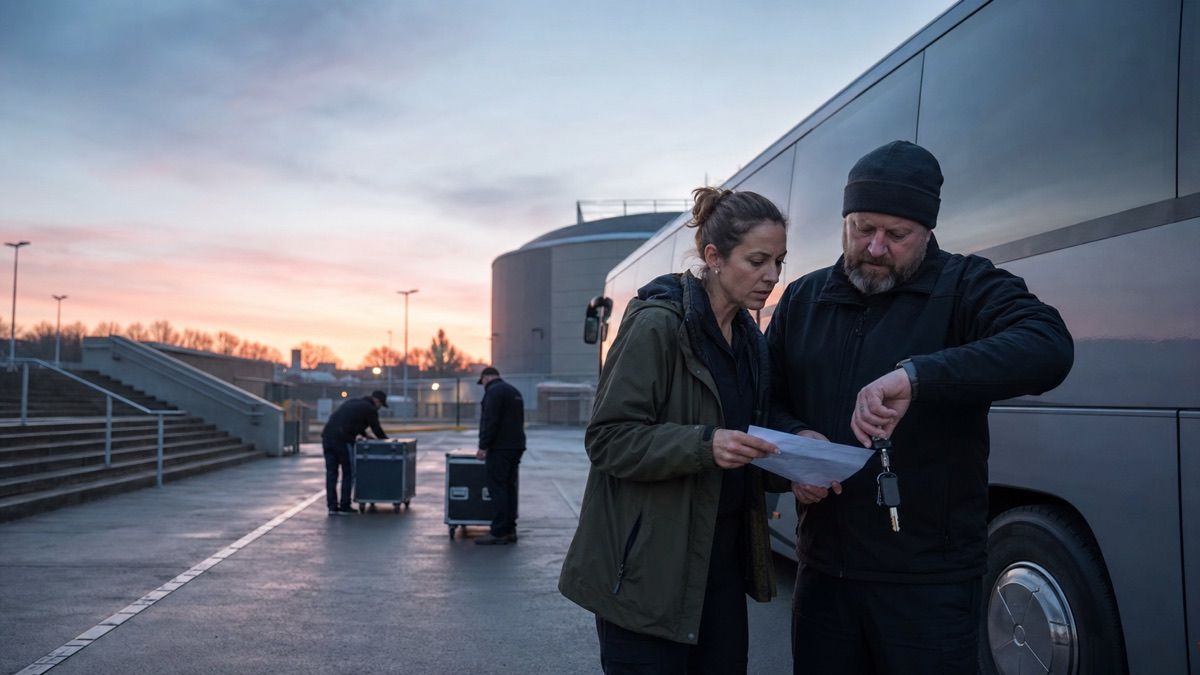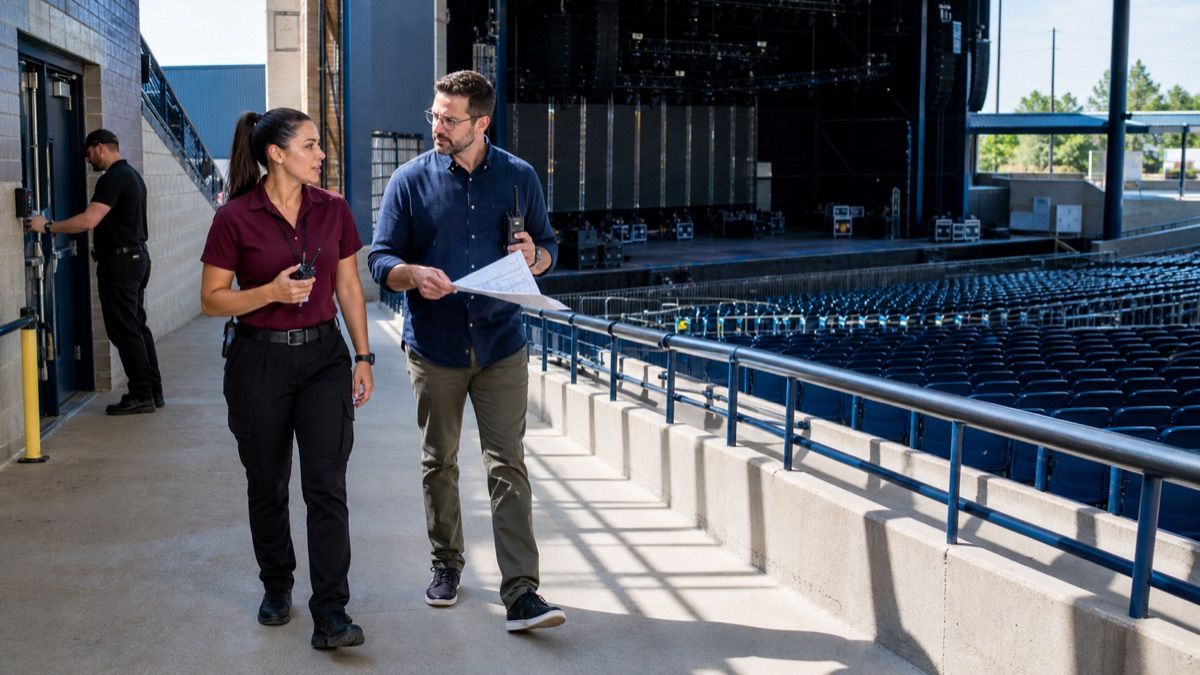
Build an artist security advance that connects risk, routes, credentials, crowd interfaces, incident authority and live venue handoffs.
An artist security advance is the shared operating record that connects a tour or artist team’s needs with the venue, promoter, security contractor and public-safety plan. It turns risk information into named owners, usable routes, access rules, communication channels and incident decisions.
The advance should protect the artist without creating a disconnected private operation. Arrival routes affect crowd queues; backstage credentials affect workers; vehicle movements affect pedestrians; and an artist incident can quickly become a venue-wide emergency.
This guide is an operational framework, not a threat assessment or legal advice. Threats, licensing, police roles, privacy duties and security powers differ by jurisdiction. Use qualified local security professionals and authorities, and keep sensitive detail in appropriately controlled systems.
What should an artist security advance include?
It should include accountable contacts, a current event-specific risk assessment, artist movements, secure and emergency routes, credential zones, dressing-room and stage access, transport interfaces, audience-profile considerations, prohibited-item and search arrangements, medical and emergency links, communications, decision authority, change control and a post-event handoff.
The UK National Protective Security Authority says major-event protective security should be based on an event- and location-specific threat, vulnerability and risk assessment. It also stresses agreed governance across internal and external stakeholders during build, readiness, operation and decommissioning.
A security advance is complete only when both teams can execute it after the schedule changes.
Begin with ownership and information boundaries
Name one tour-side security lead and one venue-side security owner, plus deputies who will actually be present. Add the promoter, production, transport, medical, crowd-management and artist-management contacts needed for decisions. A long phone list without decision rights is not governance.
Separate operational facts from sensitive protective detail. General teams may need a call time, credential zone and radio route; only a smaller group may need a precise movement time or fallback location. Record who may receive each layer, where it is stored and how obsolete copies are withdrawn.
Do not circulate personal data, accommodation information or movement details through broad chats by default. Share the minimum information each role needs and follow applicable privacy, employment and security rules.
The six-part Advance-to-Action Chain
The Advance-to-Action Chain is a WENOTIFT operating framework, not a security standard. It prevents the advance document from becoming a static artist rider that sits outside the event plan.
Build one venue handoff matrix
| Decision point | Tour-side input | Venue-side input | Accountable handoff |
|---|---|---|---|
| Arrival and departure | Party, timing range, vehicles and privacy need | Gate, traffic, pedestrian and holding controls | Transport lead to venue security |
| Access control | Required people and working guests | Credential zones, doors, staffing and challenge process | Tour security to accreditation owner |
| Backstage movement | Dressing room, stage and media sequence | Shared corridors, loading activity and emergency routes | Artist liaison to venue operations |
| Audience interface | Fan activity, known concerns and programme moments | Queue, pit, egress and welfare conditions | Tour security to crowd manager |
| Incident response | Artist priorities and protective movement | Command, medical, fire and evacuation plan | Security leads to event control |
| Change management | Schedule or party change | Resource and crowd consequence | Named leads approve and rebrief |
The matrix should reference controlled maps and procedures rather than embedding every sensitive detail in one widely distributed file.
Align the artist risk picture with the event
Review credible threats, recent concerns, the artist’s public profile, fan behaviour, planned appearances, local context and venue vulnerabilities. Avoid profiling people by appearance or identity. ProtectUK’s hostile-reconnaissance guidance says suspicious behaviour—not age, ethnicity, gender or clothing—is the relevant focus.
Translate assessment into proportionate measures. More secrecy or more guards is not automatically better. Controls must work with production, fire safety, crowd flow and guest experience. NPSA advises that protective security should deter, prevent, detect and delay while not hindering the venue’s intended function.
Set a review trigger for a changed threat, viral location disclosure, revised appearance, additional guest, protest, transport disruption or venue-layout change. The plan needs a time-stamped owner, not an assumption that yesterday’s assessment still applies.
Walk every route and interface
Inspect the route from public road to vehicle hold, entrance, dressing room, stage, media position and departure. Check doors, lighting, keys, lifts, stairs, loading activity, public sightlines, radio coverage and the effect of a blocked primary route.
Walk emergency alternatives with the venue’s competent leads. A private route cannot compromise evacuation, emergency access or crowd safety. HSE’s crowd-control guidance warns that search procedures must not create overcrowding and that queues must not block emergency access.
Test the plan in real operating conditions. A quiet midday walkthrough may not show the queue, catering carts, support-act movement or loading congestion present at show time.
Make credentials a live control
Define zones by operational need and keep the number understandable. Specify who authorises additions, who produces credentials, how staff challenge unfamiliar people, what happens when a pass is lost and how temporary guests are escorted.
Check contractors, local crew, sponsor guests, media and artist-party additions against the same system. A familiar face or forwarded message should not substitute for the agreed authorisation route.
Brief door staff on exceptions without teaching them to ignore the control. When a late change is approved, update the source of truth and notify every affected post.
Connect search, crowds and artist moments
Entry screening, prohibited items and credential checks are venue controls with artist implications. ProtectUK’s search-planning guidance recommends structured search planning; local powers, consent, licensing and contractor requirements must be confirmed with qualified professionals.
Map moments likely to change crowd behaviour: arrival rumours, soundcheck visibility, barricade interactions, confetti, surprise appearances, merchandise drops and departure. Share the running order with crowd managers early enough to adjust barriers, staffing and welfare.
Do not design a fast artist route that crosses a dense public flow. The venue owner and crowd team need authority to delay a movement when the environment no longer matches the plan.
Rehearse communications and decision authority
Give the artist security lead a reliable route into event control. Confirm radio channels, call signs, phone backups, code language, lost-communications action and who can request police, medical or venue emergency support.
Use short scenarios: the primary gate is blocked; an unauthorised person reaches a controlled corridor; a public post reveals the departure point; the show overruns; the artist requests an unplanned audience interaction; or a medical incident closes the planned route.
Record who can hold movement, change a route, cancel an appearance, lock a zone, pause entry or begin a wider event response. Private protection and venue command should not compete for control during an incident.
Close the advance after departure
Confirm the artist party has departed or transferred, temporary credentials are closed, sensitive papers are collected and open incidents have named owners. Preserve relevant records lawfully without retaining every informal message.
Debrief deviations and near misses: unbriefed doors, weak radio coverage, last-minute guests, public route exposure, delayed vehicles or crowd conditions that changed a movement. Feed lessons into the next venue advance.
For connected operating controls, see WENOTIFT’s guides to concert cancellation communications, event volunteer safeguarding and touring crew fatigue. WENOTIFT is an AI-powered brand-partnership platform — a real-time partnership dashboard for entertainment teams and sponsors.
Sources
- NPSA: Protection at Major Events, accessed 28 July 2026.
- NPSA: Security Planning Guidance, accessed 28 July 2026.
- ProtectUK: Hostile reconnaissance, published 3 January 2022.
- ProtectUK: Search planning, published 1 March 2022.
- Health and Safety Executive: Put crowd controls in place, updated 4 April 2025.
Connect artist protection to one accountable venue operating plan.
Talk to WENOTIFT about advances, partner roles and resilient live-event handoffs across entertainment programmes.