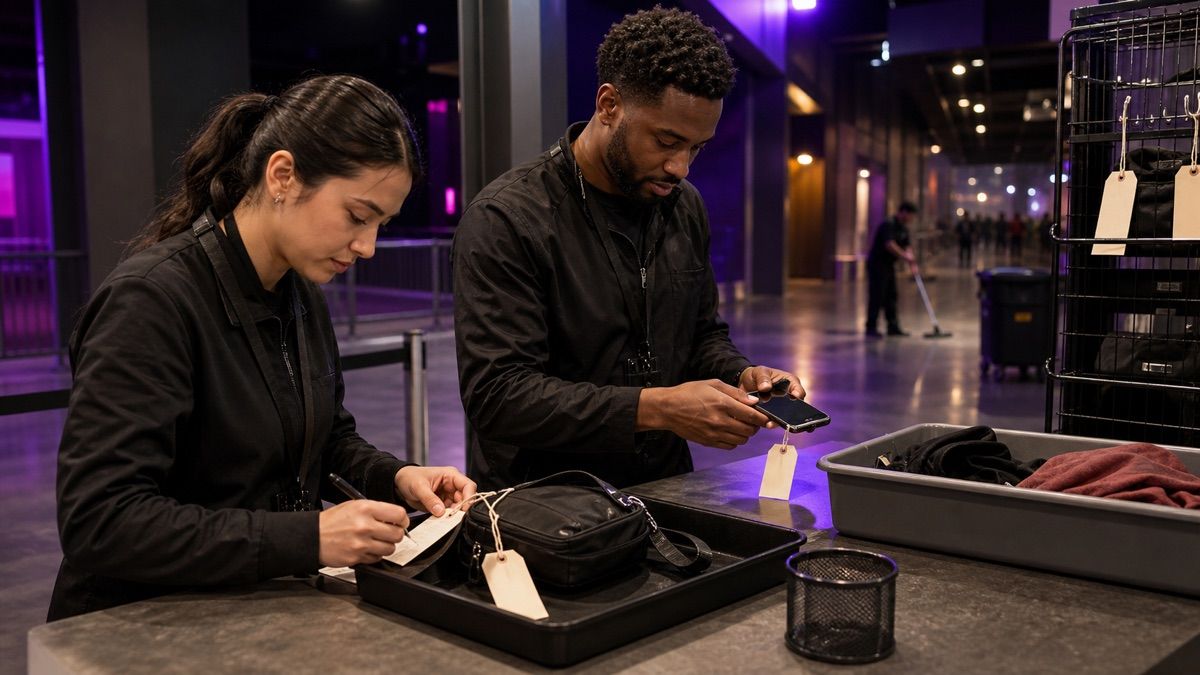
Build an event lost-property process that records finds, protects sensitive items, verifies owners, controls handoffs and closes every return or disposal.
An event lost-property plan is the operating process for receiving, recording, protecting, matching, returning and finally disposing of items found at a venue or festival. It should help a fan recover property without exposing personal information or turning an ordinary handoff into an untraceable favour.
The difficult part is rarely the box marked “lost and found.” A phone may move from a cleaner to a zone supervisor, event control, the venue office and then a third-party operator. At every transfer, the team needs to know what moved, when, where it was found and who accepted custody.
This guide is an operating framework, not legal, police, insurance or data-protection advice. Property rules, retention periods, identity-document procedures and reporting duties vary by jurisdiction. Confirm the event’s venue policy and current directions from local authorities and issuing organisations.
What should an event lost-property process control?
It should control six linked decisions: how an item enters custody, how it is described without unnecessary intrusion, where it is secured, how a claim is matched, who authorises release, and how an unclaimed item leaves the system.
A queue of messages saying “has anyone seen a black phone?” is not a record. Nor is a photograph of every object in a staff group chat. The first loses accountability; the second can spread personal data and sensitive images far beyond the people who need them.
Lost property is a fan-care service, but the control objective is custody: every item should have one current status, location and accountable owner.
Build one Find-to-Closure Chain
The Find-to-Closure Chain is a WENOTIFT operating model, not a legal standard. It prevents guest services, security, cleaners, production teams and the venue office from maintaining competing piles and spreadsheets.
Map custody before doors open
Name the operational owner for show hours and the owner after the event. Decide which posts can accept property, how runners transfer it, where valuables are stored, and when custody passes from promoter to venue or another contracted operator.
Give each accepted item one reference. Record the find time and location, a proportionate description, finder or receiving role, each transfer, current storage location and final outcome. Avoid opening bags or unlocking devices simply to gather more detail. If examination is necessary for safety or a lawful owner-identification process, restrict it to trained authorised staff.
Transport for London describes its lost-property function as collection, safekeeping, restoration and disposal. Its public transparency note also recognises that release requires information from the claimant and that unclaimed property eventually changes status. The exact TfL rules do not govern a concert, but the lifecycle is a useful control boundary.
Use an item-response matrix
| Item class | Immediate control | Claim evidence | Escalation or closure |
|---|---|---|---|
| Ordinary item | Tag, record and secure in controlled storage | Colour, brand, contents or distinctive feature | Return or dispose under published policy |
| Phone or data device | Do not browse; isolate and protect from access | Device details, case, lock-screen knowledge or serial information | Follow local authority and secure-disposal rules |
| Wallet or bag | Record externally; restrict access to contents | Non-public contents and distinguishing features | Escalate cash, cards and identity documents separately |
| Bank card or identity document | Secure immediately; do not copy unnecessarily | Follow issuer or authority process | Return to issuer, cancel or dispose as directed |
| Medication or medical device | Protect condition and privacy | Specific description and safe verification | Seek medical or authority advice when urgent |
| Hazardous or suspicious item | Do not treat as routine property | Not applicable | Keep people away and invoke the security/emergency plan |
The matrix should point to current local instructions. Police Scotland, for example, tells the public that bank cards handed to it are destroyed and the bank notified, while passports and some licences follow issuing-authority procedures. That is a reminder to route sensitive documents deliberately, not a universal venue rule.
Record the minimum useful description
The record must distinguish an item well enough to search and verify, but it should not become a copy of everything inside it. The UK Information Commissioner’s Office states that personal data should be adequate, relevant and limited to what is necessary. Apply that principle to claimant forms, photographs, staff notes and storage labels.
Use neutral observable facts: “black fabric shoulder bag, found near east concourse kiosk at 22:10.” Keep non-public details—contents, damage, engraving, case design or wallpaper description—out of public listings so they can help verify a claim.
Do not post names from identity cards, lock-screen notifications, prescriptions or personal documents in broad channels. If the owner can be contacted through an issuer or authorised process, record that the attempt was made without copying more data than the process needs.
Separate intake from the public claim channel
Publish one clear route for fans: a web form, staffed desk or venue contact. Ask for the event, approximate location and time, item category, a safe description, distinctive non-public details and contact information. Do not ask every claimant for a passport scan or full payment-card information.
Create a service expectation: when claims are reviewed, how long property is normally kept, which items follow special rules, what evidence may be requested and how collection works. A confirmation should provide a claim reference without implying a match has already been made.
At multi-day events, schedule reconciliations between zone collection points and central storage. An item that remains under a stage manager’s desk cannot match a guest-services claim, however good the database is.
Verify ownership without revealing the answer
Start with knowledge the claimant should have and that has not been published: bag contents, a distinctive mark, an approximate serial or IMEI, a device case, a keyring, the amount and denominations of cash, or the place and sequence in which it was lost.
The Metropolitan Police’s published lost-property guidance similarly gives examples such as describing wallet or bag contents, quoting a serial number or describing a distinguishing feature. Venue teams should adapt the principle to their jurisdiction and risk level.
Use stronger checks for high-value or data-bearing items. Do not ask staff to bypass a device lock. Where proportionate, the owner can unlock the device in person or demonstrate account/serial information without handing the team a reusable password.
Record why the match was accepted and who authorised release. “Looked right” is not a repeatable decision.
Control every handoff and release
Use a transfer log whenever custody changes between finder, post, runner, central store, venue, courier or authority. The receiving person confirms the reference, item condition, sealed container where used, time and destination.
For collection, record the claimant reference, verification basis, collector, release time and staff authoriser. If another person collects on the owner’s behalf, define acceptable authority in advance. Avoid retaining identity-document copies when a checked-and-recorded method is sufficient under the applicable policy.
Courier returns create a new risk: address accuracy, packaging, tracking, cost, restricted items and failed delivery. Use a supported service and make clear when responsibility transfers. Never put cash, identity documents, medication or fragile devices into a generic mail process without specific approval.
Protect phones, documents and personal data
Assume phones, laptops, wallets, passes and documents contain sensitive information. Limit who can access them, keep devices charged only when the approved process requires it, and do not connect unknown media to event systems. A lost device is property and a potential security incident.
The ICO’s storage-limitation guidance says identifiable personal data should not be kept longer than necessary and recommends clear retention and erasure policies. Apply separate retention decisions to the physical item, the claimant record and the custody log; they may not need identical periods.
If a device belongs to staff, an artist team or a partner and may hold business data, notify the named security or IT contact without exploring the contents. The UK National Cyber Security Centre notes that managed-device controls can support remote erasure when a device is lost or stolen; that decision belongs to the owner’s authorised team.
Define retention and closure before property accumulates
Set item categories, retention triggers, review dates and authorised outcomes under local law and venue policy. Some items may go to an issuer or authority quickly; others may be retained for a published period. Hazardous, illegal, perishable or highly sensitive items need specialist routes.
When an item is returned, transferred, donated, recycled, destroyed or otherwise disposed of, close the reference with the date, method and authoriser. Preserve only the record required for operational, legal, accounting or dispute purposes.
Review unmatched claims, time-to-intake, handoff gaps, returns, sensitive-item escalations and overdue closures after the event. These measures diagnose the process; they are not a reason to rank individual staff on the value of property they happen to find.
Connect lost-property messaging to the wider fan journey. WENOTIFT’s guides to concert accessibility, cancellation communications and venue entry controls show how service information and operations meet. WENOTIFT helps entertainment teams and partners design more accountable audience experiences.
Sources
- ICO: Data minimisation, accessed 30 July 2026.
- ICO: Storage limitation, accessed 30 July 2026.
- Transport for London: Lost Property Office transparency data, accessed 30 July 2026.
- Metropolitan Police: Dealing with lost and found property, accessed 30 July 2026.
- Police Scotland: Report lost property, accessed 30 July 2026.
- NCSC: Erasing devices, accessed 30 July 2026.
Turn lost property into an accountable fan-service workflow.
Talk to WENOTIFT about audience journeys, venue handoffs and partner operations that protect trust after the show.