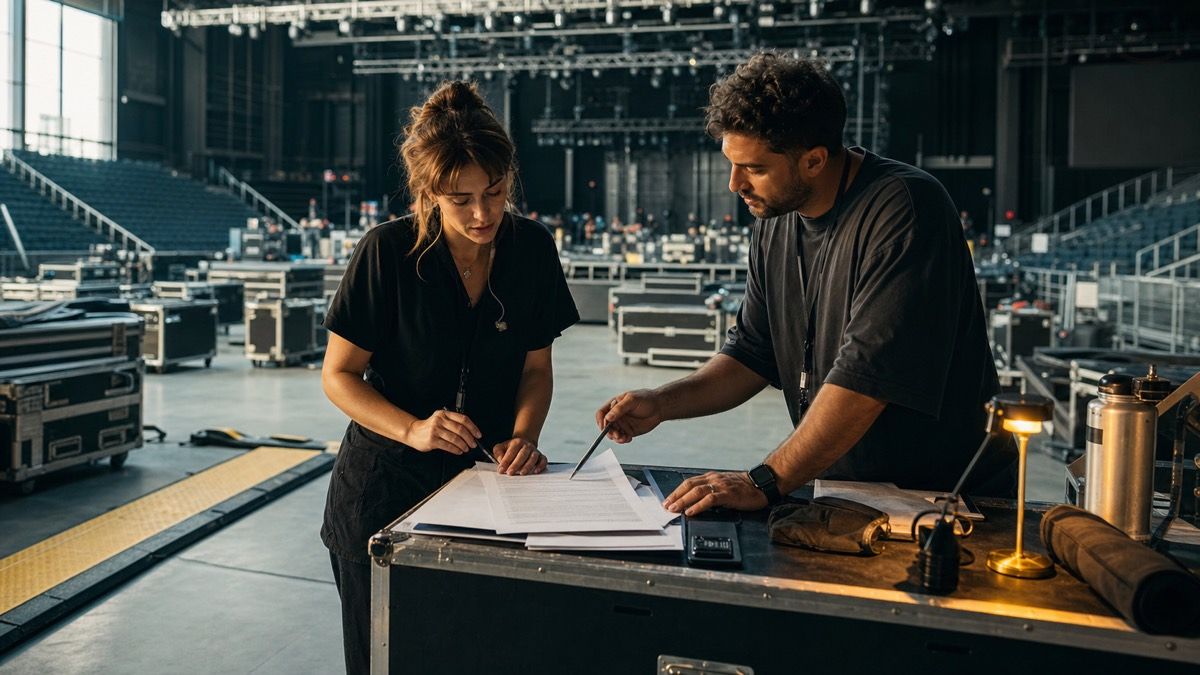
Use this artist booking contract checklist to confirm the deal, rights, production duties, cancellation rules and show-day evidence before signing.
An artist booking contract is the written agreement that records who is engaging the artist, what performance will be delivered, when and where it will happen, how the artist will be paid, what each party must provide, and what happens if the plan changes. A useful artist booking contract checklist therefore covers commercial terms, rights, production, travel, safety, cancellation, evidence, and dispute handling—not only the fee and date.
This guide is an operating and briefing framework for promoters, venues, agencies, buyers, artist teams, and production leads. It is not a contract template or legal advice. Contract law, tax, immigration, labour rules, licensing, insurance, and cancellation remedies vary by territory and deal; qualified advisers should review the actual engagement.
The central discipline is simple: every promise needs an owner, a deadline, an approval route, and evidence. If the parties cannot explain how a term will work on show day, the document has recorded ambiguity rather than removed it.
What belongs in an artist booking contract?
At minimum, the signed agreement should identify the authorised parties, event and performance, compensation, payment timing, production and hospitality responsibilities, permitted uses of the artist's name and performance, cancellation and force-majeure process, compliance duties, and governing process for disputes.
The UK's Musicians' Union says written evidence of engagements is essential when its standard contracts are not used, and that a written note should specify the date, time, place, and fee and be signed by someone authorised. Its standard-contract guidance, updated in March 2026, is written for musicians in its jurisdiction; it is useful evidence of the decisions a professional engagement records, not a universal promoter form.
Its April 2026 guide for unsigned and emerging artists adds practical booking detail: costs deducted from ticket revenue, subsistence, load-in and load-out, access, parking, gear sharing, sound-desk information, soundcheck, set time, doors, and promotion should be clarified. Larger agency deals may distribute those details across several documents, but the decisions still exist.
A contract is strongest when the commercial promise and the operating plan describe the same show.
Contract, deal memo and rider: what is the difference?
A deal memo records the negotiated headline bargain quickly: parties, date, venue, performance, fee or settlement formula, deposit, basic expenses, and key conditions. It may be binding depending on its wording and governing law, so “memo” does not automatically mean informal.
The long-form contract expands the bargain into rights, warranties, compliance, cancellation, liability, confidentiality, notices, dispute process, and other negotiated terms. It should not quietly change the agreed economics.
A technical or hospitality rider describes what the artist needs to perform: stage, sound, lighting, power, backline, access, staffing, transport, rooms, security, catering, and schedule. The agreement should say which attachments are incorporated, what happens if documents conflict, and who can approve substitutions.
The promoter's production schedule, venue rules, ticket manifest, marketing approvals, and settlement sheet may sit outside the contract. They still need traceability to the agreement and a controlled version owner.
Before drafting: pass the booking decision gate
Do not use a contract to disguise an undecided booking. Confirm the demand case, venue capacity and configuration, ticket range, show budget, currency exposure, tax assumptions, route feasibility, work-authorisation path, production capability, and downside limit first.
WENOTIFT's event demand forecasting guide explains how to connect market signals to venue, price and deal decisions. The genre-demand scorecard helps test whether attention is locally reachable rather than merely global.
An approved offer should produce a short assumptions register. Label each item confirmed, provisional, or dependent on a named third party. Those assumptions become the drafting checklist and later the show-delivery tracker.
The 14-term artist booking contract checklist
The checklist is a decision map, not preferred wording. Some items will sit in schedules or local statutory documents. The contract should make that architecture explicit.
How to turn the checklist into a booking-to-show chain
| Decision | Primary owner | Evidence before signature | Show-delivery proof |
|---|---|---|---|
| Commercial bargain | Buyer, agent and finance | Approved deal memo and budget | Invoice, payment record and settlement |
| Ticket economics | Promoter and ticketing lead | Capacity, prices, holds and deduction definitions | Manifest, box-office report and signed count |
| Work authorisation | Engaging entity and qualified immigration adviser | Route, eligibility, sponsor and deadlines | Required permission and arrival documentation |
| Production | Production manager and artist production contact | Agreed rider, venue spec and substitutions | Advancing log, sign-offs and incident record |
| Marketing rights | Promoter marketing and artist approver | Asset list, billing and approval SLA | Approval archive and published inventory |
| Recording and sponsor use | Rights lead and artist representative | Purpose, media, territory, term and approvals | Capture log, releases and delivery record |
| Cancellation response | Authorised executives and advisers | Trigger, notice, mitigation and financial process | Decision record, notices, refunds and revised plan |
The chain prevents a common failure: legal, finance, marketing, ticketing, travel, and production each holding a different version of the deal. One owner should maintain the signed agreement, incorporated attachments, amendments, approvals, and a plain-language obligation tracker.
How should payment and settlement terms be written operationally?
Start with the formula, then test it with sample numbers internally. If the artist receives a guarantee versus a percentage, define the percentage base, allowable deductions, taxes, currency conversion source and date, settlement documents, and audit access. Do not rely on labels such as “net” without defining what comes out first.
Separate the artist fee from reimbursable costs. State whether travel, accommodation, freight, visas, local transport, production upgrades, catering, or per diems are included, capped, pre-approved, or paid directly. An undefined “expenses” line can erase the economic meaning of an otherwise precise fee.
Payment operations also need a fraud-resistant change process. Verify beneficiary instructions through an agreed channel, restrict who may request a bank change, and document approvals. The contract does not replace finance controls; it tells finance which obligations those controls serve.
Who owns visas, permits and local compliance?
The answer must follow the actual territory, artist nationality, activities, duration, payer and event structure. Avoid clauses that simply say “artist handles all visas” when the local system requires an inviting or sponsoring entity to perform part of the process.
For example, the UK's Creative Worker sponsor guidance, version 04/26 describes several routes and responsibilities for creative work and paid engagements. It is UK-specific and can change. Its practical lesson is general: map the correct official route early, name the responsible entity, and keep the contract consistent with current government guidance and qualified advice.
Use the same discipline for event licensing, labour, minors, music permissions, tax withholding, insurance, health and safety, customs, and local reporting. “Comply with all laws” is not an operating plan; the team still needs owners and deadlines.
How should cancellation and force majeure be reviewed?
Read the clause as a sequence, not a slogan:
- What event activates the clause, and what is expressly excluded?
- Who decides that performance is prevented, unsafe, unlawful, or impracticable?
- What notice and evidence are required, and by when?
- What mitigation, alternative venue, delayed start, reduced production, or rescheduling must be considered?
- What happens to deposits, earned fees, non-recoverable costs, ticket refunds, travel and third-party commitments?
- Does postponement require a new date within a stated window, and who controls availability?
- Which obligations survive cancellation, such as confidentiality, accounting or content removal?
Do not copy a pandemic-era clause into a different risk environment without review. Weather, illness, transport failure, government action, security incidents, visa failure, low sales and production delay are not automatically treated the same. The allocation should reflect who can control, insure, mitigate, or price each risk under the relevant law.
Recording, sponsorship and artist-image rights need separate precision
The right to promote a concert is not automatically the right to livestream the performance, use music in an advertisement, give a sponsor backstage access, create an endorsement, or retain footage indefinitely. Break each proposed use into asset, channel, purpose, territory, term, edit approval, credit, payment, archive and takedown.
This matters when sponsorship is involved. WENOTIFT's concert sponsorship activation guide distinguishes contractual inventory from a useful fan experience. The artist agreement, promoter-sponsor agreement and production plan must describe compatible rights; no activation team should infer an artist endorsement from event sponsorship.
Audience capture adds privacy and venue-policy questions. Define who controls the data, what notices or releases apply, what the content may show, and whether an artist approval covers the final edit or only access to film.
A practical contract review workflow
1. Build the issues list
Translate the approved offer and rider into the 14 checklist areas. Mark missing, conflicting, unusual, or high-value terms. Record the business owner and legal reviewer for each issue.
2. Run cross-functional review
Legal reviews enforceability and risk; finance tests formulas, tax and payment; production tests deliverability; ticketing checks capacity and settlement; marketing checks approvals; travel checks routing and work authorisation; accessibility and safety leads test working and audience conditions.
3. Reconcile the attachments
Confirm file names, dates, version numbers, priority of terms, and incorporation. Remove obsolete riders and duplicated schedules. Record every approved substitution in writing through the agreed change mechanism.
4. Convert obligations into a tracker
For every material obligation, capture owner, due date, dependency, approval, evidence and escalation. The signed PDF is the authority; the tracker is the delivery interface.
5. Hold a pre-signature risk call
Resolve the few issues that could change the economics, legality, show format, safety, rights or cancellation exposure. Do not let urgency turn an unresolved issue into assumed consent.
Red flags that deserve a pause
- The contracting entity or signer's authority is unclear.
- The fee formula cannot be reproduced from the words on the page.
- Deductions, taxes, currency or bank charges are undefined.
- The venue capacity or show configuration conflicts with the offer.
- The rider is “to follow” after the promoter has accepted an uncapped obligation.
- Marketing, sponsor, recording or livestream rights are broader than the negotiated purpose.
- Visa or permit responsibility is assigned without checking the official route.
- Cancellation language treats low sales, illness, force majeure and postponement as one event.
- Attachments conflict and the agreement has no order of precedence.
- An approval has no response deadline, or silence is treated as consent without authority.
Pausing does not always mean rejecting the deal. It means pricing, limiting, insuring, clarifying, or escalating the risk while there is still a decision to make.
What the Editor-in-Chief would remove from a weak contract guide
A weak checklist pretends one form works everywhere, prescribes arbitrary deposits, or promises that a clause will “protect” a promoter. A useful guide names the decision, scope and evidence, then sends jurisdiction-specific wording to qualified advisers.
It also avoids adversarial theatre. The artist, promoter and venue share an interest in a safe, deliverable, properly marketed and properly paid performance. Precision is not about winning every clause; it is about knowing which party owns which risk and whether the show plan can honour the bargain.
A contract is only as good as the follow-through. WENOTIFT is an AI-powered brand-partnership platform — a real-time partnership dashboard brands, promoters and event partners use to track deliverables, rights and activation against what the agreement actually promised.
Sources
- Musicians' Union — Standard Contracts, updated 16 March 2026
- Musicians' Union — Engagement Booking for Unsigned and Emerging Artists, updated 15 April 2026
- UK Home Office — Creative Worker sponsor guidance, version 04/26
Related reading: Artist Security Advance: Build a Safer Venue Handoff.
Turn the accepted offer into a show the whole team can deliver.
Talk to WENOTIFT about demand, deal architecture, operating assumptions, rights, production handoffs and evidence for your next live booking.