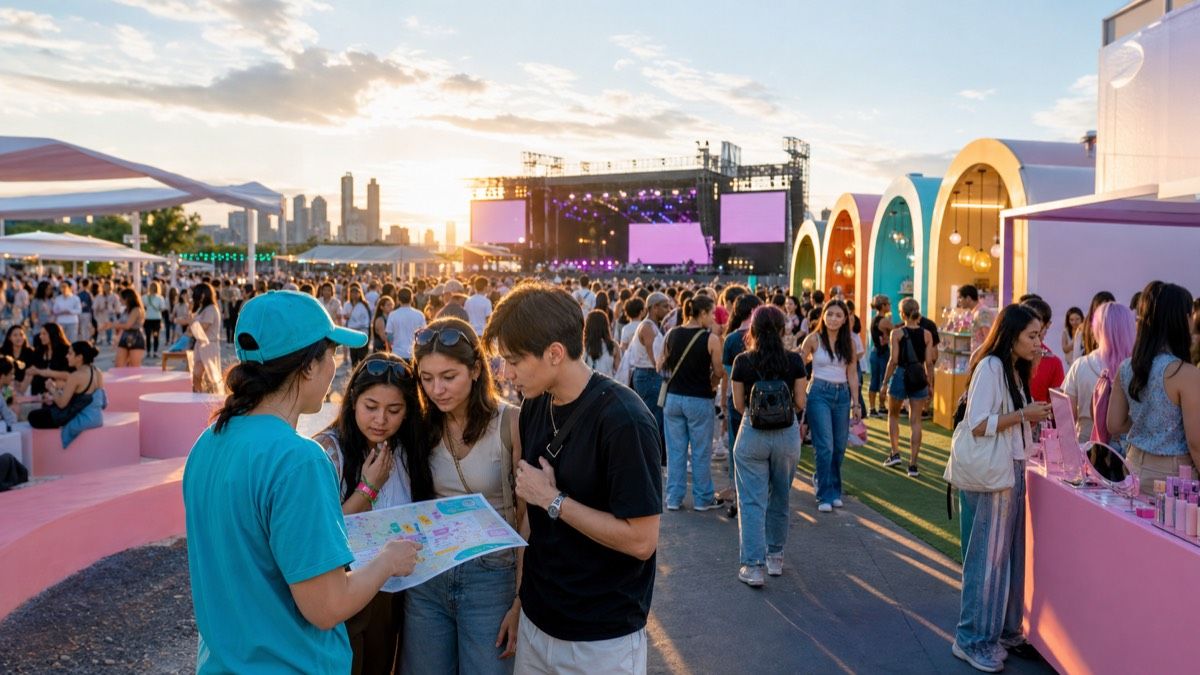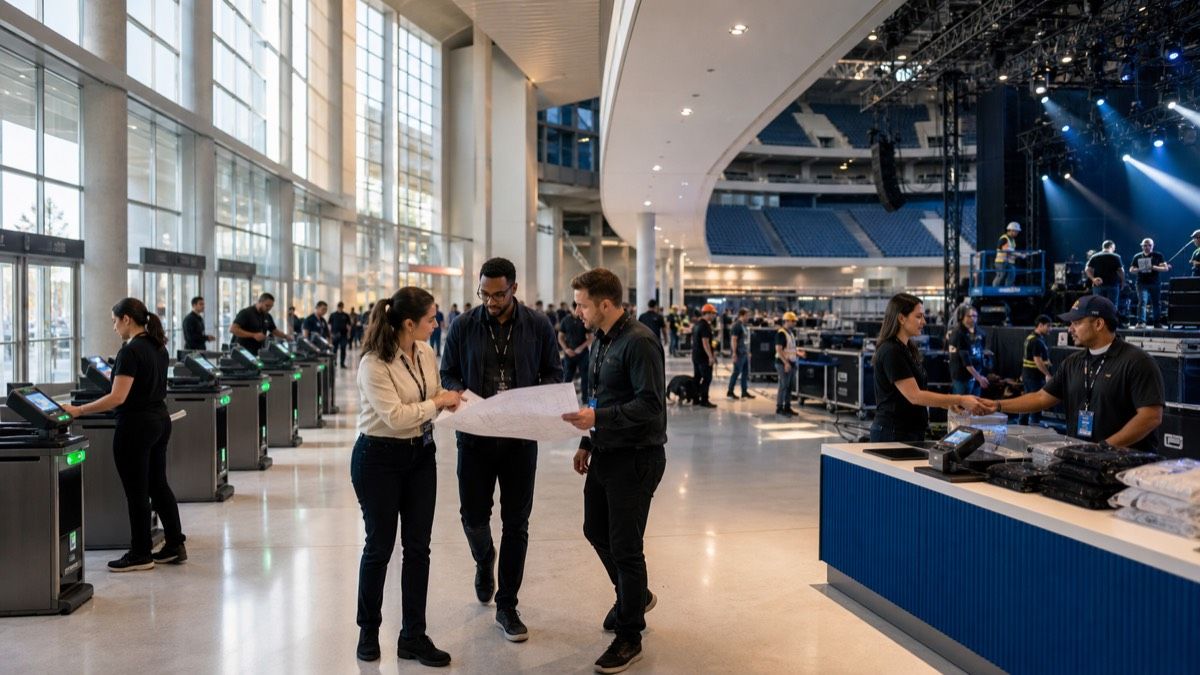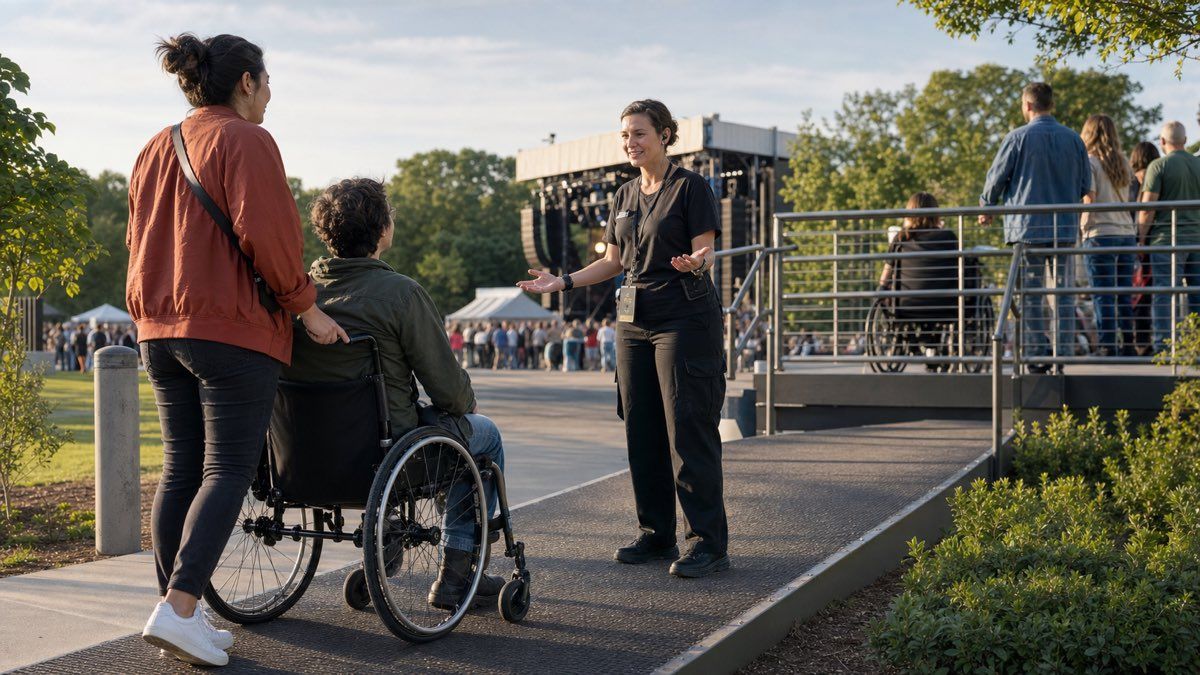
Concert accessibility spans discovery, ticketing, arrival, participation, support and exit. Use this framework to plan an inclusive fan journey.
Concert accessibility is the coordinated design of information, ticketing, transport, venue routes, viewing, sound and visual communication, sensory conditions, services, staff and contingencies so disabled, Deaf and neurodivergent fans can choose, book and participate with dignity. It begins before on-sale and continues through the journey home and post-event feedback.
An accessible entrance is necessary, but it is not a complete access plan. A fan may still be blocked by an unusable ticket form, a separate booking queue, missing seat detail, an uncertain companion policy, an inaccessible shuttle, poor sightlines, no quiet space, untrained security, or a last-minute platform change.
The right planning question is therefore not “Does this venue have a ramp?” It is “Can a fan understand and complete the whole journey, and does every handoff preserve the support they were promised?”
Why concert accessibility is a current operating priority
The UK's Turn It Up music plan, published in July 2026, backs the UK-and-Ireland All In access scheme and highlights the disability-led Attitude is Everything Live Events Access Charter. The plan says the Charter has been adopted by more than 200 venues and festivals and describes accessibility as an industry priority.
That is a UK policy and industry signal, not a global legal rule. Every organiser must identify the laws and standards that apply to its territory, venue, ticketing system and event. The broader lesson is timely: access is moving into shared standards, booking tools and operational accountability rather than remaining an informal request process.
The Attitude is Everything Live Events Access Charter treats disability equality as something built into all areas of a venue or event. Its framework is informed by disabled people's reported barriers and live-industry practice. It can support planning, but it does not replace local legal or technical advice.
Accessibility works when the fan does not have to repair the gaps between marketing, ticketing, transport, venue operations and customer support.
Accessibility and compliance are related, but not identical
Compliance sets enforceable duties in a specific jurisdiction. Inclusive practice asks how the actual fan journey works across visible and non-visible needs, temporary conditions, technology, communication, service and human behaviour.
For covered US venues, the Department of Justice's ADA ticket-sales guidance says accessible seats must be sold during the same hours, through the same methods and during the same sales stages as other tickets. It also addresses pricing, seat information, companion seats, transfers, hold-and-release policies and staff training. Those statements describe US ADA requirements and guidance; they should not be copied into another market as though the law were universal.
Good planning starts with the applicable rule, then tests the experience beyond the minimum. A technically compliant route can still be difficult to find. An accessible seat can still have poor event-specific sightlines. A phone line can exist yet fail during a high-demand on-sale. A caption screen can be present but invisible from the allocated section.
The eight-layer accessible fan journey
The layers are connected. A platform is not useful if the ticket cannot be booked, the shuttle does not reach it, the route becomes storage space, or stewards redirect fans elsewhere.
Who should own each accessibility decision?
| Journey decision | Primary owner | Required handoff | Evidence before doors |
|---|---|---|---|
| Access information | Event access lead and communications | Venue facts, transport details, ticket process and update owner | Published access guide tested on mobile and with assistive technology |
| Accessible inventory | Ticketing lead and venue | Seat map, price categories, companions, holds, transfers and support route | End-to-end test purchase and live inventory check |
| Arrival route | Transport, venue and security | Drop-off, parking, queue, search and weather plan | Physical route inspection at event configuration |
| Viewing and performance access | Production and venue access lead | Sightline, stage, screens, audio, lighting and platform capacity | Show-condition test from allocated positions |
| Sensory support | Access lead, production and guest services | Trigger information, quiet space, re-entry and assistance | Signed operating plan and staff walk-through |
| Temporary retail and hospitality | Merchandise, sponsor and venue operations | Route, counter height, queue, payment, seating and fulfilment | Fan-journey rehearsal including peak demand |
| Incident and evacuation | Safety lead and all contractors | Individual assistance, alarms, refuge, communication and transport | Event-specific emergency briefing and drill evidence |
| Feedback and remediation | Event leadership | Consent, issue log, response owner and next-event changes | Escalation tracker and scheduled post-event review |
Accessibility needs executive ownership because individual suppliers control only parts of the journey. The access lead should have authority to stop an operational change that breaks an agreed route or service.
Start with disabled fans and event-specific reality
Use disabled-led expertise early, compensate people for substantive work, and avoid asking one person to represent every disability or access need. Combine co-design, specialist assessment, venue evidence, support-request patterns and physical testing.
Walk the real route at the event's planned configuration and time. Temporary barricades, sponsor builds, cable ramps, merchandise queues, low light, weather covers, parked vehicles and security searches can change a venue that appeared accessible on a generic site plan.
Map different journeys without turning them into stereotypes: wheelchair and mobility-device users; people who cannot stand or walk long distances; blind and low-vision fans; Deaf and hard-of-hearing fans; neurodivergent people; people with chronic illness, fatigue, pain, anxiety or temporary injury; service-animal users; and companions or personal assistants. Many needs are not visible, and a fan may have more than one.
What access information should be published before on-sale?
Publish one findable, dated source of truth covering:
- how accessible tickets and companion or personal-assistant tickets are bought;
- price, location, view, seat or platform features and any capacity limit;
- step-free routes, distances, gradients, surfaces, lifts and rest points;
- parking, drop-off, public transport, shuttles and post-show options;
- entrance, queue, security, bag, medication, food and mobility-device policies;
- toilets, changing facilities where available, water, seating and shelter;
- hearing support, captions, interpretation or audio description where provided;
- lighting, strobe, pyrotechnic, smoke, sound and sensory information;
- quiet or low-sensory space, re-entry and early-entry arrangements;
- merchandise, food, hospitality and sponsor-activation access;
- contact channels, expected response time and update process;
- emergency and disruption information at an appropriate level.
The UK government's inclusive-communication guidance recommends planning access from the start, publishing facilities, providing a contact point through more than one channel, making forms accessible and allowing people to state additional requirements. Its examples are not concert specifications, but the communication principles transfer directly.
Use plain language, headings, descriptive links, alt text, captions and sufficient contrast. Offer information in formats people can adapt. The W3C event-accessibility checklist recommends accessible venues and materials, advance access information, assistive listening, interpreters or captioners as needed, and asking participants about requirements. For event web content, it points organisers to WCAG.
Accessible ticketing should be a mainstream sales path
Fans should be able to discover accurate inventory, understand its features and price, purchase it during the relevant sales stage, and receive help without losing their place. Avoid making every person disclose detailed medical information to a generic inbox.
Document:
- which inventory is designated for which access features;
- how companion or personal-assistant tickets work;
- which price categories and sightlines are available;
- how transfers, resale, exchanges and late requests are handled;
- when holds may be released under applicable rules;
- what the ticketing platform can and cannot support;
- who resolves exceptions during high demand;
- how access requirements pass to venue operations with consent and data minimisation.
For US ADA-covered assigned-seating events, use the DOJ guidance and qualified advice for the precise rules. Elsewhere, consult the relevant equality, building, consumer and data-protection requirements. A global tour may need a consistent fan promise implemented through different local processes.
Design performance access for the actual show
Review the event, not only the building. A general venue certificate will not show whether a thrust stage blocks a platform, a standing crowd removes a sightline, a camera position obscures captions, or a sponsor structure narrows a route.
Test views with the planned stage height, screens, delay towers, barriers and expected audience behaviour. Confirm accessible seating across appropriate experiences and price points under applicable rules. Provide nearby companion arrangements and a respectful process for late changes.
Where hearing loops, assistive listening, sign-language interpretation, captions or audio description are offered, document coverage, equipment collection, deposits if any, technical feeds, interpreter or captioner sightlines, lighting, screen placement, rehearsal material and failure response. Do not advertise a service until production has confirmed how it will work.
Include sensory, cognitive and non-visible access
Predictability is an access feature. Publish maps, schedules, entry steps, queue expectations, trigger information, support points and change alerts. Train staff not to demand visible proof of every need unless a specific lawful process requires documentation.
A calm space needs an operating definition: location, capacity, hours, supervision, noise and light conditions, seating, re-entry route, companion policy and what it is not. Noise-reduction equipment, water, seating and early entry may help some fans, but none is a universal substitute for asking what support is useful.
Review flashing and strobe information, sudden effects, confetti, smoke, high sound levels, crowd compression and long standing periods. Make accurate warnings easy to find before purchase and repeat material changes close to the event.
Temporary retail, sponsors and pop-ups are part of the journey
Access does not end at the auditorium. Merchandise, food, toilets, lounges, photo moments, transport benefits and sponsor activations can create avoidable exclusion through high counters, narrow turns, visual-only instructions, QR-only entry, timed games, long standing queues or inaccessible payment devices.
WENOTIFT's K-pop pop-up operating guide treats access, service and fulfilment as one temporary system. The concert sponsorship activation guide asks sponsors to solve a real fan need. Funding captioning, transport, rest, clear information or an accessible service can be valuable; using disabled fans as campaign decoration is not.
Partners should meet the event access brief, provide an accessible alternative when an interaction excludes, and route collected support information through approved privacy processes.
Train staff around decisions, not slogans
Every fan-facing team needs a short event-specific access briefing: box office, security, ushers, volunteers, transport, merchandise, hospitality, sponsor teams, medics, customer support and social media.
The briefing should cover respectful communication, non-visible needs, routes and facilities, mobility devices, service animals under local rules, companion processes, sensory support, queue alternatives, emergency assistance, incident logging and escalation. Staff must know what they can decide without sending a fan through several managers.
The DOJ's US ticketing guidance calls ongoing staff training critical because policies fail when box-office, phone, vendor, usher and security teams do not know how to implement them. The operating insight applies beyond the specific US rules: the last handoff determines whether the written promise survives.
Plan disruptions and evacuation without removing access
Rain, heat, lift failure, route closure, crowd movement, transport disruption, medical incidents and schedule changes can affect disabled fans differently. Identify accessible alternatives before the primary option fails.
Emergency planning requires qualified local safety expertise. It should address alarms in appropriate formats, assisted evacuation, refuge and accountability where relevant, mobility-device handling, service animals, medication, communications, transport and reunification. Never assume a companion is the organiser's evacuation plan.
For destination events, connect the access plan to the wider trip. WENOTIFT's music tourism strategy shows why transport, accommodation, verified information and late-night return are part of the event product, especially for visiting fans.
How should concert accessibility be measured?
Do not reduce access to the number of requests fulfilled. A low request count can mean an easy journey, poor information, inaccessible booking, distrust, or suppressed demand.
Use a balanced evidence set:
- publication timing, completeness and accessible-format checks;
- ticket-path success, response time, abandonment and unresolved cases;
- accessible-inventory availability by sale stage and price experience where lawful;
- route, lift, toilet, viewing, caption, hearing-support and calm-space uptime;
- staff briefing completion and scenario-test results;
- incidents, near misses, relocations, complaints and time to resolution;
- voluntary fan feedback by journey stage;
- supplier failures and corrective actions completed before the next event.
Collect only necessary information, explain its use, restrict access, set retention limits and follow applicable privacy law. Disability or support information should not become an unapproved marketing segment.
A 10-step accessibility planning sequence
- Name an accountable access lead with decision authority.
- Identify applicable laws, standards, contracts and specialist advice.
- Engage disabled-led expertise and define the event-specific fan journeys.
- Inspect the configured venue, routes, services and digital booking path.
- Allocate ticket inventory, companion processes and support channels.
- Publish a dated access guide before the relevant sale.
- Contract and advance performance, sensory and communication services.
- Brief every supplier and rehearse critical handoffs and failures.
- Verify the real site before doors and keep access routes protected.
- Record feedback, remediate failures and publish material changes.
Accessibility is not a promise that every barrier can disappear instantly. It is a disciplined process for identifying barriers early, making reasonable and lawful provision, communicating honestly, and improving with evidence.
An access commitment is only real if someone can see whether it was delivered. WENOTIFT is an AI-powered brand-partnership platform — a real-time partnership dashboard brands, promoters and event partners use to track deliverables, approvals and activation against what was promised.
Sources
- UK Government — Turn It Up: Our plan for music, published July 2026
- US Department of Justice — ADA Requirements: Ticket Sales
- W3C Web Accessibility Initiative — Making Events Accessible
- Attitude is Everything — Live Events Access Charter
- UK Government — Using a range of communication channels to reach disabled people
Build an event journey more fans can understand, enter and trust.
Talk to WENOTIFT about access information, ticketing, venue journeys, partner design, operations and measurement for your next concert or fan event.