Connect festival campsite lighting, night-time routes, steward patrols, welfare escalation and shift handoffs through one dusk-to-dawn operating loop.
Festival campsite night-time wayfinding is the combined system of legible routes, suitable lighting, recognisable landmarks, informed stewards and welfare response that helps campers move, orient themselves and seek support after dark. It is not a row of lamps installed before gates open.
A campsite changes overnight. Tent lines expand, guy ropes cross desire paths, surfaces deteriorate, batteries fail, vehicles arrive, noise masks instructions and a person who could navigate at dusk may be disoriented at 02:00. The operating plan must notice those changes and transfer them between patrols.
This guide is an operational framework, not engineering, fire, security, medical or legal advice. Lighting design, patrol staffing, emergency plans and welfare provision must reflect the site, audience, programme, jurisdiction and competent risk assessment.
What should a campsite night operations plan contain?
Divide the campsite into owned zones; identify primary, accessible and emergency routes; map lighting and landmarks; set condition-led inspection triggers; brief patrol observations and boundaries; connect welfare and control-room escalation; preserve a usable shift handoff; and review the site again in daylight.
The useful question is not “Did a patrol walk the campsite?” It is “What changed, who owns it, and can the next person find and verify it?”
Build one Dusk-to-Dawn loop
The Dusk-to-Dawn loop is a WENOTIFT operating model, not a prescribed patrol frequency. Its purpose is to keep the campsite's changing condition visible across teams and shifts.
Design the campsite as an inhabited night-time neighbourhood
Start with audience and site data. The UK Health and Safety Executive's venue and site design guidance says organisers should understand audience profile, workforce, access, infrastructure, emergency plans, duration and time of year before finalising the design. It explicitly includes camping and caravanning when considering safe movement around a site.
Break the campsite into zones small enough to describe on radio, find on foot and assign to an owner. Give each zone:
- a stable identifier used by maps, patrols, welfare and event control;
- primary and alternative pedestrian routes;
- vehicle interfaces and times of permitted movement;
- toilets, water, welfare and information points;
- distinctive, non-commercial landmarks visible at night;
- lighting circuits or assets and their owner; and
- known ground, drainage, fire or crowd dependencies.
Do not rely on colour alone. Use combinations of shape, location, number or tactile/audio information where appropriate, and test recognition from the direction campers actually approach.
Layer lighting, landmarks and people
Lighting should support movement, hazards, decisions and escape without producing glare, deep shadow or a false sense of universal visibility. The HSE's site-lighting guidance warns that shadows can obscure hazards, safety-item colours must remain visible, and emergency lighting is needed where failure of primary lighting would create risk. That page addresses construction workplaces, so apply it as a lighting principle and confirm event-specific requirements separately.
Use four layers:
- Route continuity: people can follow the primary path without guessing at every junction.
- Decision points: junctions, crossings, toilets, water and welfare points are identifiable.
- Hazard visibility: changes in level, barriers, guy lines, muddy edges and vehicle interfaces can be seen or protected.
- Resilience: failure is detectable and an emergency or temporary alternative is available where the assessment requires it.
Light is only one cue. Landmarks give memory; maps give structure; stewards give interpretation and assistance. A bright route that leads to the wrong gate is still a wayfinding failure.
Keep pedestrian routes separate from overnight vehicle movements
Campsite servicing, waste, medical access, deliveries and late arrivals can introduce vehicles into an environment where campers expect pedestrian priority. Define the routes, windows, crossing controls, lighting and authority for exceptions.
HSE guidance on pedestrian safety recommends separating pedestrians and vehicles where possible and managing times when crowds are likely to enter roadways. The event crowd-control guidance also says pedestrian routes should be clear and emergency arrangements in place before entry. These principles matter overnight when visibility, fatigue and informal movement patterns can increase uncertainty.
Connect route checks to WENOTIFT's festival ground-condition recovery plan. If rain, traffic or an improvised tent line changes a route, the patrol must be able to classify, protect, report and recheck it—not merely mention it at the end of a shift.
Write a patrol brief around observations and decisions
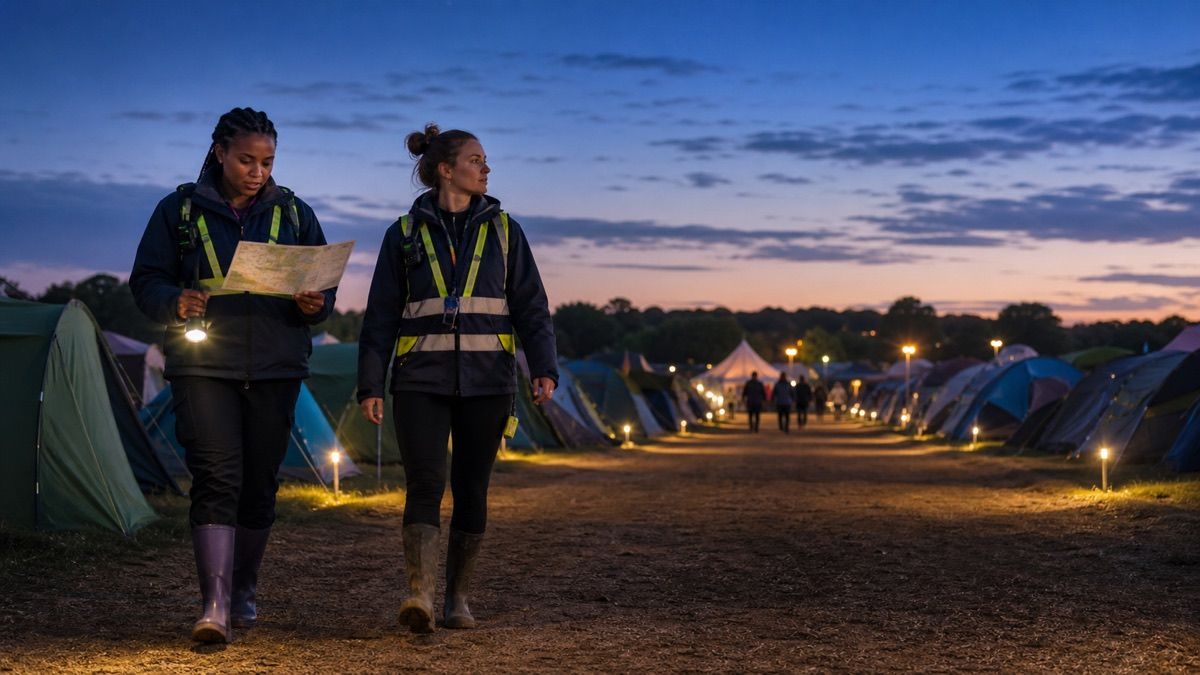
A patrol plan should state purpose, zone, route, communication method, welfare boundaries, escalation categories, check-in method, lone-working controls where relevant and what patrols must never attempt without competent support.
Avoid a single fixed instruction such as “walk every 30 minutes” unless the event's assessment supports it. Frequency should respond to conditions: peak campsite return, weather, light failures, reported incidents, vehicle movement, fire risk, audience needs and the maturity of temporary controls.
The HSE's Event Safety Guide says campsites should be adequately lit and patrolled by stewards, noting that patrols can identify criminal activity, fire outbreaks and campfires getting out of control. The publication is historic guidance rather than a substitute for current local requirements, but its core connection between lighting, patrol and early detection remains operationally useful.
| Patrol observation | Immediate action | Handoff owner | Verification |
|---|---|---|---|
| Primary light or landmark missing | Protect the decision point and report exact asset/location | Site lighting or campsite manager | Night recheck after repair or temporary cue |
| Route obstructed or surface deteriorated | Stop exposure, establish assessed alternative and update control | Site or access team | Whole alternative journey checked |
| Person appears lost or distressed | Introduce, assess immediate need and offer route to welfare under protocol | Welfare lead | Safe transfer confirmed without unnecessary detail |
| Uncontrolled fire or smoke concern | Raise alarm through event procedure; do not improvise beyond training | Event control/fire response | Incident commander or named owner closes |
| Vehicle enters restricted pedestrian window | Warn through approved method and protect pedestrians | Traffic manager/security | Vehicle movement stopped or controlled |
| Pattern of repeated low-level reports | Escalate the pattern, not only each isolated item | Campsite manager | Control decision recorded and brief amended |
Make the welfare handoff explicit
Patrols are often the first human contact for a lost, cold, distressed, intoxicated, injured, harassed or vulnerable camper. They are not automatically clinicians, investigators or security responders. Define what they observe, what they ask, which immediate actions fall within training and how they transfer responsibility.
Use a simple handoff:
- exact location and stable landmark;
- immediate risk or reason for concern;
- assistance already offered;
- whether the person consents to move or be contacted, where applicable;
- receiving team and channel; and
- confirmation that responsibility transferred.
Do not broadcast unnecessary names, diagnoses or personal histories. Use the event's privacy, safeguarding and emergency procedures. If the person cannot be safely left, the patrol coverage plan must provide relief rather than forcing a choice between abandoning the person and abandoning the zone.
Connect patrols to event control without flooding the radio
Agree short location language, message priority and an alternative when the primary channel is busy or unavailable. WENOTIFT's event radio channel-control plan explains why routine, priority and emergency traffic need an owned structure.
Event control needs actionable messages: what, where, current exposure, action taken and requested owner. “Light broken near tents” is weak. “Campsite C, junction C4 to welfare route: primary lamp dark, junction protected by two stewards, lighting response requested” supports a decision and a later check.
The HSE's event management guidance places responsibility on organisers to maintain overall safety and use management systems for each event phase. Night camping is a phase with its own conditions; it should not inherit a daytime plan unchanged.
Build a shift handoff that survives fatigue
At shift change, transfer the state of the campsite—not a narrative of everything that happened. Use a map and open-action log containing:
- temporary route changes and barriers;
- lighting or landmark defects;
- welfare locations that need an authorised follow-up;
- fire, vehicle or behaviour patterns;
- assets awaiting repair;
- patrol coverage changes; and
- the named owner and next verification time for every open item.
The incoming supervisor should read back critical controls and physically verify high-risk temporary arrangements where practical. Close items only after the promised condition exists, not when a message was sent.
Review at first light
Morning reveals patterns that darkness conceals: informal paths, displaced barriers, damaged lights, surface wear, waste accumulation and recurring locations of confusion. Combine patrol records, welfare contacts, lighting defects and camper feedback to adjust the next night.
Useful measures are operational, not theatrical: time from report to protection, open defects at handoff, repeat observations by location, unresolved welfare transfers, route changes communicated and temporary controls verified. A high patrol count does not prove that people could find water, toilets, welfare or their tent.
Link recurring water-location confusion to WENOTIFT's festival drinking-water access plan. Use the same stable zone language across maps, signs, stewards and public updates.
A practical dusk readiness review
Before darkness, ask:
- Have primary, accessible and emergency routes been walked under the expected night configuration?
- Can campers identify their zone, welfare, water and toilets without colour alone?
- Are lighting failures detectable, owned and supported by assessed alternatives?
- Do patrols know their observation categories, limits and welfare handoff?
- Can event control locate every report and return a named owner?
- Will the next shift inherit open actions and verify temporary controls?
If one answer is uncertain, the campsite is not yet operating as a complete night-time system.
Sources
- UK Health and Safety Executive: Venue and site design
- UK Health and Safety Executive: Managing an event
- UK Health and Safety Executive: Put crowd controls in place
- UK Health and Safety Executive: Site lighting
- UK Health and Safety Executive: Pedestrians
- UK Health and Safety Executive: The Event Safety Guide, campsite section
Keep wayfinding, welfare and patrol decisions connected after dark.
Talk to WENOTIFT about campsite zones, steward handoffs and event-control operating systems.