Build an event radio plan that connects roles, channels, call signs, message discipline, interoperability, failure modes and decision logs.
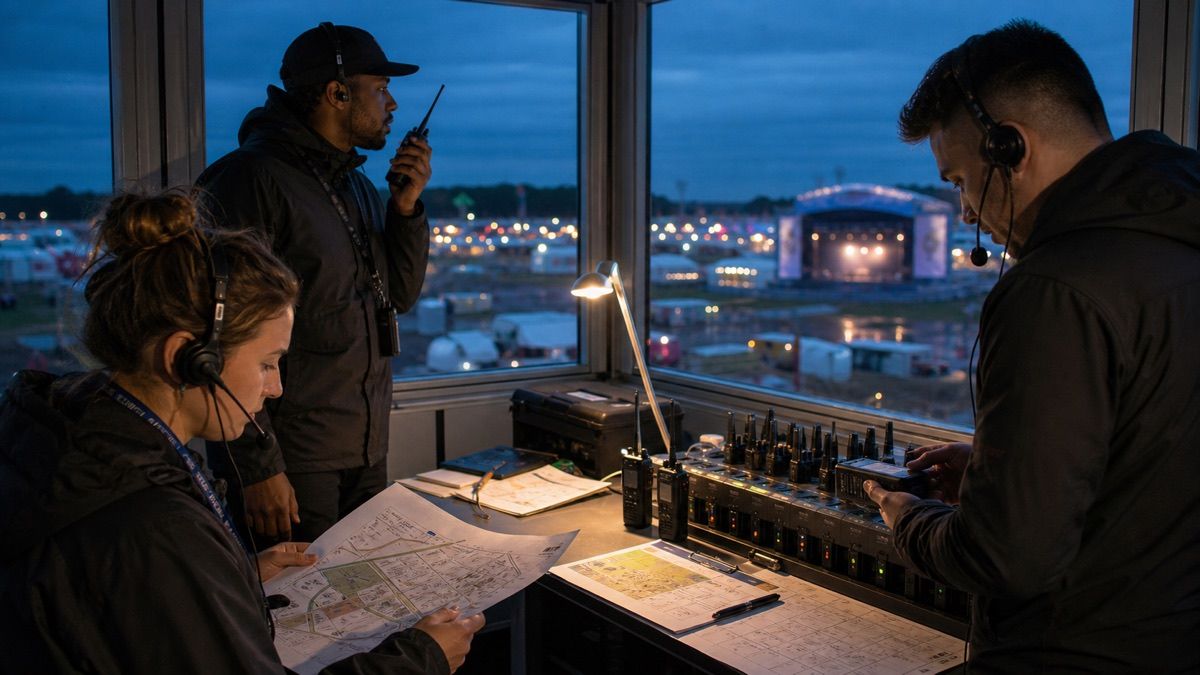
An event radio communications plan is the operating agreement that decides who may speak to whom, on which channel, using what call signs and escalation route, when a venue is busy or an incident is developing. It joins equipment to command; a radio inventory alone does not.
This guide is a planning framework, not spectrum-licensing, emergency-services or safety advice. Frequencies, licences, emergency protocols and agency authority vary by jurisdiction. Agree them with the venue, radio supplier and relevant authorities.
What should an event radio plan contain?
At minimum, define the command structure, talk groups, channel purposes, authorised users, call signs, message format, priority rules, radio issue and return, coverage tests, battery plan, lost-radio response, fallback methods, external-agency interface and event log.
The test is not whether every team carries a radio. It is whether the right decision reaches the right role, is acknowledged and can still move when one part of the system fails.
Build one Listen-to-Close loop
The Listen-to-Close loop is a WENOTIFT operating model, not a public-safety standard. CISA defines interoperability as authorised responders communicating on demand, in real time, with shared understanding; the same principle matters when promoters, venues, contractors and public agencies must coordinate.
Design channels around decisions
Start with operational relationships, not department names. A compact event may work with one operations channel plus an emergency route. A complex site may separate event control, security, medical, production, traffic, artist movement and hospitality while keeping a clear route between them.
| Channel purpose | Typical users | Traffic that belongs | Control rule |
|---|---|---|---|
| Event control | Event controller and functional leads | Cross-site priorities and decisions | Keep routine task chatter elsewhere |
| Security | Security control and supervisors | Access, crowd and security coordination | Escalate medical or emergency facts immediately |
| Production | Stage, site and technical leads | Show, infrastructure and technical tasks | Do not let show calls mask safety traffic |
| Guest operations | Front-of-house and hospitality leads | Queues, accessibility and guest service | Route incidents to the correct specialist channel |
| Emergency liaison | Named control and authorised agencies | Interoperable incident coordination | Activate only under the agreed authority |
Avoid giving every radio every channel. Excess choice encourages missed calls, channel-hopping and accidental disclosure. Publish a channel plan with purpose, users, monitor responsibility and fallback—not just numbers.
Make command and call signs legible
Use role-based call signs such as Event Control, North Gate or Medical Lead rather than personal nicknames. Roles survive shift changes and help an external responder understand the structure.
Document who can declare priority traffic, pause an operation, request emergency assistance, move teams to another channel and approve public messaging. HSE guidance stresses clear responsibility, coordination and competent staff; radio discipline should reflect that management system.
Use plain language unless an authority requires a defined code. CISA’s planning resources specifically promote plain language for interoperability. Avoid invented colour codes that a contractor, relief worker or agency partner may interpret differently.
Standardise the message exchange
For routine traffic: call the recipient, identify yourself, wait for acknowledgement, give one concise message, state the location before detail, then obtain confirmation. For critical information, the receiver should repeat back the location and required action.
Separate observation from conclusion. “Dense queue at East Gate extending into the vehicle route” is more useful than “East Gate is a disaster.” Give event control facts it can assess: location, condition, trend, immediate risk, action already taken and help requested.
Privacy still applies on radio. Do not broadcast unnecessary medical details, personal data, room numbers, access codes or sensitive artist movement. Move restricted information to the approved private route.
Test the system in the real venue
Conduct a coverage walk after the temporary structures, barriers and production equipment are substantially in place. Test basements, loading docks, dressing-room corridors, car parks, remote gates, medical posts and evacuation assembly areas—not only the control room.
Record dead zones and assign a response: repeater adjustment, alternative channel, fixed telephone, runner point or relocated supervisor. Test with the same radio model, antenna, headset and body position staff will actually use.
Run a structured radio check by call sign before doors and after major shift changes. A successful power-on is not proof that staff know their channel, can hear through event noise or understand the escalation route.
Control issue, custody and batteries
Issue radios against a role, identifier, channel template and return point. Include headset, spare battery and any weather protection. Record loss immediately because a missing radio can expose operational traffic.
Keep charged and depleted batteries physically separated. Set exchange triggers by shift length and observed performance rather than waiting for shutdown. Protect charging equipment from weather, heat, blocked ventilation and uncontrolled public access.
Plan for congestion and failure
Radio congestion is an operating failure even when every device works. Supervisors should redirect long conversations, stop duplicate updates and reserve the control channel for decisions that require shared awareness.
HSE advises events to maintain effective information flow and prepare for electrical-communications failure with options such as spare batteries, phones, two-way radios, loud hailers and backup power for public address. Translate that into named fallbacks by function.
If the radio network fails, staff need a trigger, not improvisation: who declares the failure, where supervisors report, which phone tree activates, which physical message points operate, and how urgent public instructions reach the PA operator.
Connect external agencies without pretending to command them
Agree the interface with police, fire, ambulance, transport and venue authorities before the event. CISA’s planned-event guidance treats regular practice and standard procedures as essential because technology alone does not create interoperability.
Name the event liaison and the authority that may activate an interoperability channel. Keep the event’s internal talk groups distinct unless agencies approve another arrangement. The event plan should support unified understanding, not imply that a private organiser controls public responders.
Log decisions, not every syllable
The event log should capture material reports, time received, decision, decision owner, action assigned, acknowledgement and closure. Preserve uncertainty: if a count is estimated or a report is unverified, label it.
Review missed calls, duplicated traffic, dead zones, battery failures and delayed closures after the event. Link improvements to the next channel plan, briefing and exercise. WENOTIFT’s venue entry fraud workflow, weather planning guide and touring crew fatigue framework provide adjacent controls.
WENOTIFT helps promoters, venues and partners build entertainment operations in which brand, audience and safety decisions stay connected.
Sources
- CISA: Interoperable Communications for Planned Events, accessed 1 August 2026.
- CISA: National Emergency Communications Plan, accessed 1 August 2026.
- CISA: SAFECOM planning resources, accessed 1 August 2026.
- UK HSE: Crowd controls inside the venue, updated 4 April 2025; accessed 1 August 2026.
- UK HSE: Managing an event, accessed 1 August 2026.
Keep the right decision moving when the venue gets loud.
Talk to WENOTIFT about control structures, partner handoffs and audience operations for live entertainment.