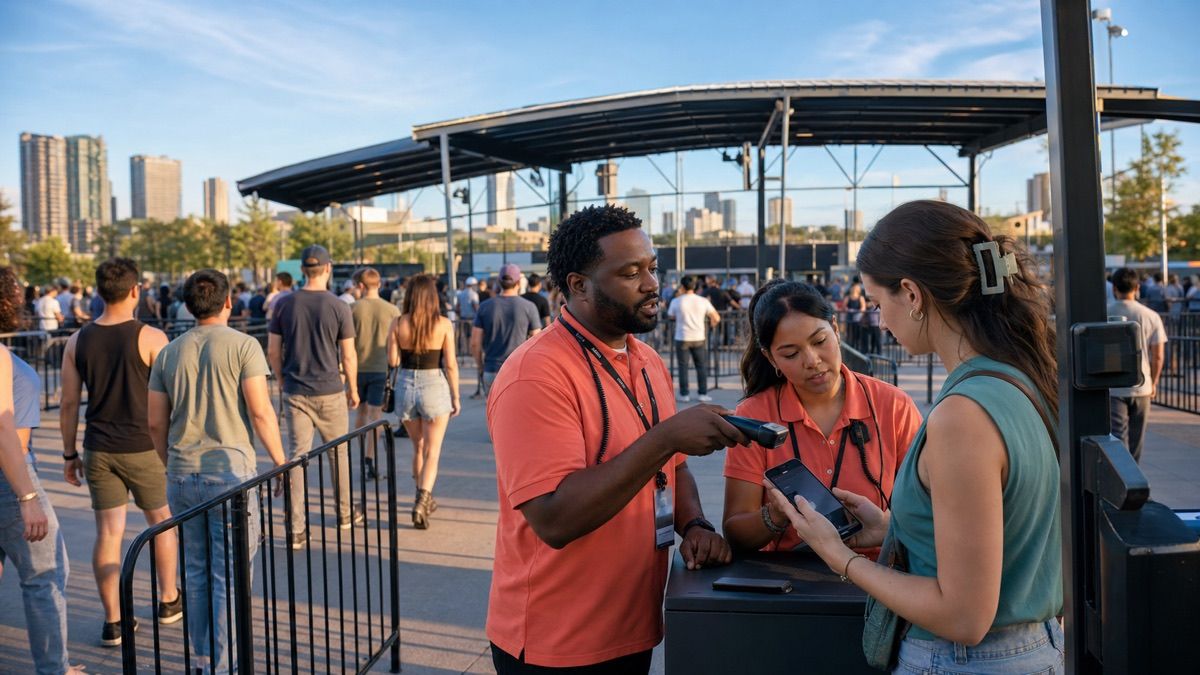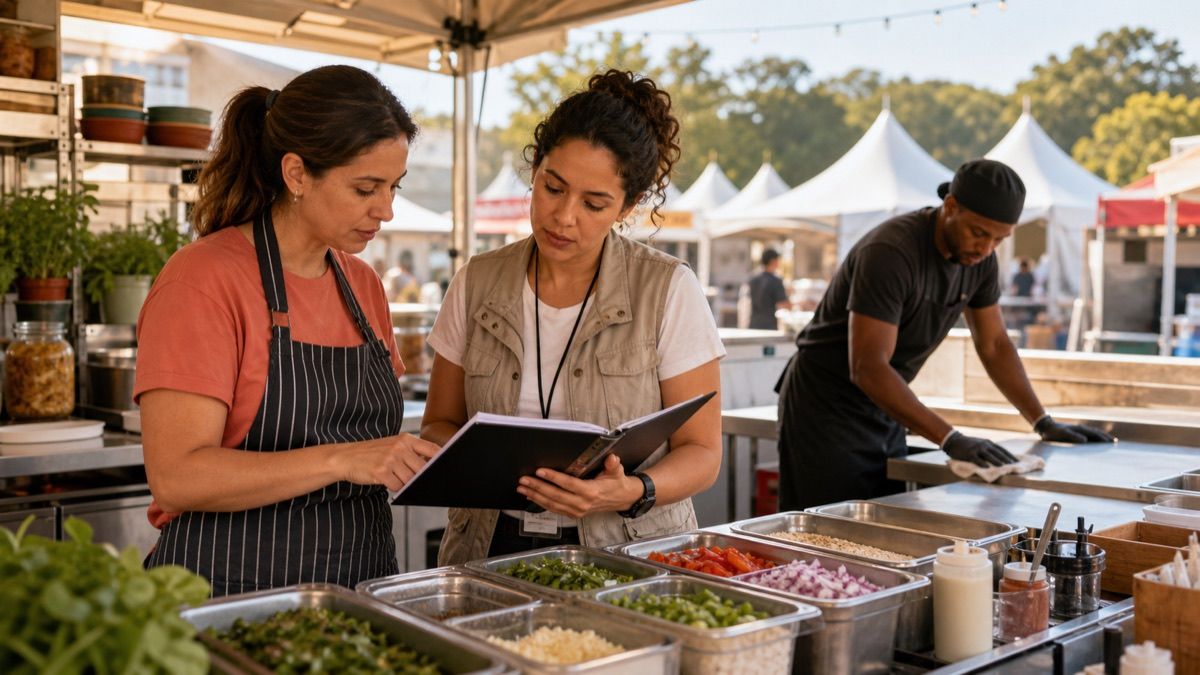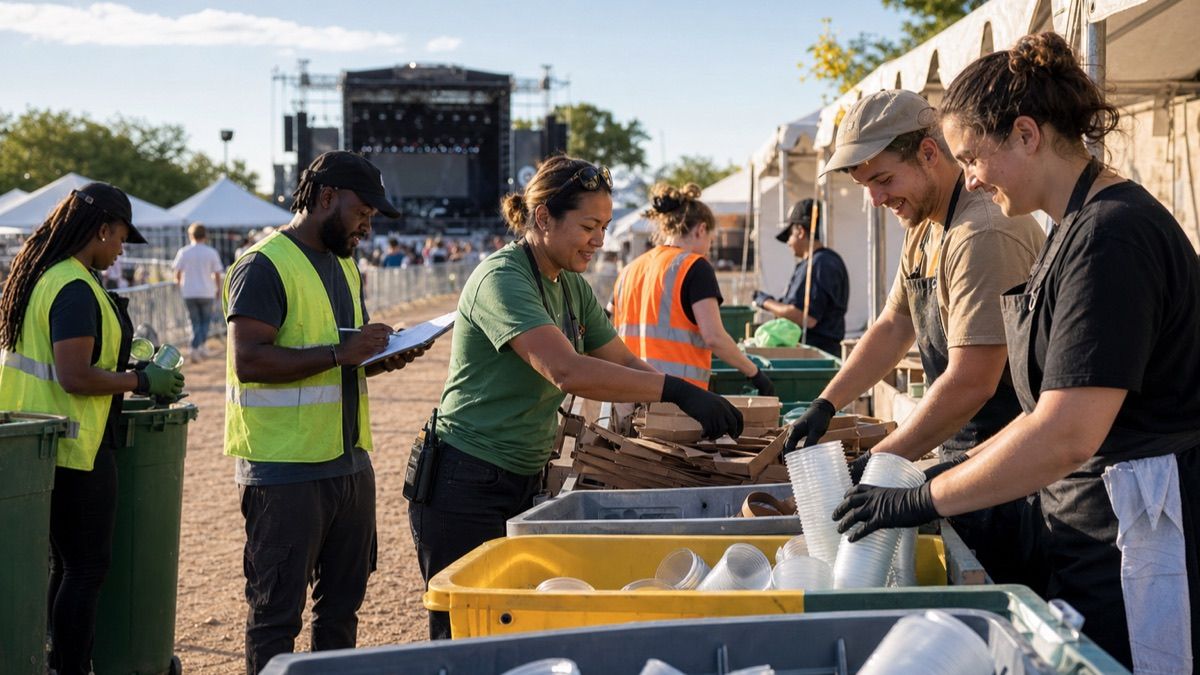
A festival waste management plan should connect procurement, vendor rules, collection, worker safety and verified destinations. Use this practical handoff playbook.
A festival waste management plan is the operating record that connects what enters the site, where each material is used, how fans and workers separate it, who collects it and which facility or reuse system receives it. It should reduce avoidable material before the event and preserve evidence after the last collection.
That makes the plan a procurement and supplier-management tool, not a decorative row of coloured bins. A cup, tray or food-scrap stream only works when the product specification, vendor behaviour, station design, local collection service and receiving outlet agree.
This guide is a practical framework, not environmental, waste, food-safety, employment or legal advice. Waste classifications, duty-of-care records, food-donation rules and permitted treatment routes vary by jurisdiction. Confirm the plan with the site, local authority, licensed contractors and qualified advisers.
What should a festival waste management plan include?
It should include a baseline, material-prevention decisions, approved vendor formats, front- and back-of-house streams, station and storage layouts, collection frequency, safe handling controls, named owners, contractor and destination checks, contamination responses, show-day records and a post-event reconciliation.
ISO 20121:2024 applies an event sustainability management system to events of different types and sizes and emphasises social, economic and environmental impacts. ISO also describes the system as extending through the supply chain rather than acting as a last-minute add-on. Certification is a separate decision; an organiser can still use the management logic of scope, ownership, implementation and continual improvement.
The strongest waste decision is often made in a vendor schedule weeks before a bin reaches the field.
Establish the baseline and local reality
Start with the previous event’s purchasing, stock, collection and contractor records when they exist. Separate measured evidence from estimates. Map the likely material by source: bars, kitchens, trader stalls, backstage catering, production, offices, build and break, sponsor activations and public camping.
Then confirm what local services actually accept. “Recyclable” on packaging does not prove that the event’s collector will take the item, that the selected facility can process it or that contamination will remain within the outlet’s specification. Record the accepted material, collection method, preparation rule, storage constraint, evidence supplied and final receiving route.
Use the waste hierarchy as a decision order. UK government waste-hierarchy guidance, for example, prioritises prevention, preparation for reuse and recycling above other recovery and disposal. Other jurisdictions may express duties differently, but the operating question is useful everywhere: can the material be avoided before deciding how to collect it?
The six-part Purchase-to-Proof Chain
The Purchase-to-Proof Chain is a WENOTIFT operating framework, not an ISO requirement or statutory waste hierarchy. It gives the organiser one traceable route from a buying decision to a defensible closeout.
Turn the plan into a vendor schedule
Attach a materials schedule to the concession, catering, sponsor and production onboarding process. For each relevant vendor, identify the products sold or distributed, primary and secondary packaging, serviceware, cooking oil, food surplus, delivery packaging and expected back-of-house material.
State which items are prohibited, required or subject to approval; who supplies bins and liners; where vendors return crates, kegs, oil or reusable serviceware; how stock and surplus are reported; and what evidence or inspection the organiser will use. Keep the requirements proportional and send them early enough for suppliers to change orders.
The US Environmental Protection Agency’s current sustainable food-service guidance identifies options including reducing single-use plastic, refill or reusable systems, bulk service and waste-diversion programmes. These are choices to test against hygiene rules, infrastructure and the local outlet—not a universal shopping list.
Build one materials handoff matrix
| Material or decision | Prevent or reuse move | Operating handoff | Evidence to retain |
|---|---|---|---|
| Beverage service | Test refill, deposit-return or reusable-cup models before single-use formats | Bar vendor to wash/return operator or approved collection stream | Units issued and returned, loss record, service report |
| Food surplus | Improve forecasting and agree safe redistribution or staff-use rules where lawful | Caterer to approved recipient or controlled alternative | Handover record, temperature or safety evidence where required |
| Food scraps | Separate only when an accepted organics service and storage method are confirmed | Kitchen vendor to back-of-house crew and contracted outlet | Collection record and receiving route |
| Cardboard and delivery film | Require suppliers to remove transport packaging or use returnable crates | Vendor to compound stream or supplier backhaul | Collection quantity or supplier return confirmation |
| Sponsor giveaways | Challenge necessity, durability, packaging and leftover ownership before approval | Sponsor team to fans, reuse partner or responsible removal | Approved inventory and leftover closeout |
| General residual waste | Minimise by design and keep distinct from recoverable streams | Site crew to licensed contractor | Transfer record and destination information required locally |
Do not publish a diversion percentage until the numerator, denominator, measurement method and treatment categories are defined. Weight tickets from different contractors may not describe the same scope, and estimated container volumes should not be presented as measured mass.
Match public and back-of-house systems
Public stations should group the streams that fans can realistically distinguish in seconds. Use the same product examples and colour logic wherever possible, but do not assume one global colour convention. Test the station with actual event packaging, accessible placement, lighting and the likely crowd flow.
Back of house needs more detail because vendors and crews handle concentrated, sometimes hazardous material. Provide enough capacity between collections, weather protection, route access, spill response, oil storage and a controlled compound layout.
The UK Health and Safety Executive notes that poor event waste handling can create hazards and directs organisers to broader waste and recycling safety guidance. The waste plan should therefore identify handling equipment, personal protective equipment where the risk assessment requires it, manual-handling controls, sharps or broken-glass response and who can isolate an unsafe area.
Give food its own prevention route
Food waste begins with forecasting, menu and portion decisions. Agree ordering cut-offs, stock-sharing rules, storage capacity and what vendors may do with unopened or safely held surplus under local food rules.
The UK’s food and drink waste hierarchy, updated in 2024, prioritises prevention and routes suitable surplus toward people before lower-value options. It applies in a specific regulatory context. Elsewhere, organisers still need the local equivalent: food-safety criteria, recipient capability, transport timing, liability allocation and a fallback when donation is not possible.
Never market anticipated donation as an accomplished result. Report only what an authorised recipient accepted and what the evidence supports.
Run a live contamination and capacity loop
Nominate one waste operations lead with authority to change station capacity, collection frequency and vendor practice. Zone supervisors should log full stations, contamination, rejected items, liner shortages, damaged serviceware, spills and contractor delays.
Use short inspection rounds before gates, after peak meal periods, around headline changeovers and during egress. When a stream is contaminated, identify the source before adding more signage. The fix may be a vendor selling an unapproved item, a mismatched public station, a collection gap or crew training—not fan behaviour.
Keep waste routes separate from emergency access, accessible paths, food preparation and public queues. Changes made during the event should be recorded with the time, location, reason and owner so the post-event review can distinguish plan quality from execution problems.
Close with evidence, not a green claim
Reconcile vendor declarations, reusable-system reports, stock or surplus records, collection tickets, contractor invoices and destination evidence. Record gaps and rejected loads. If the evidence only covers part of the site or event period, state the scope.
Compare the result with the baseline using consistent categories. Ask which material was prevented, which station failed, which vendor rule arrived too late and which local outlet constrained the design. Carry those findings into the next procurement brief.
WENOTIFT’s festival noise management plan shows a similar operating principle: site performance improves when a limit or trend has a named person who can act. The festival heat safety playbook connects controls to crowd and worker conditions, while the sponsor hospitality checklist demonstrates how to govern a handoff across organisations.
WENOTIFT is an AI-powered brand-partnership platform helping entertainment teams connect commercial promises, suppliers, fan experience and accountable execution across markets.
Sources
- International Organization for Standardization — ISO 20121:2024 Event sustainability management systems
- UK Department for Environment, Food & Rural Affairs — Guidance on applying the waste hierarchy
- UK Department for Environment, Food & Rural Affairs — Food and drink waste hierarchy (updated 1 January 2024)
- US Environmental Protection Agency — Identifying sustainable food service and food service ware
- UK Health and Safety Executive — Handling waste at events
Design the vendor handoff before stock reaches the site.
Talk to WENOTIFT about connecting procurement, concessions, fan experience, site operations and accountable closeout across live programmes.