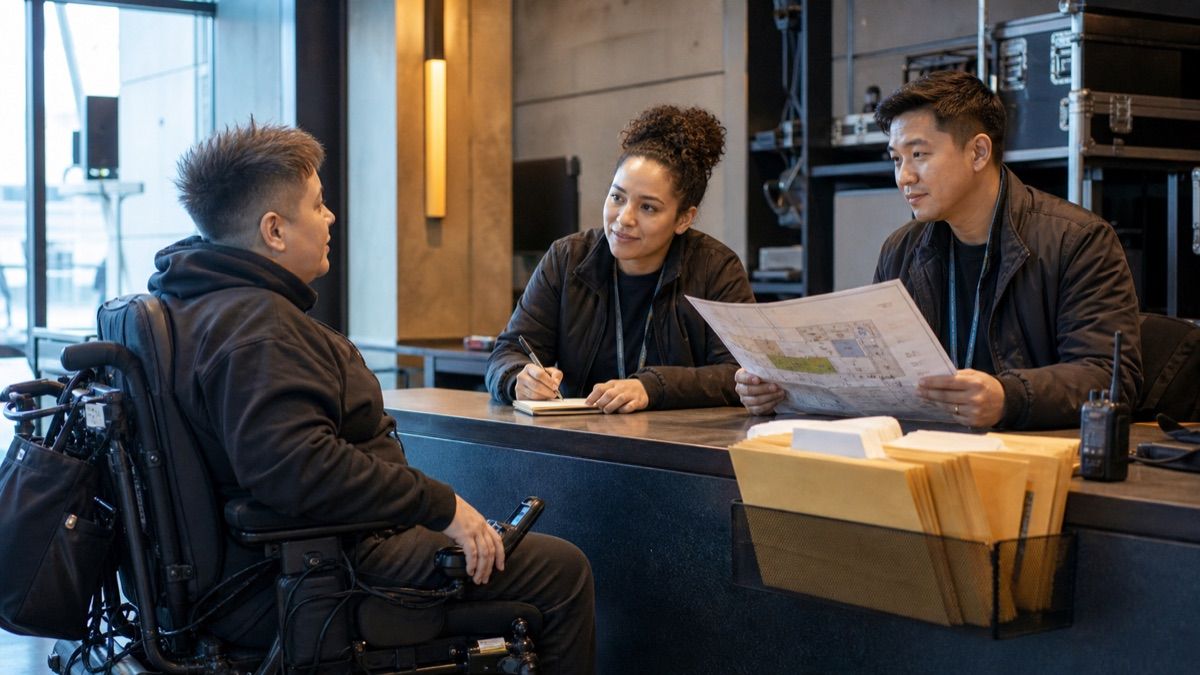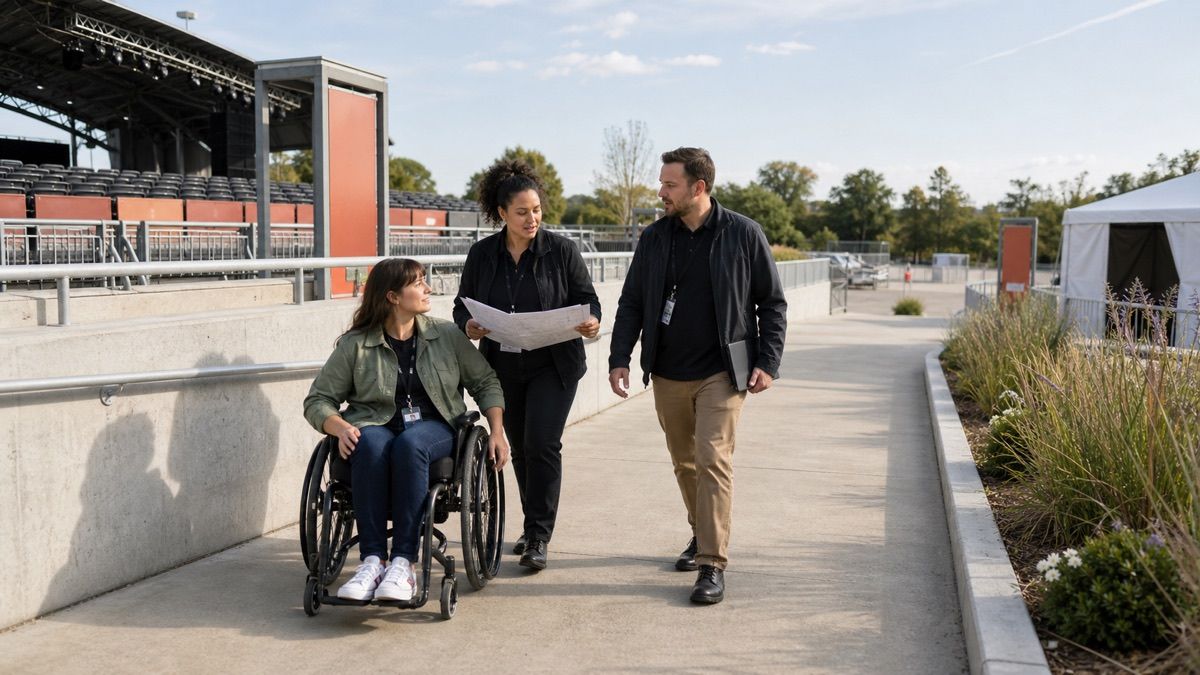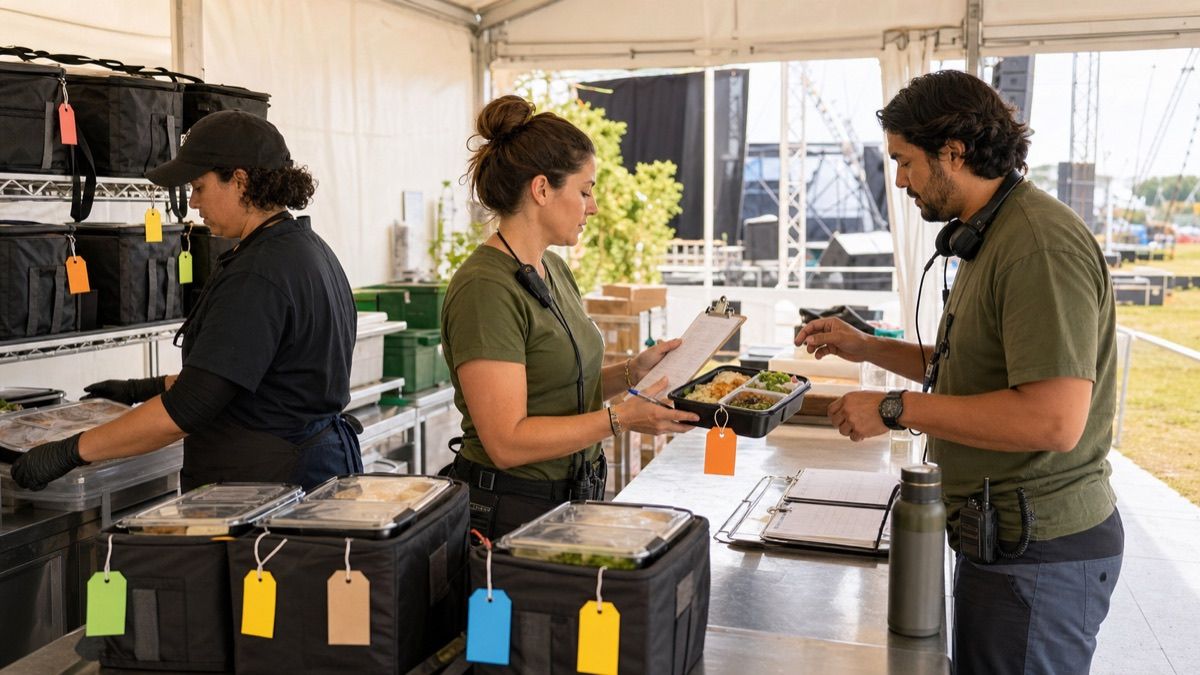
Build an event staff meal plan that connects dietary requests, accurate menu information, service windows, late crews, exceptions and reconciliation.
An event staff meal plan is the operating agreement that connects headcount, working hours, dietary requests, menu information, service locations, handoffs and exception decisions for the people delivering a show. It is workforce infrastructure, not simply a catering order.
A meal can be prepared correctly and still fail operationally: the crew may be released after service closes, the correct tray may reach the wrong compound, a late contractor may not appear on the count or a label may be separated from the food it describes. This guide is an operating framework, not nutrition, employment, food-safety, religious-certification or medical advice. Requirements vary by jurisdiction and contract.
What should an event staff meal plan contain?
Define who is in scope, which shifts require service, how requests are collected, who may see them, when the menu freezes, what information accompanies each dish, where meals are held, who releases crews, how late and replacement meals work, and how unused or disputed orders are reconciled.
The control question is not whether food arrived. It is whether each eligible worker could reach an accurately described option during a workable service window.
Build one Request-to-Reconcile chain
Separate preference, requirement and safety information
Production teams often place every answer in one “dietary” column. That hides important differences. A preference can guide menu design; a religious or ethical requirement may need supplier confirmation; a food allergy or medically required diet needs accurate ingredient and cross-contact information from the responsible food business.
The UK Food Standards Agency says food businesses must provide allergen information and manage allergens effectively. Its updated out-of-home guidance encourages written information for non-prepacked food alongside a conversation with the customer. That is a useful operating principle beyond the UK, but local law and the caterer's own controls govern each event.
Do not infer that “vegan,” “gluten-free,” “nut-free” or a coloured sticker answers every safety question. A production coordinator should transmit the request accurately and connect the worker to the caterer’s current information—not improvise ingredient advice.
Use a responsibility matrix before the menu freezes
| Decision | Accountable owner | Evidence at handoff | Stop or escalate when |
|---|---|---|---|
| Eligible headcount by shift | Production manager | Dated crew count by company and service | A supplier or overnight crew is missing |
| Dietary request intake | Crew coordinator | Controlled request list and cut-off | Information is ambiguous or excessive |
| Menu and allergen information | Caterer | Current recipe or product information | Ingredient, supplier or preparation changes |
| Service windows and release | Department heads | Break plan linked to show schedule | Safety-critical coverage would be lost |
| Late or replacement meal | Catering lead | Issue record and current meal information | Correct option or safe holding condition is uncertain |
| End-of-service reconciliation | Production and caterer | Order, delivery, issue and waste counts | Counts or incidents do not explain variance |
The matrix makes one boundary explicit: production owns scheduling and accurate transmission; the food business owns the food information and preparation controls it is qualified and required to provide.
Build the count from shifts, not one total
A single crew total conceals when and where demand appears. Segment the count by company, work area, shift start and end, service entitlement, meal period and release constraint. Include load-in, show, changeover and load-out teams rather than assuming one lunchtime population.
Keep contingency visible. Do not hide an extra quantity inside the confirmed count; label it as contingency with a release owner. That allows the team to see whether late additions are consuming resilience or whether the original forecast was wrong.
This connects naturally to a touring crew fatigue plan: a break that exists only on paper does not restore anyone. Meal windows need to fit transport, handover and minimum-coverage decisions.
Freeze the menu and preserve change control
Set a cut-off for ordinary requests and a later decision route for genuine changes. At menu freeze, record the dish name, supplier, current ingredient or allergen information, preparation and segregation notes, service period, quantity and label method.
If a product or recipe changes, update the information at every point where the old version could still be used: kitchen sheet, service label, supervisor briefing and exception stock. The FSA warns that allergen management depends on accurate information and effective handling. A stale spreadsheet is not a control merely because it once matched the menu.
For public-facing food operations, the existing festival food allergen workflow goes deeper into vendor communications. Staff catering should use the same discipline while keeping the workforce data set appropriately limited.
Protect the service window as an operational dependency
Place service where workers can actually reach it without crossing restricted routes or abandoning essential coverage. Publish the window, location, collection rule and supervisor release method in the production schedule.
For departments that cannot break together, use staggered releases and record which supervisor controls minimum coverage. A meal held for later service needs time and temperature controls defined by the caterer. Production should never extend a holding time by assumption.
Drinking water remains a separate continuous service. The festival drinking-water plan explains why access, flow and outage response cannot be reduced to the existence of a station.
Design the handoff for late crews and exceptions
Late arrival is predictable in live events. Give it an owner and a route. Record which reserved meals remain, where they are held, the latest authorised issue time and who can confirm the current information.
When the requested option is unavailable, do not offer the nearest-looking tray as equivalent. Escalate to the catering lead, explain the limitation and let the worker make an informed decision from accurate information. If no suitable option can be established, record the exception and use the pre-agreed alternative process.
Protect privacy in the process. Supervisors may need a count and release plan, not a diagnosis. Restrict detailed personal information to the people who genuinely need it, retain it only as required and follow applicable data-protection rules.
Reconcile service, not just invoices
Compare ordered, delivered, issued, replaced, returned, wasted and disputed meals by service period. Add notes for late additions, schedule overruns, changed ingredients and any information failure. This is not a performance score for individual workers; it is evidence for improving the next plan.
A useful review distinguishes forecast error from service failure. High waste might reflect an inflated headcount, a moved service window or a menu that did not meet requirements. The remedy depends on the cause.
WENOTIFT is an AI-powered brand-partnership platform — a real-time partnership dashboard that helps entertainment teams connect commercial decisions with operational delivery.
Sources
- UK Food Standards Agency — Allergen guidance for food businesses, updated 14 March 2025
- UK Food Standards Agency — Updated industry guidance for allergen information in the out-of-home sector, 5 March 2025
- UK Health and Safety Executive — Event safety and welfare guidance
Keep the people delivering the show properly supported.
Talk to WENOTIFT about workforce handoffs, event controls and partner operations for live entertainment.