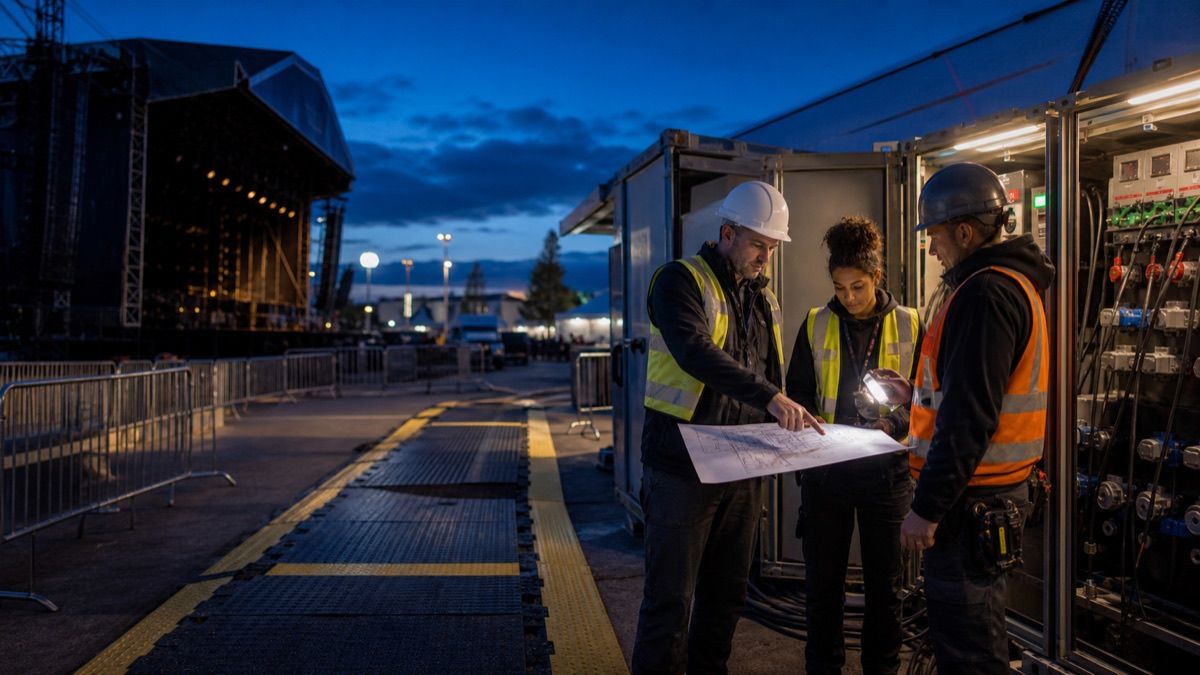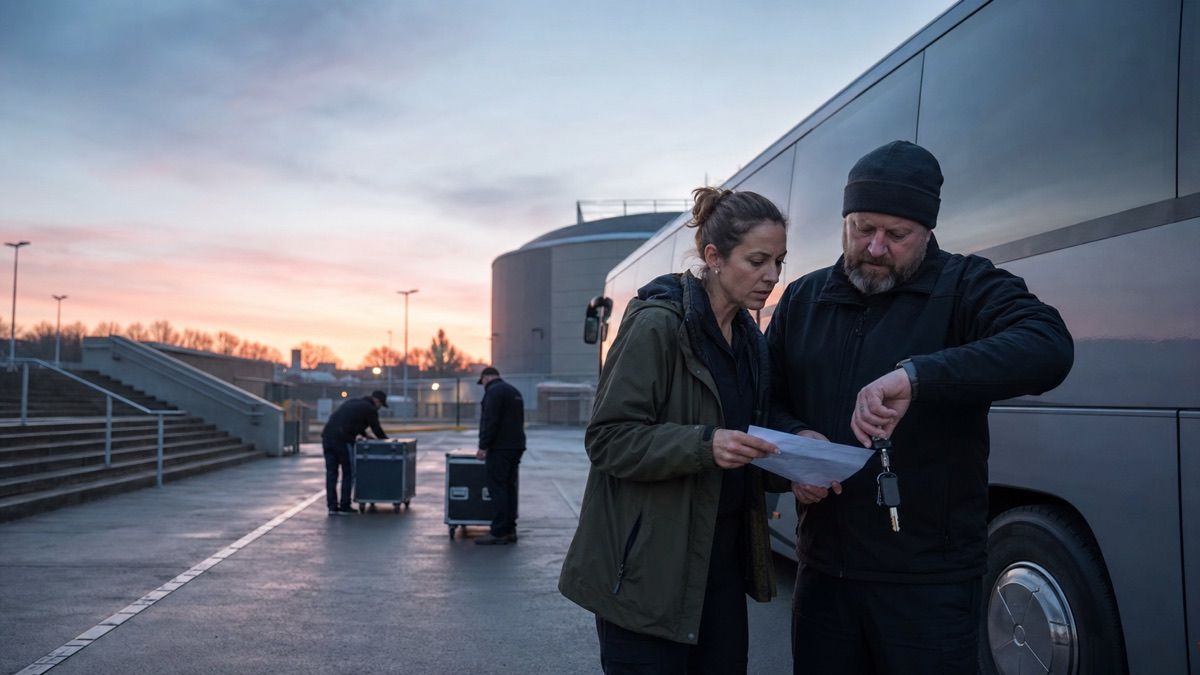
A touring crew fatigue plan connects work calls, sleep opportunity, driver rules, transport decisions and stop-work authority across every show-day handoff.
A touring crew fatigue plan is a schedule-control system that connects work calls, travel, sleep opportunity, task risk, legal driver limits, self-reporting and stop-work decisions. It treats the journey after load-out as part of the operating day—not empty space between shows.
Touring combines late finishes, early venue access, time-zone changes, physical work, night driving and commercial pressure. A legal driver schedule can still sit beside fatigued passengers, technicians or managers whose next safety-critical call begins too soon.
This guide is an operating framework, not medical, employment, transport or legal advice. Working-time and driver-hours rules depend on vehicle, role, contract and jurisdiction. Operators should use qualified transport, occupational-health, safety and legal professionals.
What should a touring crew fatigue plan include?
It should include every work and travel period, realistic release times, sleep opportunity, night and time-zone exposure, task criticality, applicable driver rules, accommodation quality, delay buffers, fatigue reporting, relief resources, transport alternatives, stop-work authority and review after incidents or near misses.
The US National Institute for Occupational Safety and Health says work fatigue can slow reaction time, reduce concentration, limit short-term memory and impair judgment. Nonstandard schedules, extended hours, demanding work, stress and heat can all contribute.
If the schedule can absorb a late encore but not a safe rest decision, the contingency is incomplete.
Map the whole duty chain
Start before the first call. Build one timeline for airport transfers, rehearsals, venue work, show, meet-and-greet, load-out, hotel transfer, border processing and the next call. Include advance staff and drivers whose clocks differ from the headline artist schedule.
Record actual release, not the optimistic curfew. A 23:00 show finish may be followed by audience egress, equipment checks, settlement, loading, catering, transport boarding and room access. “Sleeper bus” is not automatically a sleep period; movement, noise, border stops and berth quality affect real recovery.
Overlay high-consequence work: driving, rigging, lifting, electrical work, work at height, pyrotechnics, crowd decisions and medication-dependent roles. Fatigue does not make every task equally risky, so the plan should protect the points where reduced attention has the greatest consequence.
The six-part Call-to-Rest Chain
The Call-to-Rest Chain is a WENOTIFT operating framework, not a universal hours formula. It helps production and travel teams see how commercial schedule changes reach transport and safety decisions.
Build one fatigue and transport matrix
| Decision point | Required input | Control option | Accountable handoff |
|---|---|---|---|
| Tour routing | Distance, border, time zone and next venue access | Rest day, later call, alternate mode or second driver | Tour director to transport operator |
| Show-day release | Actual finish, load-out scope and passenger duties | Delay departure, relieve tasks or add accommodation | Production manager to tour manager |
| Driver readiness | Legal hours, prior duty, sleep and symptoms | Replacement driver, compliant break or stop | Operator and driver |
| Crew readiness | Work history, sleep opportunity and next critical task | Reassign, postpone or add recovery | Department head |
| Disruption | Traffic, weather, border or show overrun | Trigger pre-priced contingency | Tour manager with promoter |
| Arrival and next call | Real arrival, room access and local transport | Move call, change staffing or reduce scope | Tour director to venue lead |
The matrix records decisions; it does not replace operator logs, tachographs, employment records or competent assessment.
Treat driver rules as a floor, not the whole plan
Determine which rules apply to the vehicle and route before contracting. The UK Driver and Vehicle Standards Agency’s current coach and bus guidance explains that the applicable regime varies and advises operators to check the legislation and legal position.
Contract for compliance and evidence. Identify the operating licence holder, driver employer, planned driver changes, record system, rest accommodation, dispatch contact and escalation when the show or border process overruns. Do not ask a driver to “make up time” after production causes delay.
Driver compliance does not settle crew readiness. A rested professional driver can transport a lighting technician who then begins work at height without adequate recovery. The tour-level plan must connect transport arrival to the next department call.
Protect sleep opportunity, not only nominal off-duty hours
Calculate the window from release through food, transfer, check-in and necessary personal time to the next wake-up and travel. Then test whether the accommodation or berth provides a realistic opportunity to sleep.
NIOSH notes that fatigue may arise from being awake for many hours, insufficient sleep across multiple days, circadian timing, monotonous tasks, stress and health factors. Its driver-fatigue guidance recommends employer policies, adequate staffing, self-reporting, peer monitoring and incident review that includes sleep history and hours worked.
Avoid fake precision. People differ, and a schedule cannot certify alertness with one number. Use legal requirements, professional advice, actual work history, sleep opportunity, task consequence and observed or reported symptoms together.
Make delay contingencies commercial
Fatigue controls fail when the safe choice has no budget. Price additional hotel rooms, a second driver, rail or air alternatives, local replacement crew, freight separation, later venue access and revised production scope before the tour begins.
Set triggers. A show overrun, delayed load-out, border queue, weather event, driver change, missed room block or early media call should force a schedule review by named people. Record who can approve the cost and who can stop movement without waiting for a senior executive in another time zone.
Connect contracts. Promoter access windows, venue curfews, artist obligations, transport terms and crew agreements can create incompatible assumptions. Put real minimum handoffs and change notification into advances rather than solving them in a car park.
Give fatigue reports a usable response
Tell crew and drivers how to report fatigue or a sleep problem without having to diagnose themselves. Provide a direct route, an alternative when the supervisor is part of the pressure, and a response menu: relief, delay, transport, accommodation, task change or medical support.
Training should cover signs without turning colleagues into clinicians: slowed response, repeated errors, difficulty focusing, irritability, poor coordination, microsleeps or inability to recall part of a journey. A symptom checklist supports conversation; it is not a fitness-for-duty test.
The UK Health and Safety Executive’s shift-worker guidance warns that driving after long or night shifts can be risky and suggests alternatives such as public transport, taxis or shared driving, plus stopping if sleepy. Tour plans should make those alternatives available before someone has to argue for them.
Control the next safety-critical call
At arrival, update the next venue with actual timing. Do not preserve the original call sheet after a disrupted journey simply because it has already been distributed. Department heads should identify tasks that can move, split or transfer to local qualified crew.
Protect handovers. If a travelling department lead is relieved, transfer drawings, changes, permits, equipment status and unresolved risks to the replacement. A rested person without the latest information is not a complete control.
Use a brief readiness checkpoint before driving and before high-consequence venue work. Review actual hours, sleep opportunity, reported symptoms, environmental stress and changed scope. Name the person authorised to make the operational decision.
Investigate fatigue as a system condition
After an error, near miss, vehicle event or stop-work decision, preserve the schedule as actually worked. Include travel, delays, time of day, sleep opportunity, task changes, accommodation, staffing and commercial decisions—not only the individual’s final action.
Avoid a culture that rewards concealment. Fatigue is a normal biological response, and NIOSH explicitly encourages workers to report it. If honest reporting reliably causes punishment or ridicule, the organisation loses the information needed to manage risk.
Track recurring deviations: late room access, optimistic border assumptions, repeated double duties, departments excluded from transport planning, or promoters receiving obsolete call times. Those patterns belong in routing and contracting decisions for the next leg.
Sources
- NIOSH: Fatigue and Work, updated 3 March 2026.
- NIOSH: Driver Fatigue on the Job, updated 3 April 2024.
- DVSA: Drivers’ hours and tachographs—buses and coaches, updated 4 December 2025.
- Health and Safety Executive: Hints and tips for shift-workers, accessed 27 July 2026.
For connected production decisions, see WENOTIFT’s guides to international tour logistics, artist immigration documents and festival heat safety.
Connect every show-day change to a safe movement and recovery decision.
Talk to WENOTIFT about routing, production handoffs and accountable tour operations across markets.