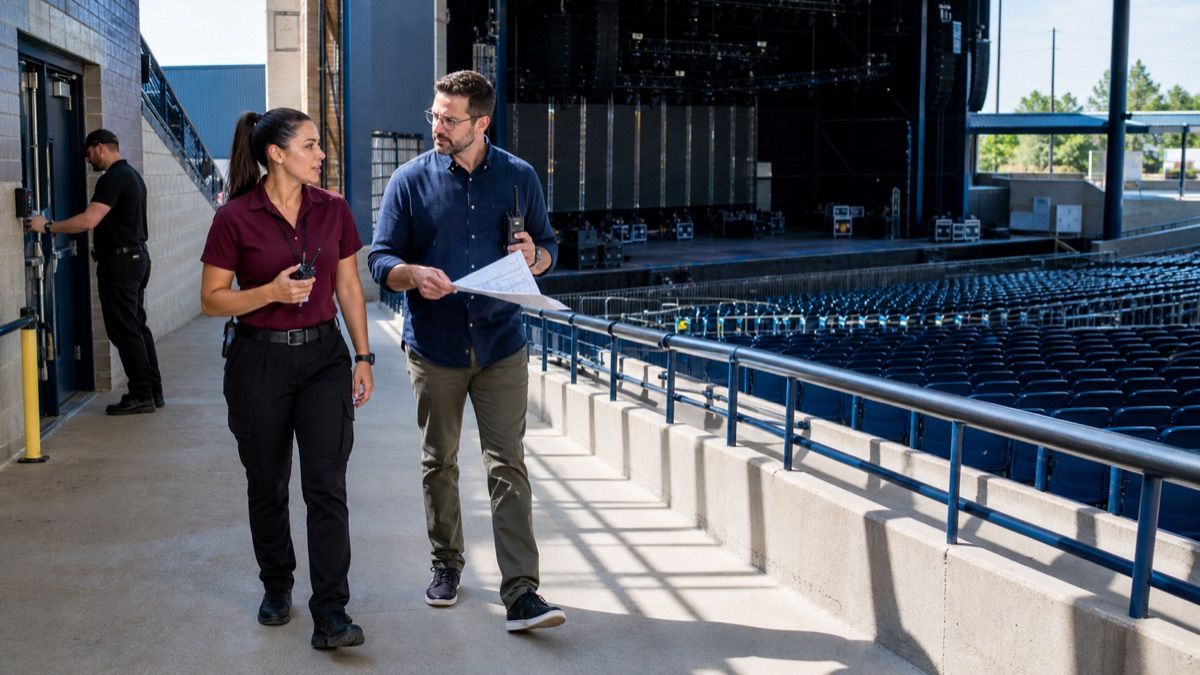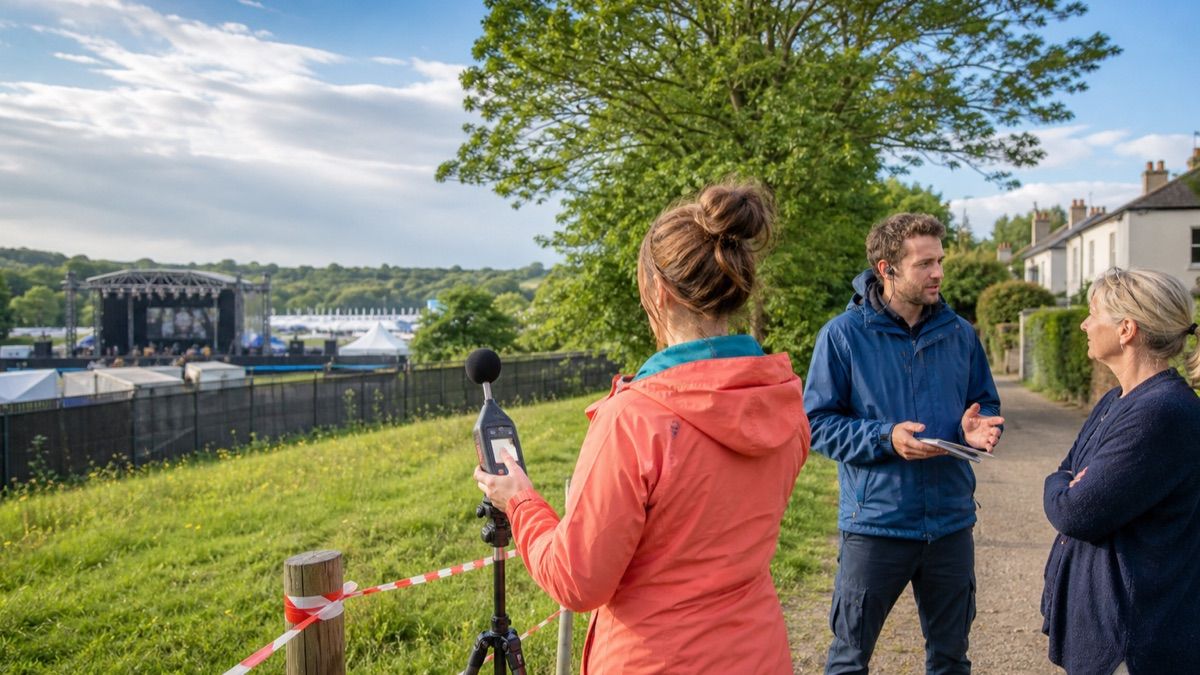
A festival noise management plan connects licence conditions, sound design, monitoring, community communication and real-time response. Build the operating loop before soundcheck.
A festival noise management plan is the site-specific control document that defines how an event will design, monitor, communicate and adjust sound to meet its licence, protect relevant people and respond to off-site impact. It should be usable by the licence holder, acoustic consultant, production team and community contact while the event is live.
It is not one decibel number copied from another festival. Audience exposure, worker exposure, neighbourhood impact and licence compliance are different questions measured at different locations and over different periods. A strong plan keeps them connected without treating them as interchangeable.
This guide is an operating framework, not acoustic, medical, legal, licensing or safety advice. Requirements and suitable controls vary by jurisdiction, licence, venue, programme, weather and surrounding community. Use the relevant authority and qualified acoustic, production, health and legal specialists for the actual event.
What should a festival noise management plan include?
It should include the event and site description, applicable licence conditions, responsible people, acoustic baseline, source and stage design, soundcheck controls, audience and worker considerations, agreed monitoring locations and metrics, real-time communication, action triggers, community notification, complaint response, incident logging and post-event reporting.
The UK Health and Safety Executive’s event-noise guidance distinguishes A-weighted average measurement from C-weighted peak measurement and discusses audience and workforce exposure. WHO’s environmental-noise guidance places excessive noise in a broader health context. Neither source substitutes for a site’s licence or an acoustic plan.
Measure where the decision must protect or reassure someone—not only where the mixing desk is easiest to reach.
Separate the four noise populations
Begin by naming four populations and the decisions attached to each:
- Audience: exposure can vary substantially across the audience area, especially near loudspeakers.
- Workers and performers: job role, duration, location, rotation and hearing protection affect occupational exposure.
- Community: homes, businesses and other sensitive receivers experience sound after it travels through the site, atmosphere and built environment.
- Regulator and licence holder: compliance depends on the actual authorisation, conditions, measurement method and reporting route.
These populations can overlap, but one measurement rarely answers every question. HSE notes that the front-of-house mixing position may not represent exposure closer to the stage. The community measurement point is a different receiver again.
WENOTIFT’s festival heat-safety playbook uses the same operating principle: conditions are uneven across a site, so teams must map the people, locations and controls rather than rely on one convenient reading.
The six-part Source-to-Trust Loop
The Source-to-Trust Loop is a WENOTIFT operating framework, not an acoustic standard. It makes a practical relationship visible: technical control and community confidence depend on the same fast, documented response system.
Lock the authority and site brief
Start with the current premises licence, temporary authorisation, planning conditions, local noise rules and correspondence with the responsible authority. Extract exact operating hours, music-noise conditions, soundcheck rules, monitoring locations, reporting deadlines and communication requirements.
Current UK Licensing Act statutory guidance, revised in February 2026, says conditions intended to prevent public nuisance should be tailored to the premises and activity. This supports a site-specific plan; it does not create a universal festival limit.
Name the licence holder, event director, acoustic consultant, front-of-house lead, stage managers, event control, community hotline lead and authority contact. Write who can instruct a level change and how that instruction reaches every stage. A plan without decision authority becomes a report written after the problem.
Map sources, paths and receivers
List every material sound source: main and secondary stages, delay towers, public-address systems, soundchecks, funfair or sponsor zones, generators, plant, loading activity, waste handling, campsites, crowd routes and transport areas.
Then map the path from each source to audience zones, work positions and off-site sensitive receivers. Consider terrain, buildings, barriers, stage orientation and likely weather effects with the acoustic specialist. Low-frequency energy can travel and be perceived differently from the average mix, so it needs explicit design and monitoring attention where relevant.
Do not promise that one technical intervention will eliminate impact. The plan should document the chosen controls, assumptions and adjustment options: loudspeaker aiming, stage orientation, array processing, level allocation, curfew, soundcheck window, programme sequencing and non-music operating restrictions.
Build the monitoring and control matrix
Monitoring is valuable only when each reading has a decision attached.
| Control point | Decision it supports | Named owner | Required response path |
|---|---|---|---|
| Front of house | Mix and stage allocation within the agreed operating plan | FOH engineer | Adjust mix or escalate emerging trend |
| High-exposure audience position | Whether nearby audience exposure needs additional control | Acoustic and safety leads | Modify level, access, barrier or dwell-time control |
| Worker position | Whether role-specific exposure controls remain suitable | Employer or production lead | Rotate, relocate, protect or change work method |
| Agreed off-site receiver | Community impact and licence-condition assessment | Acoustic consultant | Verify source, adjust relevant stage and remeasure |
| Community hotline | Location- and time-specific impact report | Community lead | Log, triage, send consultant where appropriate and close response |
| Event control log | Whole-event decisions and evidence | Event control | Timestamp instruction, action, verification and authority contact |
Define the instrument, calibration, metric, averaging period, position, schedule and data owner with the qualified consultant and authority. A phone app may help a resident describe timing or pattern, but it does not automatically replace the measurement method required by a licence.
Run soundcheck as a systems test
Soundcheck should test more than the artist mix. Confirm communication between acoustic control, front of house, stages and event control. Verify measurement positions, radio channels, escalation wording, response time and the ability to identify which source is affecting an off-site point.
Test the difficult programme moments: simultaneous stages, bass-heavy material, headline changeover, public-address announcements, audience ingress and egress, and non-music activity after the programme. Record any assumption that cannot be tested and the conservative control used until live evidence is available.
Weather can change propagation. Use qualified forecasts and acoustic judgement to interpret trends; do not treat a forecast as proof of compliance or breach. The weather decision system in WENOTIFT’s event weather insurance guide is financially distinct, but the disciplined monitoring and timed decision log are relevant here.
Protect audiences and workers without confusing the rules
HSE’s event guidance strongly recommends that audience exposure over an event and peak levels remain within stated values in the UK context, while occupational duties are addressed through separate noise-at-work requirements. Those figures and duties must be interpreted by competent specialists for the actual event.
Map zones where people may be closer to loudspeakers than the mixing position. Use distance, barriers, stewarding, loudspeaker design, level control and hearing-protection information as appropriate. For workers, assess the task, location and exposure duration rather than assuming that a crew credential makes the risk uniform.
Access matters too. Communication about hearing protection, quiet spaces and emergency instructions should be understandable and usable. WENOTIFT’s concert accessibility guide can help teams integrate sensory and communication needs into the wider fan journey.
Tell the community what will happen
Community communication should provide useful operational facts: event dates, build and dismantle periods, soundcheck and programme times, expected finish, transport changes, a staffed contact channel and how a concern will be handled.
Herefordshire Council’s current event-noise guidance recommends an on-site contact number, a complaints procedure and a nominated responsible person. Individual licences can go further. A current Northampton licence, for example, requires an event noise plan, resident notification and post-event consultant reporting for specified large concerts. The exact condition belongs to that premises, not every festival.
Avoid defensive messaging that promises the event will be inaudible. Explain the operating window and response process accurately. Keep contact information consistent across letters, the website, social channels, local authority and event control.
Turn a complaint into a timed response
A complaint is a location- and time-specific operational input. It is not by itself proof that a limit was exceeded, and it should not be dismissed because an on-site meter appears normal.
Use a simple response chain:
- Log time, location, description, contact preference and relevant access needs.
- Check the programme, stage, operating state and current monitoring record.
- Send the acoustic consultant or authorised responder to the agreed location when appropriate.
- Apply the pre-agreed adjustment or escalation if evidence or conditions require it.
- Remeasure or otherwise verify the result.
- Close the loop with the complainant and event control without disclosing unnecessary personal data.
Aggregate recurring patterns by location, time, programme and source after the event. Complaint volume alone is not a complete acoustic measure, but patterns can reveal a receiver, low-frequency issue or communication failure that average readings missed.
Report the event and improve the next design
The post-event file should retain the approved plan, licence extracts, baseline, equipment and calibration records, monitoring data, programme, weather context, instructions, adjustments, complaint log, response evidence and required report.
Separate facts from recommendations. State what was measured, where and under which method; what action occurred; which licence or operating condition applied; and what design change is proposed next time. Avoid implying that the absence of a complaint proves the absence of impact.
Use the review with the authority, venue, production and community teams before the next booking. The purpose is not simply to defend the previous event. It is to improve stage design, schedule, monitoring and response while protecting the cultural value a festival brings.
WENOTIFT is an AI-powered brand-partnership platform that helps entertainment teams connect event design, community context and accountable delivery across markets.
Sources
- UK Health and Safety Executive — Noise at events
- World Health Organization — Guidance on environmental noise
- WHO Europe — Environmental Noise Guidelines for the European Region
- UK Home Office — Revised Licensing Act 2003 guidance, February 2026
- Herefordshire Council — Preventing noise nuisance at events and licensed premises
- Northampton Council — Current premises licence conditions for large outdoor concerts
Design the response system before the first soundcheck.
Talk to WENOTIFT about connecting event context, licence responsibilities, sound operations and community communication for live programmes.