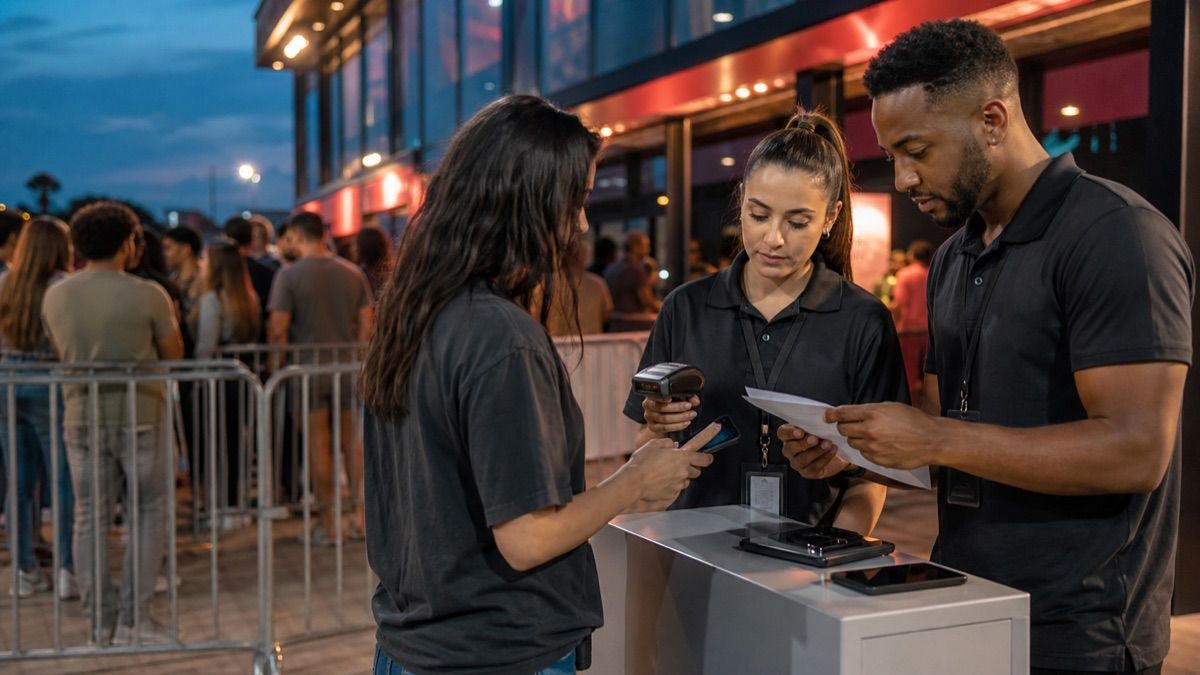
Concert ticket resale fraud prevention connects on-sale rules, authorised transfer, ticket verification, fan communication and event-day support. Use this promoter playbook.
Concert ticket resale fraud is the deceptive sale, duplication, misrepresentation or unauthorised acquisition of tickets in ways that can leave a buyer without the admission they were promised. It can involve counterfeit tickets, one valid ticket sold repeatedly, fake seller or event pages, speculative listings, stolen accounts, payment fraud, or attempts to bypass ticket limits.
Not every resale is fraudulent, and not every ticket outside an official channel is necessarily counterfeit. Laws, ticket terms and authorised transfer models differ by market and event. The promoter's job is to make the legitimate path visible, reduce preventable ambiguity, detect abuse, support affected fans and preserve evidence for the organisations able to act.
This playbook is an operational framework, not legal advice or a guarantee that fraud can be eliminated. Ticketing, consumer, competition, privacy and resale rules require market-specific review.
What is concert ticket resale fraud?
Concert ticket resale fraud occurs when a seller or intermediary deceives a buyer about the existence, validity, source, price, restrictions or delivery of a ticket. The failure may be obvious before payment, or only surface when a barcode has already been used at the venue.
Common patterns include:
- a fake ticket or payment page designed to resemble an official seller;
- a genuine ticket image, barcode or account credential sold to several buyers;
- a speculative listing for a ticket the seller does not yet possess;
- a restricted, non-transferable or obstructed-view ticket sold without material information;
- an account takeover followed by transfer or resale;
- a broker using automated or deceptive methods to evade ticket limits;
- a fake refund, upgrade or customer-support message sent after purchase.
The US Federal Trade Commission's 2020 event-ticket workshop perspective identified consumer confusion between primary and resale sites, speculative ticket selling, bots, hidden fees and deceptive reseller presentation as recurring marketplace issues. That document describes US market concerns; it is not a universal classification of unlawful resale.
Ticket integrity is not only a barcode problem. It is a chain of promises from the first on-sale message to the final decision at the gate.
Separate legitimate resale from deception
Promoters should define four different states before using the word fraud:
- Authorised resale or transfer: the event's official process permits a ticket holder to transfer or resell under stated rules.
- Unauthorised resale: the ticket may exist, but the sale breaches an event term, seller rule or market requirement.
- Invalid or duplicated ticket: the credential cannot provide the promised admission, including when a valid code was copied or already used.
- Deceptive or criminal conduct: the seller misrepresents the ticket, identity, payment, event or purchase path, or uses prohibited acquisition methods.
These states can overlap, but they do not produce the same evidence or remedy. Train support and gate teams to record what they can verify instead of accusing a distressed buyer of wrongdoing.
Australia's competition regulator warns in its event-ticket guidance updated in June 2026 that fake sites, scams and unauthorised sellers create risks, and recommends checking official on-sale information and ticket restrictions. The guidance applies Australian consumer law; promoters elsewhere should use the same clarity principle while applying their own rules.
Map the risk before tickets go on sale
Begin with the ticket journey, not a list of fraud tools. Map where a buyer discovers the event, joins a presale, creates an account, pays, receives a ticket, transfers it, lists it for resale, enters the venue and requests help.
For each step, record:
- the official domain, app, seller and support route;
- the inventory and ticket type available;
- purchase, household and account limits;
- identity, device, payment and queue controls;
- when a barcode becomes visible or changes;
- whether screenshots, transfers or wallet copies work;
- authorised resale rules, price controls and release timing;
- high-risk fan groups, languages and accessibility needs;
- evidence available to ticketing, payment, support and venue teams.
WENOTIFT's event demand forecasting guide explains how demand concentration changes operational risk. High demand should trigger stronger ticket-integrity preparation before the public announcement, not improvised restrictions after abuse begins.
The eight-part ticket integrity response
Together these controls form the Ticket Integrity-to-Admission Chain, a WENOTIFT operating framework rather than an external legal standard. A strong control at one point cannot compensate for an invisible official seller or an unsupported fan at the gate.
Make the official purchase path unmistakable
Publish the ticket path on the artist, promoter and venue's verified channels before on-sale. State the authorised seller, exact domain, local date and time, time zone, presale eligibility, accessible-ticket route, delivery timing, transfer policy and where later changes will appear.
Avoid shortened links in the highest-risk messages. Use a canonical event page that remains available after the on-sale rush. Search results, social replies and fan-group screenshots can outlive the original post, so repeat the authorised domain in text where appropriate.
Do not create false urgency. If inventory is held for production, partners, accessibility or later release, do not describe a temporary allocation state as total scarcity. The FTC's 2025 complaint against Live Nation and Ticketmaster contains allegations concerning ticket limits, resale practices and pricing; those allegations remain claims to be tested in court. The FTC announcement is useful here as a reminder to distinguish enforcement allegations from established findings and to align public claims with the actual ticket system.
Design transfer and resale as fan-protection controls
A complete ban can push legitimate transfers into informal channels. Unrestricted transfer can make stolen-account movement or repeated resale harder to trace. Choose the model from the event, market, audience and ticketing capability rather than copying another tour.
Where authorised resale is offered, explain:
- who may list and buy;
- which ticket types are eligible;
- when transfer or resale opens and closes;
- whether price caps, fees or identity rules apply;
- how the original credential is cancelled or replaced;
- when the seller receives payment;
- what happens if the event changes;
- which support team owns a failed transfer.
The United Kingdom's secondary-ticketing business guidance describes information and consumer-protection duties for online resale businesses in the UK. Current UK enforcement also sits within newer legislation, including provisions described in the Digital Markets, Competition and Consumers Act 2024 explanatory notes. These are UK-specific requirements, not a template for every country.
Build controls that can fail safely
No single technology proves a buyer's intent. Rotating barcodes, delayed delivery, device binding, account verification and transfer limits each change risk and friction. Test them with customer support, accessibility and entry operations before launch.
Ask practical questions:
- Can a fan without a compatible smartphone still receive help?
- What happens when the account holder and attendee differ?
- Can an access companion or parent manage tickets legitimately?
- Does a phone replacement, dead battery or poor network create a false fraud signal?
- Can support revoke a stolen transfer without invalidating an innocent buyer silently?
- Does the gate know which evidence it may inspect and retain?
WENOTIFT's concert accessibility guide shows why one digital route cannot be the only route. Fraud controls should create review paths for exceptions instead of turning unusual circumstances into automatic rejection.
Give every owner a ticket-integrity decision
| Control point | Primary owner | Fan-facing answer | Evidence to retain |
|---|---|---|---|
| Official on-sale | Promoter and ticketing | Authorised seller, date, time, domain and eligibility | Approved event page and channel record |
| Purchase limits | Ticketing and promoter | Limit, account rule and prohibited circumvention | Configuration, exceptions and abuse signals |
| Delivery and barcode | Ticketing | When and how the credential appears and works | Ticket state, delivery event and device history |
| Transfer or resale | Ticketing, legal and finance | Eligibility, timing, fees, price rule and payment | Original and replacement credential chain |
| Impersonation response | Communications and security | Authorised domains and reporting route | Captures, URLs, timestamps and platform reports |
| Payment dispute | Finance and support | Seller route, evidence required and next step | Transaction, seller identity and case record |
| Gate rejection | Venue and ticketing | Reason category, review route and escalation | Scan result, credential state and support decision |
| Post-event action | Promoter and partners | Closure, warning or verified remedy where applicable | Reconciled cases and control changes |
The table is an operating model, not a universal allocation of legal responsibility. Contracts and local law may assign duties differently.
Prepare the venue help desk before doors open
The event-day team needs more than a scanner error. Create reason categories that distinguish already-used, cancelled, wrong event, wrong date, transfer pending, account inaccessible, screenshot unsupported and unreadable credential. Give each category a safe explanation and escalation route.
Do not ask fans to shout order numbers or display payment information in a public queue. Provide a private review position and an accessible alternative. Record the seller named by the buyer without requiring them to surrender a device or expose unrelated personal information.
When the ticket is invalid, staff should explain what is known, what cannot be verified, where the fan can report the seller, and whether any legitimate inventory remains. Do not promise admission, reimbursement or enforcement that the venue does not control.
If an event is cancelled or postponed, fraudsters may switch to fake refunds. Use the concert cancellation communications plan to name authorised refund domains, sellers and update times.
Monitor signals without inventing a fraud score
Track signals across the whole chain:
- lookalike domains and paid-search impersonation;
- unauthorised listings before official on-sale;
- repeated account, device, payment or address patterns;
- unusual transfer velocity or credential replacement;
- customer reports by seller, platform and message type;
- gate failures by reason, seller and ticket product;
- duplicate scan timing and entry location;
- support outcomes, payment disputes and platform takedowns.
One signal should not automatically label a person fraudulent. Set thresholds for review, document false positives and restrict access to personal information. When escalating to a platform, payment provider or authority, preserve original URLs, timestamps, transaction references and communications in the form that recipient requests.
The FTC's first BOTS Act cases, announced in January 2021, concerned alleged use of automated software, concealed IP addresses, fictitious accounts and other methods to bypass ticket limits. The resulting proposed judgments illustrate why acquisition evidence matters; they do not prove that every high-volume purchase uses bots.
Measure protected journeys, not only blocked transactions
Use four outcome layers:
- Clarity: authorised-page reach, support searches, repeated seller questions and impersonation reports.
- Integrity: reviewed acquisition patterns, invalidated credentials, verified transfers and confirmed platform actions.
- Service: help-desk wait, accessible-route usage, cases resolved before doors and unresolved escalations.
- Admission: invalid-ticket reasons, duplicate scans, legitimate exceptions restored and affected buyers referred correctly.
Avoid publishing a dramatic fraud percentage unless the denominator, definitions and evidence are defensible. A fall in detected cases can mean controls improved, monitoring weakened or fraud moved elsewhere. Review the whole chain after each on-sale and event.
Sources
- US Federal Trade Commission — Online event tickets workshop perspective, May 2020
- US Federal Trade Commission — First BOTS Act cases, January 2021
- US Federal Trade Commission — Live Nation and Ticketmaster complaint announcement, September 2025
- Australian Competition and Consumer Commission — Buying tickets to events, updated June 2026
- UK Government — Secondary ticketing websites: guidance for business
- UK legislation — Digital Markets, Competition and Consumers Act 2024 explanatory notes
Protect the legitimate journey before demand peaks.
Talk to WENOTIFT about authorised purchase paths, resale and transfer design, fan communication, monitoring and event-day resolution.