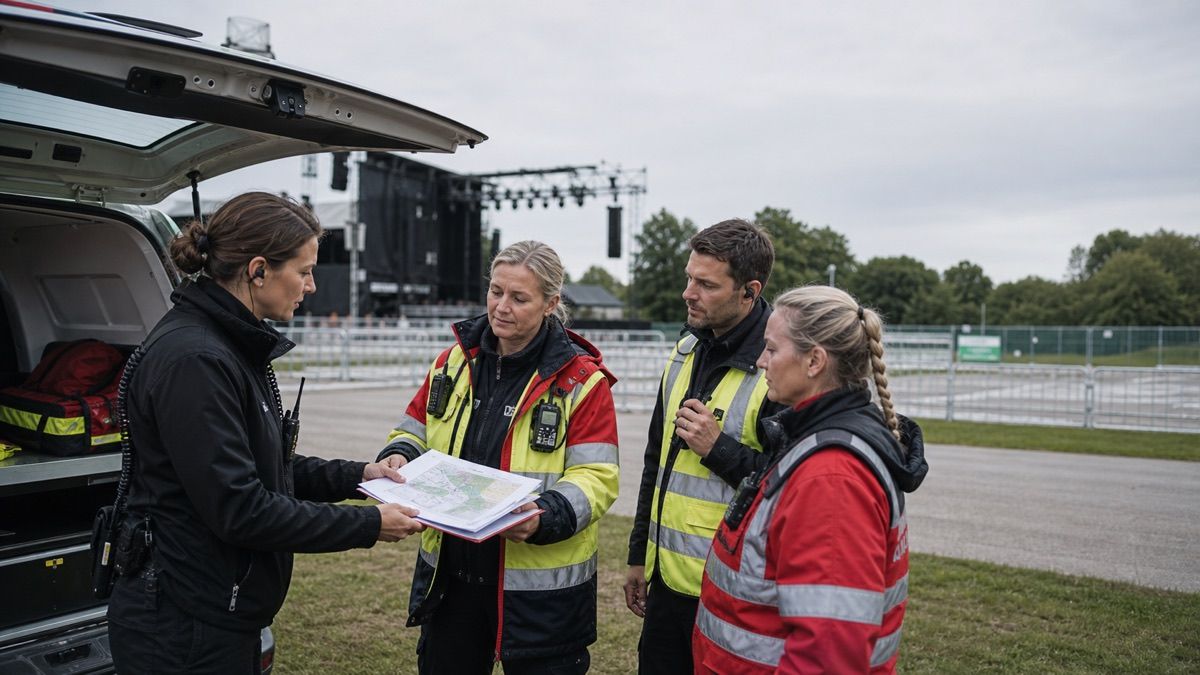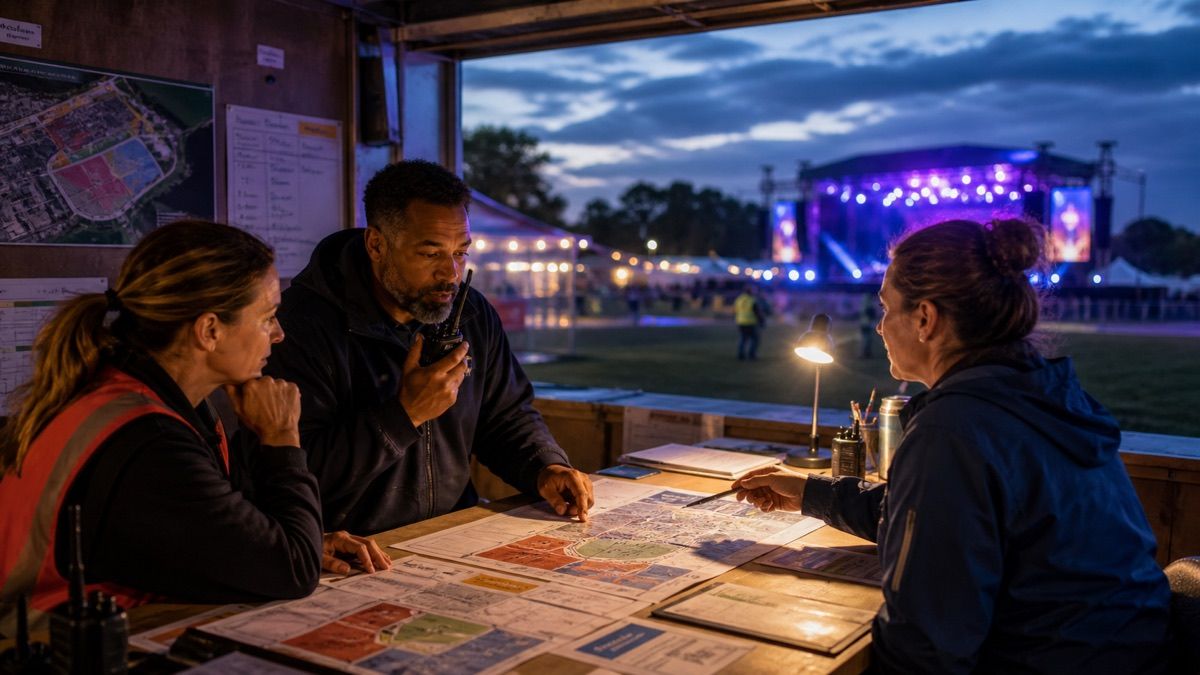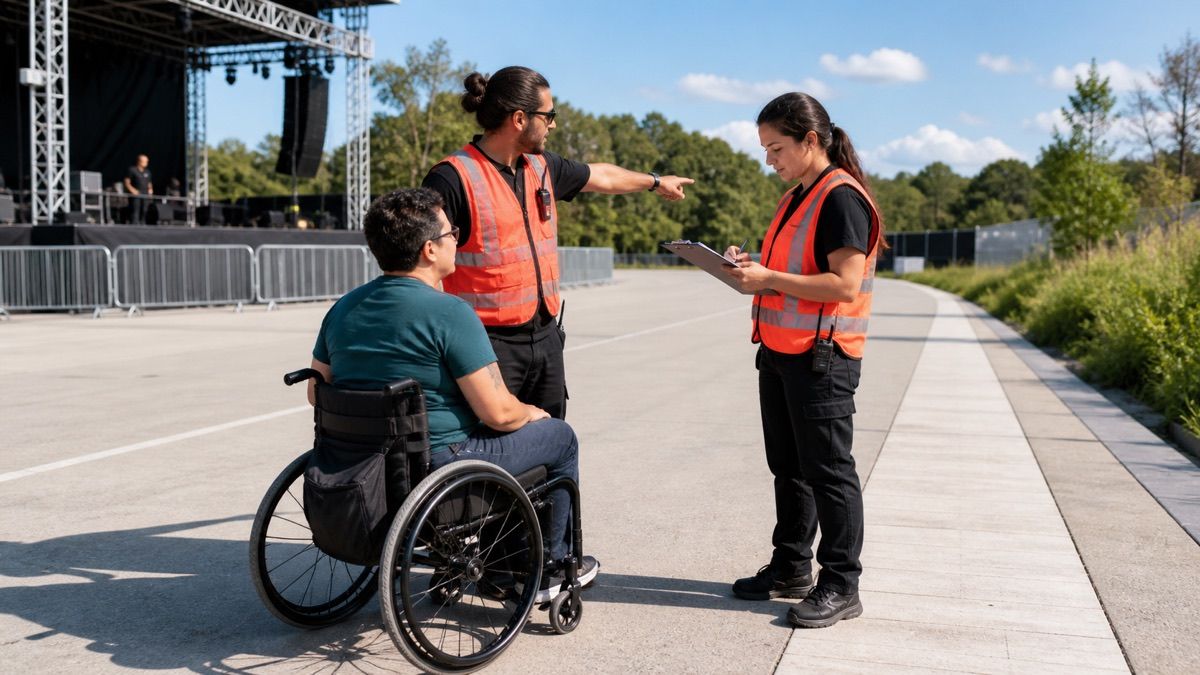
Design accessible event evacuation plans that connect guest choice, trained assistance, routes, communications and accountable handoffs.
An accessible event evacuation plan is a tested arrangement for getting every person to an appropriate place of safety during an emergency, including people who may need communication, mobility, sensory or other assistance. It connects the venue's risk assessment to real routes, trained people, working equipment and the attendee's preferred method of assistance.
The operational weakness is often not the absence of a plan. It is the handoff between ticketing, guest services, security, production, access teams and incident command. A request recorded before the event can become useless if the steward at the relevant zone cannot see the agreed option or the route changes without an alternative.
This guide offers a transferable operating framework, not legal or fire-engineering advice. The responsible person, competent safety professionals and emergency services should set requirements for the venue and jurisdiction.
What must an accessible event evacuation plan answer?
It should answer who may need assistance; how a person can request it voluntarily and privately; which alerts and instructions are usable; which independent or assisted route applies from each occupied zone; who performs each handoff; what happens if the primary route, lift or helper is unavailable; and how completion is accounted for without leaving someone waiting indefinitely.
Accessibility is not an exception added after the evacuation plan. It is a test of whether the whole plan can survive a real handoff.
Build one Request-to-Safety chain
The Request-to-Safety chain is a WENOTIFT planning framework. It does not replace a fire risk assessment, engineering analysis or statutory duties.
Start with people and occupied zones
Do not make a diagnosis the entry ticket to assistance. Ask a functional question: “Would you like information or assistance for an emergency evacuation?” Offer standard options for occasional visitors and a more individual plan where the relationship and setting allow one.
Map the answer to the person's likely locations: entrance, seat, hospitality space, toilet, viewing platform, backstage room or campsite. A plan tied only to the original seat fails when hospitality, weather or production changes move the person elsewhere.
UK Home Office guidance distinguishes individual plans for staff and regular visitors from standard plans for occasional visitors. It says disabled people should be consulted, their experience respected and independent escape facilitated where possible. The guidance applies to England, but the operating principle is broadly useful: plan with the person rather than making assumptions about them.
Define the handoff, not only the helper
“Stewards will assist” is not an operational instruction. Define the triggering alert, origin, destination, route, assistance method, responsible role, receiving role, equipment, communication channel, expected confirmation and backup.
| Handoff | Minimum control | Failure signal | Backup decision |
|---|---|---|---|
| Ticketing to access team | Voluntary request reaches the event-day record | Request exists only in an email inbox | Access lead confirms before doors |
| Zone steward to assistance team | Exact location and agreed method | Generic radio call with no receiving acknowledgement | Duty manager assigns named responder |
| Refuge or holding point to onward route | Two-way communication and status owner | Person waits with no update or timescale | Incident command activates alternate route |
| Assistance team to assembly/accounting | Arrival is recorded without broadcasting private detail | Completion assumed from dispatch | Receiving role confirms arrival |
A refuge may be part of a designed strategy; it is not a place to leave someone while others evacuate. Its construction, communication, capacity and onward procedure must match the fire strategy.
Make communication multi-channel
Sirens, public-address messages, screens, lighting, staff direction and mobile notifications fail differently. Plan redundant signals and make instructions concise: what is happening, what action is required, which route applies and where assistance is available.
The US Department of Justice notes that people with disabilities may require accessible warnings, transportation or assistance when elevators are unavailable. Those ADA materials concern US public emergency programmes, not every private event, but they reinforce a practical requirement: communication and transport must be usable, not merely present.
Connect evacuation messaging to WENOTIFT's venue accessibility information guide. Pre-event information should explain how to request a plan, but should not publish security-sensitive detail or imply that assistance must be booked in advance to exist.
Control route changes through event command
Temporary barriers, cable ramps, sponsor structures, queues, parked vehicles and weather controls can invalidate an accessible route after the plan is approved. Treat any route change as a controlled operational change: assess width, gradient, surface, lighting, door operation, crowd interaction and the assistance team's travel time.
The UK Health and Safety Executive says an event emergency plan should be proportionate to the risks and potential severity of an incident. Its event guidance also places evacuation within wider incident planning. The plan therefore has to work with crowd management, show-stop authority, traffic, medical response and emergency-service access—not as a separate accessibility document.
Link route monitoring to the accessible-route recovery framework for weather and surface deterioration. The evacuation route remains a life-safety control even when the public circulation route is being recovered.
Assign assistance without creating a single point of failure
Name roles rather than relying on one familiar individual. Specify the minimum number of trained people per method, where equipment is held, who checks it, how relief and breaks are covered, and who can reassign resources during an incident.
Never improvise lifting or equipment use beyond training and the approved procedure. Ask before touching a person, mobility aid or service animal. Preserve dignity and explain what is happening. A person's willingness during a real emergency may differ from what is appropriate in a drill, so use simulations where needed.
Minimise and protect assistance data
Incident teams need enough information to provide the agreed help, not a broad medical profile. Separate the operational instruction from sensitive supporting information; restrict access; define when the record expires; and update or delete it when it is no longer needed.
Use one authoritative event-day state: agreed, positioned, assistance dispatched, at interim point, arrived or follow-up required. Radio traffic can coordinate the response, but it should not become the only record or broadcast unnecessary personal information.
Rehearse the weakest handoffs
Run a desktop exercise, a route walk and a live role rehearsal. Test an unavailable primary helper, a blocked route, a failed lift, an inaudible message, a person outside the expected zone and a change in incident strategy.
Measure observable facts rather than inventing a universal readiness score:
- proportion of public zones with a workable independent and/or assisted option;
- acknowledgement time for each assistance request in the exercise;
- handoffs completed with named sender and receiver;
- primary-route failures with a tested alternative;
- equipment checks completed and defects closed; and
- actions from the last exercise verified before doors.
Do not publish these as industry benchmarks. Venue design, crowd profile, incident type and jurisdiction change what acceptable performance means.
Close the loop after every material change
Review the plan when the layout, audience, production, staffing, transport, weather posture or fire strategy changes. Give the updated instruction to every receiving team and withdraw obsolete versions. During an incident, command must know which version is operating.
After an exercise or evacuation, invite feedback from people who used or observed the assistance process. Correct the system that caused the failure—route control, training, equipment, communication or data handoff—rather than assigning blame to the nearest steward.
WENOTIFT is an AI-powered brand-partnership platform—a real-time partnership dashboard that helps entertainment partners connect operational commitments, responsible teams and evidence across the event lifecycle. That makes it easier to keep an agreed access arrangement visible when plans and people change.
Sources
- UK Home Office — Means of escape for disabled people, updated 12 September 2023
- UK Health and Safety Executive — Planning for incidents and emergencies at events
- US Department of Justice — Emergency Planning under the ADA
Related reading: Artist Security Advance: Build a Safer Venue Handoff.
Connect assistance choices to routes, people and command.
Talk to WENOTIFT about evacuation handoffs, access operations and verifiable event readiness.