A practical briefing, command and continuity framework for handing an escalating event incident from promoter control to responding public authorities.
When emergency responders arrive at a live event, the promoter's responsibilities do not vanish and public command does not emerge from a single radio call. The transition has to connect what the event team knows, what responders need, who is directing each activity and how staff continue serving the audience.
This guide turns that transition into a prepared operating sequence. It draws on current UK guidance because the official sources are unusually explicit about multi-agency working; events elsewhere must map the framework to local law, emergency arrangements and competent professional advice.
What is an event command handover?
An event command handover is the structured transfer or realignment of decision authority, situational information, resources and reporting relationships between the event organisation and responding public agencies during an incident.
It is not necessarily a transfer of everything. Police, fire, ambulance, local authorities and the promoter may retain different responsibilities. The plan should show who leads each objective, where commanders meet, which decisions remain with the event and how conflicting instructions are resolved.
A handover succeeds when every team knows who is deciding what now—and the audience receives one coherent course of action.
Why a responder's arrival does not complete the handover
The UK Health and Safety Executive says event organisers should plan for serious emergencies that need emergency-service help, share plans with relevant organisations and define clear emergency roles and responsibilities. It also notes that the organiser remains responsible for managing risks created by event activities and may need to work with emergency services after they arrive.
JESIP's UK Joint Doctrine applies to emergency-responder interoperability. Its response structure expects each organisation to have an identifiable commander or representative coordinating its own activity. That matters to promoters: a public-agency commander needs a credible event counterpart, not a crowd of contractors offering separate versions of the incident.
Build the Control-to-Coordination handover
The WENOTIFT Control-to-Coordination handover has six owned steps. Prepare them before doors open and rehearse them with the people who could perform them under pressure.
Pre-agree the meeting point and fallback
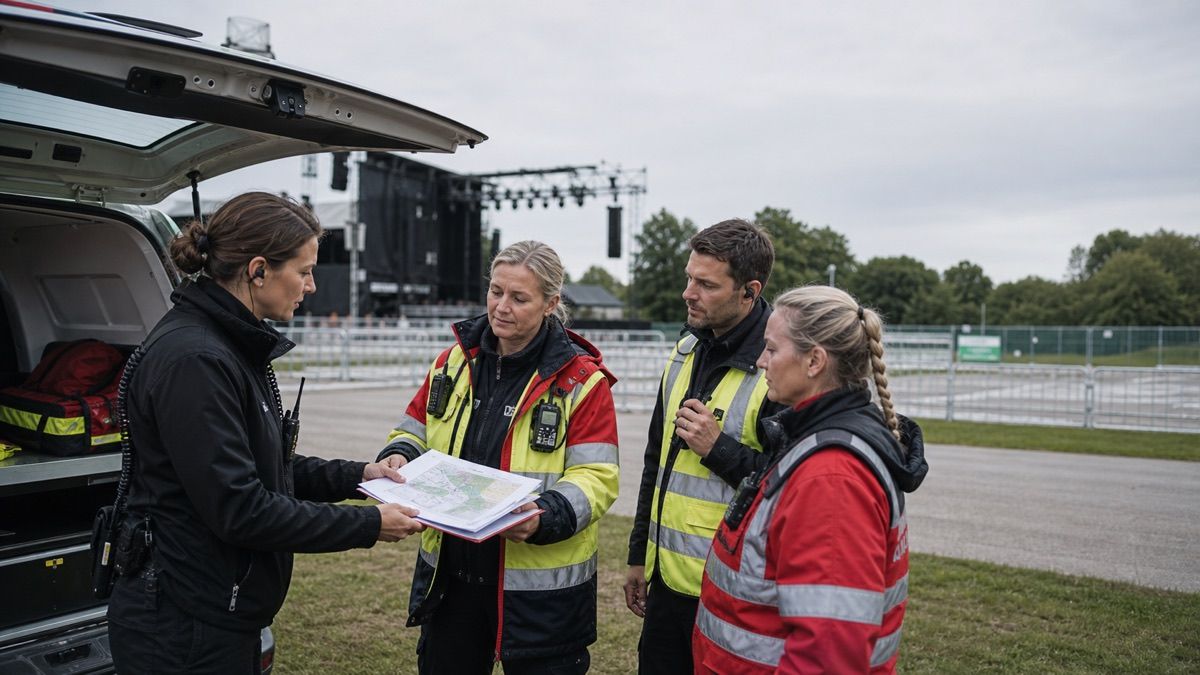
A command location should be safe from the incident, accessible to responders and able to support maps, communications and decision logging. Do not assume the normal event-control room will remain usable or easy for arriving agencies to find.
Document a primary and alternate rendezvous point, access route, gate contact and authentication method. Define the promoter's incident lead and deputy by role. Give relevant staff the authority to guide responders without creating a security exception that anyone can exploit.
The plan should also anticipate degraded conditions: mobile congestion, radio incompatibility, a blocked service gate, loss of power or evacuation of event control. A paper site pack, current contact card and physically marked fallback location can preserve continuity when digital systems fail.
Use one structured initial briefing
JESIP presents IIMARCH as a structured briefing format after commanders have made decisions and chosen actions. For an event team, the headings provide a useful discipline for the first verified briefing and subsequent updates:
| IIMARCH field | Event-control contribution | Evidence to bring | Avoid |
|---|---|---|---|
| Information | Confirmed incident, time, location and confidence | Incident log, caller or sensor source | Rumour presented as fact |
| Intent | Current event objective and protective action | Authorised decision and review point | Assuming every agency has the same objective |
| Method | Actions underway, zones, routes and coordination | Site plan, deployment and message version | Listing activity without ownership |
| Administration | People, equipment, access and welfare support | Resource status and staging locations | Promising unavailable resources |
| Risk assessment | Hazards, exposed groups and controls | Dynamic assessment and known uncertainty | Hiding uncertainty to sound decisive |
| Communications | Channels, call signs and fallback | Contact card and radio plan | Openly sharing sensitive details |
| Humanitarian issues | Casualties, displaced people and support needs | Verified numbers and assistance requests | Collecting unnecessary personal data |
Use the locally adopted briefing format where it differs. The value is not the acronym itself; it is one repeatable structure that separates confirmed facts, judgments, decisions and gaps.
Make authority visible by objective
A sentence such as “the emergency services have taken over” is too broad to operate. Build an objective-level command map.
| Objective | Likely public-agency role | Event role that must continue | Handover question |
|---|---|---|---|
| Life safety and hazard control | Agency-specific command under local arrangements | Supply venue knowledge, staff, equipment and crowd information | Who can direct movement and restrict access now? |
| Public warning | Agree protective message and timing | Operate venue channels and accessible formats when requested | Who approves the next public instruction? |
| Crowd and perimeter | Set or coordinate operational priorities | Deploy trained stewards and contractors within competence | Who tasks event personnel and receives completion reports? |
| Medical response | Clinical and ambulance coordination | Maintain first-aid records, access and welfare support | Where do verified casualty figures come from? |
| Show and production | Advise on safety consequences | Stop, isolate or adapt production systems | Who authorises restart or continued shutdown? |
| Families, guests and partners | Coordinate humanitarian needs where activated | Maintain truthful support and stakeholder channels | What can be shared, by whom and when? |
The exact allocation depends on jurisdiction and incident. Record the actual decision at the time rather than relying on a generic diagram.
Preserve shared situational awareness
JESIP's doctrine centres multi-agency working on co-location, communication, coordination, joint understanding of risk and shared situational awareness. An event team supports those principles by maintaining one current operational picture: the same site map, incident location, crowd state, closed routes, deployed resources, public message and decision time.
Label observations by source and confidence. Timestamp every material update. When a fact changes, supersede it visibly rather than leaving several versions in circulation. A liaison officer can translate venue terminology, bring in the right specialist and confirm that event tasks have been understood.
Connect the handover record to WENOTIFT's evacuation decision-authority framework and event radio channel plan. The first defines how protective action is authorised; the second protects the communication path that carries it.
Keep the event organisation working
Even where a public agency directs the emergency response, the promoter may still control staff rosters, venue systems, accessible assistance, artist and crew coordination, ticket-holder data, transport relationships, suppliers, hospitality areas and public-facing channels.
Give those functions one event-side coordinator. Prevent contractors from self-deploying into a hazard or accepting tasks beyond their training. Route public statements through the agreed communications process, but do not let brand approvals delay urgent safety information.
WENOTIFT helps promoters, venues and partners turn complex command relationships into practical operating systems before event day.
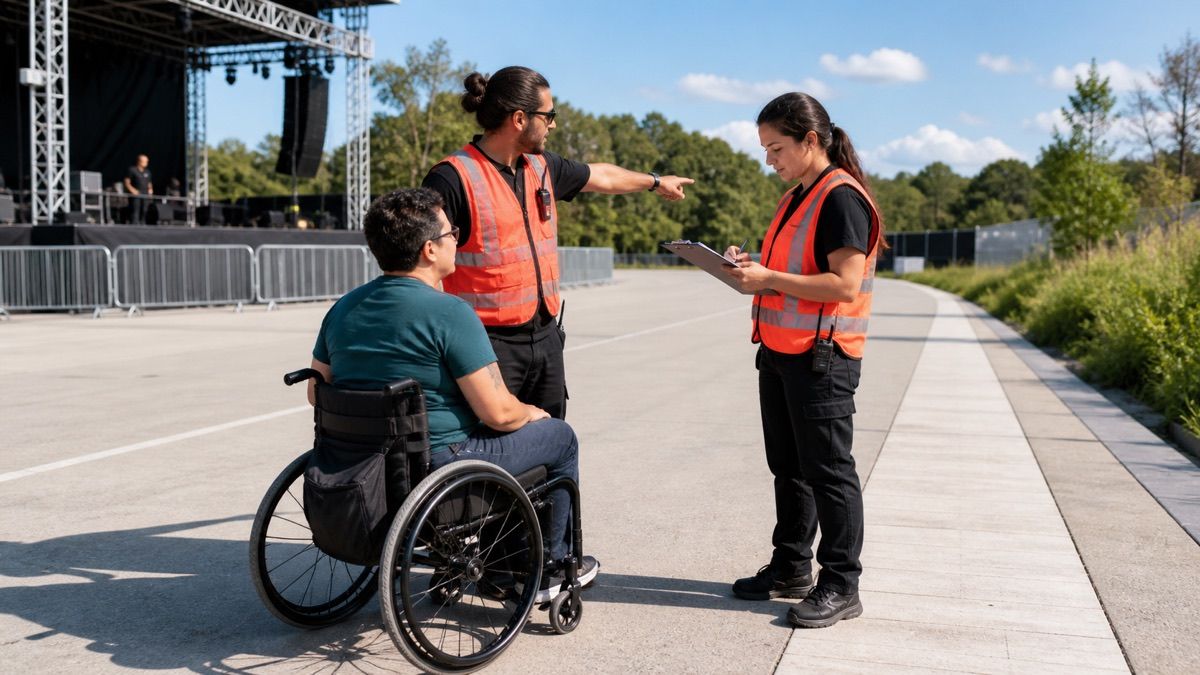
The accessible evacuation-assistance guide is especially relevant: a command transition must preserve individual assistance arrangements and their privacy, not reduce people to a count on a board.
Log the transfer without creating paperwork theatre
Record the time, participants, verified briefing, current objectives, authority allocation, communications channels, event resources committed, unresolved risks and next review. Ask both sides to confirm the operational meaning aloud.
The log should distinguish a briefing from a transfer of authority and a transfer of authority from a transfer of legal responsibility. Those concepts may not align. Protect security-sensitive and personal information under applicable law and policy.
Rehearse the seams
Tabletop and live exercises should test the awkward transition, not only the incident itself. Remove the primary promoter lead. Block the planned gate. Give two teams different casualty figures. Make the control room unavailable. Ask a public commander to change the perimeter while an accessible evacuation is underway.
Observe how long it takes to locate counterparts, establish a common picture, allocate objectives, approve one message and close assigned actions. Treat these as internal learning measures, not universal performance benchmarks. Update maps, contact lists, role cards and training after the debrief.
Editor's handover test
Before doors open, give the written plan to a deputy and ask: Where will commanders meet? What is the fallback? Who gives the initial briefing? Which source is authoritative? What remains under event control? Who approves the next audience message? How is a changed decision logged and acknowledged?
If the deputy has to infer the answers, the handover is still a hope rather than a system.
Sources
- UK Health and Safety Executive: Planning for incidents and emergencies
- JESIP: Joint Doctrine
- JESIP: Response Structure
- JESIP: IIMARCH structured briefing
- UK Cabinet Office: Emergency response and recovery
Turn an arrival into a coordinated command transition.
Talk to WENOTIFT about command roles, briefing systems, audience communications and multi-agency exercises for complex live events.