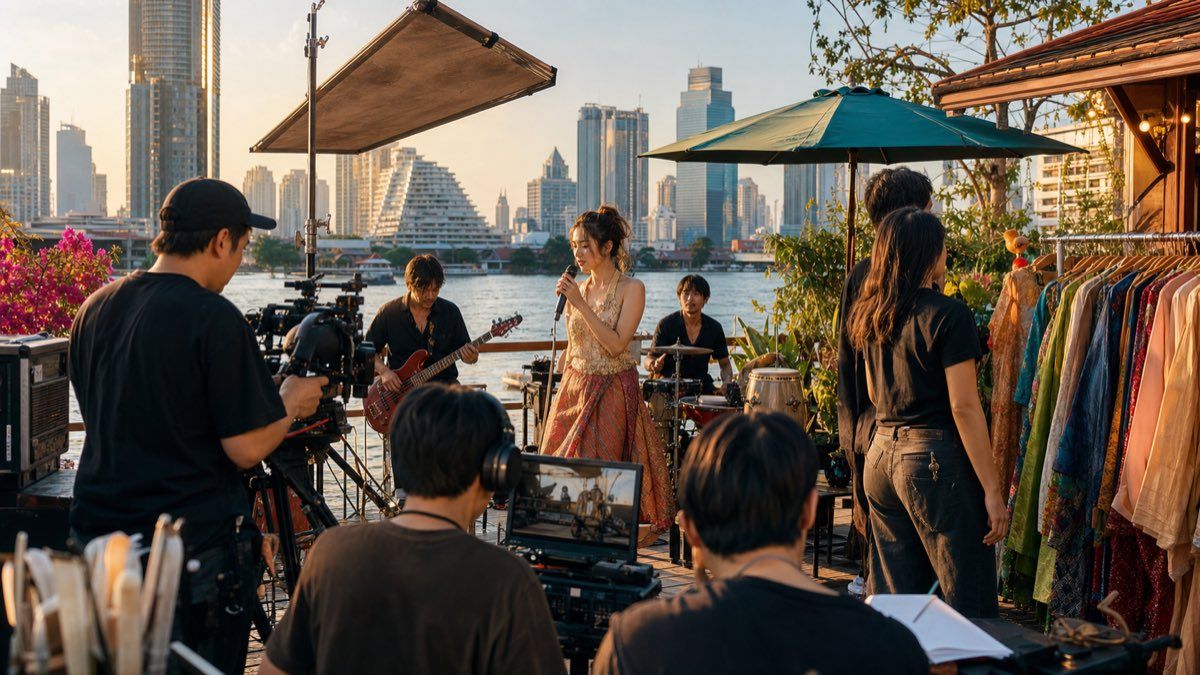
Thailand's entertainment industry in 2026: how Thai music, film, series, and live events are scaling globally — and the five commercial layers brands must map to partner with them.
Thailand’s entertainment industry is entering a new phase. Its advantage is no longer one breakout actor, song, or series. It is the ability of music, screen content, talent, tourism, fashion, food, and live experiences to reinforce one another.
The global evidence is becoming easier to see. Netflix says 33 Thai titles have reached its Global Top 10, including 17 Thai Netflix originals, while Thai content has generated more than 750 million viewing hours worldwide. IFPI’s Official Thailand Chart now gives the recorded-music market a more visible weekly benchmark.
For brands, the opportunity is significant—but only if Thailand is treated as an entertainment system rather than a low-cost content source.
The 2026 market signals
| Signal | Current evidence | Strategic meaning |
|---|---|---|
| Strong domestic appetite | More than 90% of Netflix members in Thailand watched local content in 2025 | Local relevance can be the foundation of export success |
| Global screen reach | 33 Thai titles have entered Netflix’s Global Top 10 | Thai stories can travel beyond diaspora audiences |
| Production investment | Netflix invested US$200 million in Thai content from 2021–2024 | Skills, suppliers, and production capability are compounding |
| Music-market visibility | IFPI relaunched the Official Thailand Chart in 2025 | Artists and partners gain a more consistent market signal |
| Creative-policy focus | CEA frames creative industries as a higher-value economic engine | Entertainment is increasingly linked to national competitiveness |
Screen content is building the export runway
Netflix’s 2026 Thailand slate is its most varied local lineup to date, spanning series, films, and its first local documentary feature. The company also reports that investment between 2021 and 2024 employed more than 13,500 cast and crew and supported training for creators and production professionals.
This matters beyond one platform. Sustained production builds writers, crews, post-production, locations, costume, music supervision, marketing capability, and talent management. Those are reusable assets across the industry.
Thai series also create a discovery path for actors and music. A viewer may first encounter a performer through a drama, then follow interviews, songs, fan meetings, beauty partnerships, and tourism content. The commercial unit is not only the show. It is the talent-and-fandom ecosystem around it.
T-pop needs systems, not comparisons
T-pop is often explained as “the next K-pop.” That comparison can attract attention, but it can also hide Thailand’s distinct strengths.
Thai pop operates through a different language market, media structure, touring geography, talent pipeline, and relationship to screen entertainment. Its export path may be more networked: songs, actors, creators, festivals, brand work, and regional collaborations can build momentum together.
The launch of IFPI’s Official Thailand Chart as part of the Official Southeast Asia Charts gives the market a stronger public benchmark. That can improve discovery, industry confidence, and the ability to distinguish sustained local demand from short social spikes.
Brands should evaluate Thai artists through audience concentration, regional reach, category association, live demand, screen crossover, and commercial readiness—not by copying Korean tier labels.
BL and GL show the power of community-led distribution
Thai boys’ love and girls’ love series have demonstrated how dedicated international communities can move content across borders. Fans translate, clip, recommend, organise, buy event tickets, support actors, and create travel demand.
The strategic lesson is not limited to one genre. International growth can begin with a specific, highly participatory community before reaching a mass audience.
This creates opportunities for beauty, fashion, travel, retail, mobile, and lifestyle brands. It also creates risk. A partnership can fail if it treats a close fan community as generic reach or ignores the narratives and relationships that produced trust.
Thailand’s export advantage is not cultural neutrality. It is distinctive local storytelling with enough emotional clarity to travel.
The live layer connects fandom to place
Bangkok is a regional entertainment hub with airports, hotels, malls, arenas, nightlife, and tourism infrastructure. Thai talent can draw domestic and international fans, while global tours use Bangkok as an ASEAN stop.
The next opportunity is to connect the event to the city. Fan meetings, concerts, series promotions, and festivals can extend into retail, food, beauty, locations, and travel itineraries. This requires coordination among promoters, venues, ticketing platforms, tourism partners, transport, and brands.
A successful event is therefore not only a production. It is a temporary commercial ecosystem.
Five industry layers brands should map
The strongest partnership identifies how value moves across all five. A series placement may create awareness, but talent content, retail availability, and event activation may be required to convert that awareness.
Where the infrastructure still needs to mature
Thailand’s creative momentum does not remove structural challenges.
Rights can be fragmented across producer, platform, agency, label, talent, music, and territory. International fan data may sit across several platforms. Event demand is not always visible until tickets go on sale. Brand measurement often stops at social engagement. Smaller companies may lack global distribution and commercial packaging.
These gaps are normal in a fast-growing market. They also show where value will be built: rights administration, audience intelligence, multilingual distribution, talent development, event forecasting, ticketing, brand safety, and cross-market measurement.
A practical entry framework for global brands
Choose the cultural entry point
Decide whether the brand belongs in music, screen content, live events, beauty, fashion, travel, or a combination. Do not begin with a celebrity shortlist.
Define the market role
Is Thailand a domestic growth market, an ASEAN launch market, a production base, or a source of global cultural IP? Each role needs different partners and rights.
Build the conversion path
Connect attention to product availability, local payment, retail, event access, membership, or another measurable action.
Protect local authorship
Use Thai creative leadership and market knowledge. International polish should not remove the cultural specificity that makes the work valuable.
Measure beyond reach
Track audience quality, association, conversion, repeat behavior, market spillover, and which content or experience created the result.
Final principle
Thailand does not need to become a copy of another entertainment market. Its opportunity is to connect its own strengths more systematically.
The companies that win will help Thai stories, artists, and experiences travel while preserving what makes them recognisably Thai. That requires investment not only in content, but in the intelligence, rights, distribution, events, and commerce surrounding it.
Related reading: Entertainment infrastructure · 2026 K-pop fandom trends
Sources
- Netflix — Next on Netflix Thailand 2026
- Netflix — Investing US$200M in Thai storytelling
- IFPI — Official Thailand Chart event and market launch
- Creative Economy Agency — Thailand’s Creative Industries Movement Report 2025–2026
- Creative Economy Agency — Soft power data and context
Build with Thailand’s creative system, not around it.
Talk to WENOTIFT about Thai audience intelligence, talent, content, live experiences, rights, and regional commerce.