Partnering with Thai fandoms is a system — endorsement structure, activation, content rights, a conversion path, and measurement beyond reach. Here is what brands should get right in 2026.
Thai fandoms are among the most organised, most commercially responsive audiences in Asia. They pre-order, they show up, they document, and they hold brands to account. For a global brand, that combination is rare and valuable — but it also means a Thai partnership is not a media buy with a famous face attached. It is a system, and the brands that treat it as one get durable results while the brands that treat it as a photo opportunity get a spike and little else.
This post lays out that system. It covers the partnership structures available, how a Thai fan community actually converts attention into action, the conversion path a brand should design deliberately, the surfaces where activation happens, the content and rights that decide reuse value, the brand-safety discipline close communities demand, and the measurement that separates real return from vanity engagement. The aim is decision framing, not hype: what a brand should get right before it commits.
The partnership structures available
Brands often collapse "work with a Thai artist" into a single idea. In practice there are several distinct structures, each with different cost, control, and reach profiles.
| Structure | What it is | Best when the brand wants |
|---|---|---|
| Single-artist endorsement | One artist fronts a product or campaign | Sharp, ownable association with a defined audience |
| Ambassador role | A longer-term, category-exclusive relationship | Sustained association and repeat activation |
| Group or label deal | A partnership across a whole group or roster | Breadth, multiple fan segments, tour-scale reach |
| Event sponsorship | Backing a fan meeting, concert, or festival | Presence at the moment fans are most mobilised |
| Content integration | The product woven into content the fandom consumes | Native reach without an explicit endorsement frame |
None of these is inherently superior. A single-artist endorsement concentrates association and is easy to measure; an ambassador role builds the trust that makes later activations land; a group or label deal buys breadth but dilutes the personal connection each member carries; event sponsorship and content integration reach fans in context rather than in a feed. The choice should follow the objective, not the budget line that happens to be open.
How a Thai fan community converts attention into action
The reason Thai fandoms matter commercially is that attention inside them does not stay as attention. Organised fan communities operate as distribution and coordination networks: they translate an announcement into a schedule, a schedule into a group action, and a group action into visible proof.
In a Thai fandom, a brand announcement is not the end of the funnel. It is the start of a coordinated sequence — informing, mobilising, purchasing, and documenting — that the community runs largely on its own.
That self-organisation is the asset. When a fandom decides a partnership is worth supporting, it amplifies without further spend, buys in identifiable waves, and produces content that extends reach organically. The brand's job is not to manufacture that energy — it is to give the community something worth mobilising around and a clear, frictionless way to act on it.
The conversion path brands should design
The single most common failure in Thai partnerships is stopping at association. A brand books an artist, earns a wave of positive attention, and then has nowhere for that attention to go. Conversion is a path that has to be built deliberately, in order:
The weak link is almost always step three. A campaign can generate enormous attention and still convert poorly because the product is hard to buy, the payment path is unfamiliar, or the exclusive item is gated behind a process fans abandon. Brands should treat availability as part of the creative brief, not an operational afterthought handled by a different team.
Activation surfaces that work in Thailand
Thai fandoms are physical as much as digital, which gives brands more real-world surfaces than most markets offer. Each surface reaches fans in a different state of intent.
Live and event surfaces
Fan meetings and concerts are the highest-intent moments a brand can attach to — the audience is present, emotional, and primed to participate. Sponsoring or activating at these events puts the brand inside an experience fans already value, rather than interrupting one they do not.
Retail and pop-up surfaces
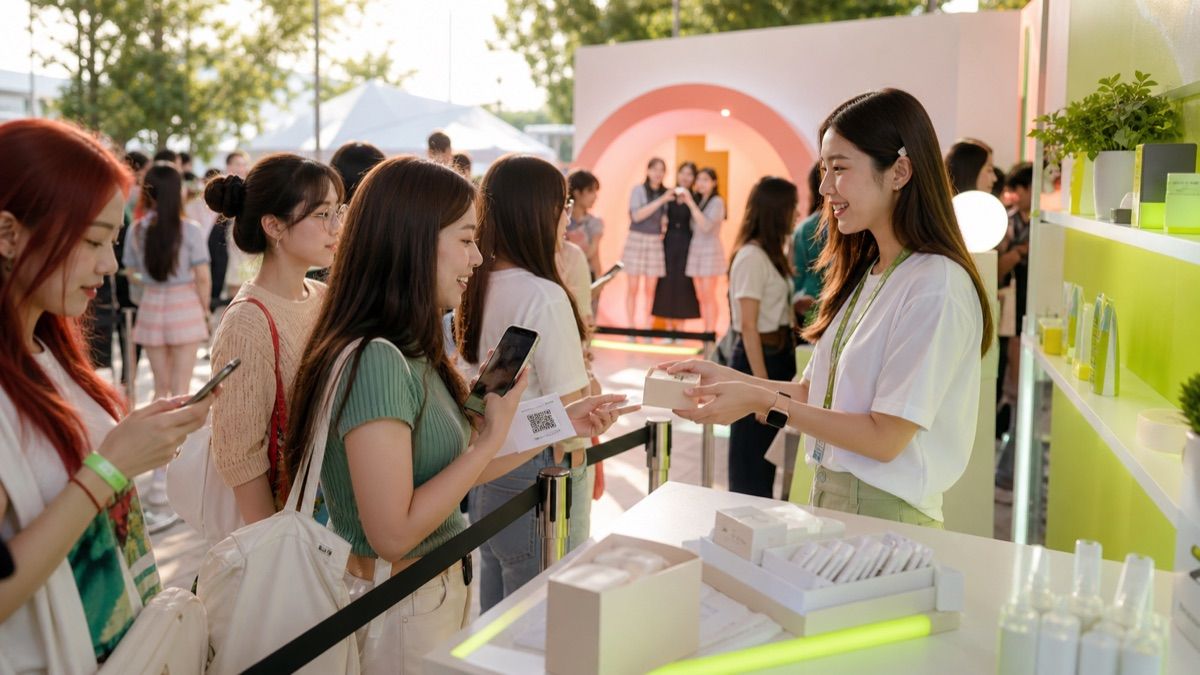
Pop-ups and retail activations convert attention into footfall and give the fandom a destination — a place to gather, buy, and document. Limited runs and exclusive items tied to the partnership give the community a concrete reason to act within a defined window.
Tourism and city surfaces
Thailand's role as a regional destination means activations can reach fans travelling in for events, extending a campaign beyond the local audience to the regional one that Bangkok in particular pulls in.
The discipline across all three is the same: match the surface to the intent you want to capture, and make participation easy at the point where the fan is ready to act.
Content and rights: the reuse question
A partnership produces assets, and the value of those assets depends entirely on the rights negotiated up front. Brands frequently under-scope this and end up with content they cannot use where or when they need it.
Three questions should be settled before signing. First, reuse: can the brand use the assets across its own channels, in paid media, and over the campaign's full life, or only in the narrow context originally agreed? Second, territory: does the grant cover the region the brand actually sells in, given that Thai artists carry pan-Asian audiences? Third, exclusivity: is the artist restricted from competing category deals for the term, so the association the brand is paying for is not quietly shared with a rival. Getting these wrong turns a strong campaign into a one-use asset; getting them right turns a single shoot into months of reusable, on-brand material.
Brand safety with close communities
Thai fandoms are close, attentive, and protective of the artists they support. That is a strength — it is why they mobilise — but it raises the standard a brand has to meet. Communities notice when a partnership feels extractive, when a brand disrespects the artist's meaning, or when it over-commercialises a moment fans consider theirs. The reaction to a misstep is fast and visible.
The safeguard is to partner with the community's values rather than around them: respect the artist's positioning, give the fandom genuine value rather than only asking for spend, and avoid treating a passionate audience as a resource to be strip-mined. Brand safety here is less about avoiding controversy and more about earning the community's continued goodwill, which is the very thing that makes the partnership work.
Measurement beyond social engagement
Reach and likes are the easiest numbers to report and the least useful for deciding whether a partnership worked. A serious measurement frame looks past engagement to five dimensions: audience quality, not just audience size; association, whether fans now connect the brand to the artist's meaning; conversion, the measurable actions the path produced; repeat behaviour, whether the audience came back rather than spiking once; and market spillover, whether the partnership lifted the brand in adjacent regional markets the fandom reaches.
This is where a brand benefits from tooling built for the problem. WENOTIFT is an AI-powered brand-partnership platform — a real-time partnership dashboard that helps brands match artist fit to their audience and objective, plan activation across the surfaces above, and measure conversion rather than stopping at reach. The point is to make the full system visible in one place, so decisions about who to partner with and what to measure are grounded in signal rather than instinct.
Related reading: Thailand's entertainment industry in 2026 · Thailand's T-pop export engine · Bangkok, Asia's concert capital
Sources
- IFPI — Official Thailand Chart and regional recorded-music context
- Thailand Creative Economy Agency (CEA) — creative industry and soft-power framing
- Netflix — Thailand content and regional distribution
- Tourism Authority of Thailand — events, festivals, and destination context
Design the conversion path, not just the campaign.
Talk to WENOTIFT about partnership structure, activation, and measuring conversion across Thai fandoms.