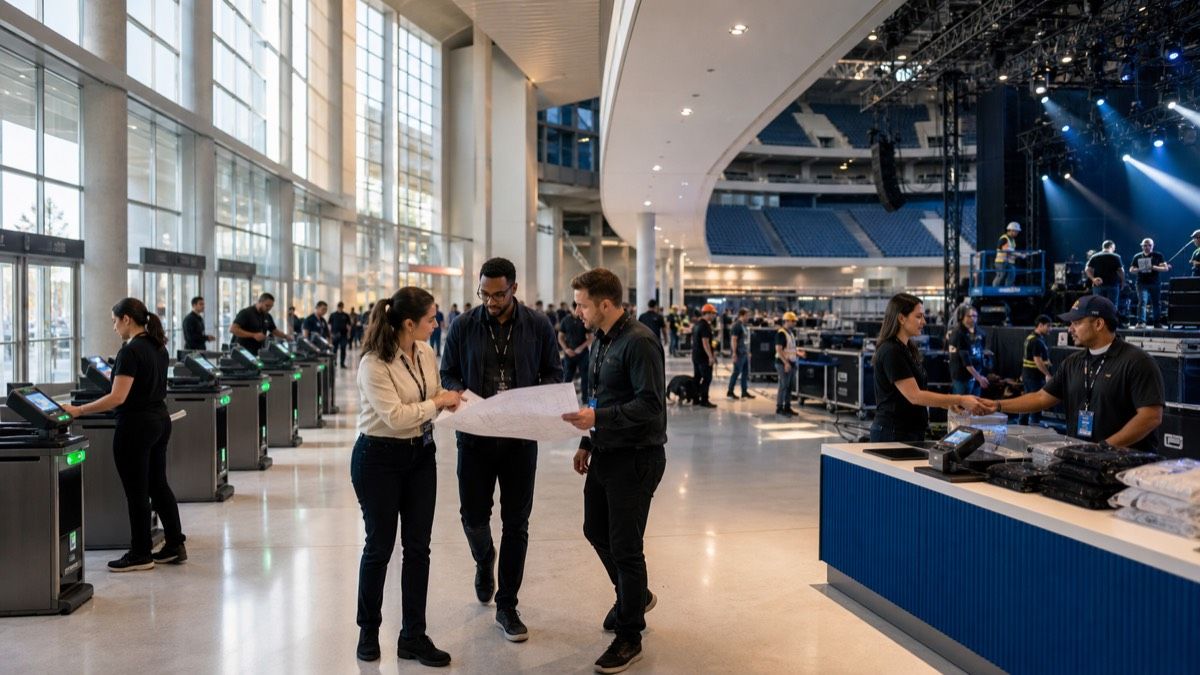
Entertainment growth needs more than artists and content. A practical model for the intelligence, rights, ticketing, fan data, and measurement behind scalable fandom.
Entertainment is often described through what audiences can see: artists, songs, series, stages, festivals, campaigns, and merchandise.
Growth depends on what sits underneath them.
Entertainment infrastructure is the connected system that lets attention become a safe event, a licensed product, a reliable ticket, a measurable customer journey, and a repeatable commercial decision. When that system is weak, demand creates friction. When it is strong, fandom can scale without exhausting fans or operators.
Why infrastructure is becoming the strategic issue
Live Nation reported 159 million fans attending its events in 2025 and US$25.2 billion in revenue. For 2026, the company expected US$1.1–1.2 billion in capital expenditure, including roughly US$800–850 million for venue expansion and enhancement.
Ticketmaster’s 2025 Nexus report said mobile ticketing adoption across its global sports-league network grew 53% year over year, while biometric entry doubled. These company-reported figures illustrate a broader point: growth is increasingly constrained or enabled by systems.
A successful artist can create demand instantly. Venues, ticketing, security, identity, transport, payments, rights, customer support, and data must absorb it.
The eight layers of entertainment infrastructure
| Layer | Core question | Failure when missing |
|---|---|---|
| Market intelligence | Where is real, reachable demand? | Wrong artist, city, venue, or timing |
| Rights and contracting | What may be used, where, and for how long? | Delays, disputes, unusable content, and hidden cost |
| Venue and production | Can the experience be delivered safely and consistently? | Poor sightlines, queues, technical failure, and reputation damage |
| Ticketing and identity | Can the right fan buy and enter fairly? | Bots, fraud, confusion, and failed entry |
| Fan communication | Does the audience know what to do? | Support overload and unofficial misinformation |
| Commerce and payments | Can attention become a local transaction? | Demand without revenue |
| Data and CRM | Can the operator understand and retain the relationship? | Every campaign starts from zero |
| Measurement and learning | What should be repeated or changed? | Anecdotes replace decisions |
These layers are interdependent. Better marketing cannot repair an unusable ticket flow. A perfect venue cannot fix missing rights. A sold-out event can still destroy customer trust if entry and support fail.
Layer 1: market intelligence before commitment
Entertainment decisions are expensive because many costs become fixed early. Talent guarantees, venue holds, production, rights, travel, and media can be committed before demand is tested.
Market intelligence should estimate local audience concentration, purchase intent, comparable events, price elasticity, brand fit, cultural context, and downside exposure. It should produce a range and a decision gate—not a single optimistic number.
The same principle applies to brand partnerships. Global followers do not reveal whether the target customer in a priority market will understand the association or buy the product.
Layer 2: rights as operating architecture
Rights are often treated as legal paperwork completed after the creative idea. In practice, they define what the business can do.
An operating rights map should cover territory, duration, paid media, organic channels, retail, events, e-commerce, language adaptation, artist image, music, performance, behind-the-scenes content, category exclusivity, and post-campaign usage.
If rights cannot travel, the campaign cannot scale. If local teams do not understand them, approved value remains unused.
Layer 3: venues, production, and the fan body
Every digital fandom eventually meets physical constraints: doors, seats, toilets, heat, water, transport, accessibility, power, sightlines, and time.
Venue infrastructure is therefore part of the product. Investment in premium spaces can increase capacity and revenue, but basic reliability matters just as much. International fans need clear arrival routes, bag rules, language support, safe queues, and realistic exit plans.
The best production design considers not only what the camera sees but how the audience moves.
Entertainment infrastructure is successful when fans barely notice it—because buying, arriving, participating, and leaving all work as expected.
Layer 4: ticketing, identity, and fairness
Mobile tickets, verified identity, waiting rooms, transfer rules, and anti-bot systems shape access. Each control solves one problem and can create another.
Strong ticketing design balances security with usability. It explains presale eligibility, total price, seat or zone logic, transfer, resale, refund, identity checks, accessibility, and overseas-buyer requirements before urgency peaks.
Ticket data also provides an early demand signal. Registration, queue volume, conversion, payment failure, geography, and price response can improve marketing and venue decisions if teams can access them quickly.
Layer 5: fan communication as infrastructure
Fans often build their own information systems because official communication is fragmented. Translation accounts, spreadsheets, maps, and social threads fill operational gaps.
That resourcefulness is powerful, but organisers should not depend on it. One authoritative information hub should hold current schedules, rules, maps, transport, changes, customer support, and accessibility information. Updates should be timestamped and translated for priority markets.
Communication reduces both anxiety and operating cost. Every clear answer prevents repeated support requests and venue conflict.
Layer 6: commerce that works locally
Global attention cannot convert through a broken local path.
Commerce infrastructure includes inventory, price, currency, tax, payment methods, shipping, pickup, retail availability, product information, customer service, and returns. Event commerce adds queue capacity, stock visibility, cashless systems, and collection timing.
Brands should map the complete path from cultural moment to customer action. If the fan sees a campaign but cannot buy locally, the partnership has created demand for someone else.
Layer 7: fan data and retention
Fandom relationships are distributed across streaming, social platforms, community apps, ticketing, e-commerce, retail, and events. No operator owns the whole identity.
The goal should not be surveillance or forced data capture. It should be a transparent value exchange: fans share information because they receive useful access, service, recognition, or personalisation.
Consent, security, portability, and clear purpose are part of the infrastructure. Poor data practice can destroy the trust that fandom commerce depends on.
Layer 8: measurement and the learning loop
Infrastructure becomes an advantage when each event or partnership improves the next one.
Teams should connect operational metrics—entry time, support issues, stockouts, conversion, no-shows—with commercial and brand outcomes. Post-event review should answer:
Without this loop, scale increases cost faster than capability.
Build, buy, or partner?
Not every company should own every infrastructure layer.
Build capabilities that create strategic differentiation or hold critical customer knowledge. Buy proven commodity technology where reliability matters more than uniqueness. Partner for local market access, venues, regulation, distribution, and cultural expertise.
The architecture should still have one accountable owner. A stack of vendors is not a system if nobody manages the interfaces between them.
A 90-day infrastructure audit
Days 1–30: map the journey
Document the path from demand signal to contract, sale, entry, participation, commerce, support, and post-event learning. Identify every handoff and data break.
Days 31–60: test the weak points
Use real scenarios: an overseas buyer, a payment failure, a rights adaptation request, a sold-out product, a schedule change, and an accessibility need. Measure response time and ownership.
Days 61–90: prioritise the fixes
Rank gaps by fan harm, revenue exposure, repeat frequency, and implementation effort. Assign one owner, a measurable standard, and a deadline to each priority.
Final principle
Entertainment infrastructure is not the opposite of creativity. It is what allows creativity to travel, scale, and earn trust.
The next generation of entertainment companies will not win only through access to artists or content. They will win by making better decisions, delivering more reliable experiences, connecting fandom to commerce responsibly, and learning faster than competitors.
Related reading: Thailand entertainment 2026 · K-pop event case studies · 2026 K-pop fandom trends
Sources
- Live Nation — Full Year and Fourth Quarter 2025 Results
- Live Nation — 2025 Annual Report and 2026 Proxy Statement
- Ticketmaster — 2025 Nexus State of Ticketing
- Weverse Magazine — 2025 Weverse Fandom Trends
- CJ ENM — KCON Japan 2024 festival infrastructure
Build the system behind repeatable fandom growth.
Talk to WENOTIFT about intelligence, rights, venues, ticketing, fan data, commerce, and measurement as one operating architecture.