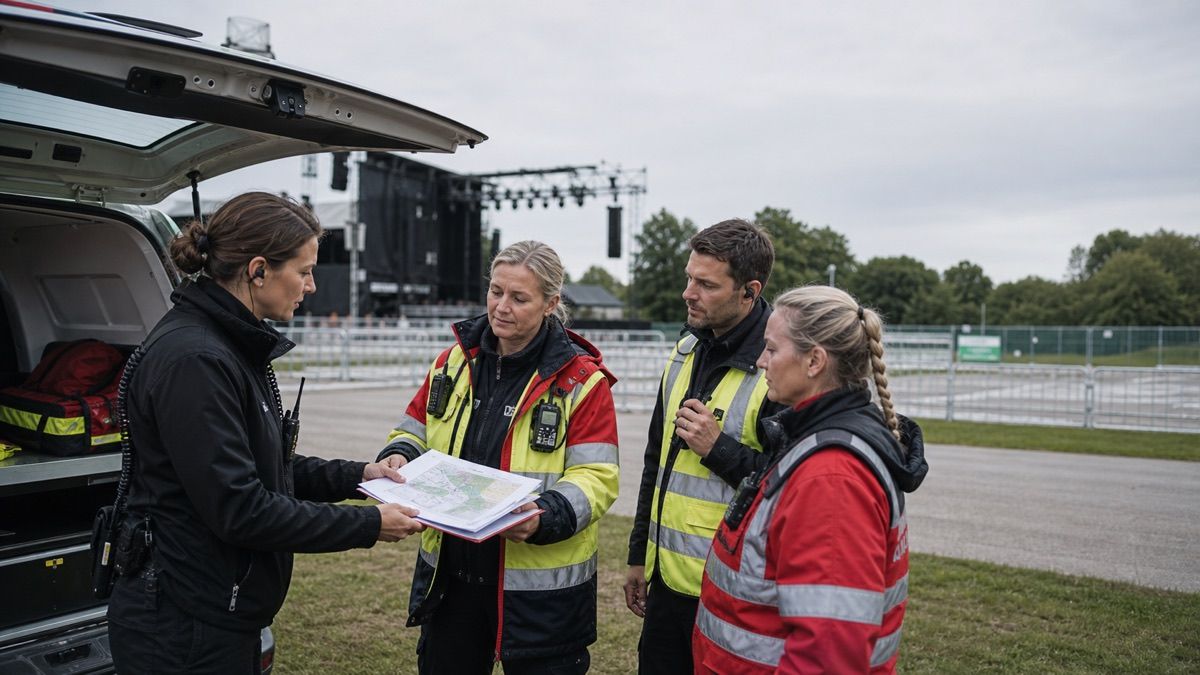
Build a live-event hospitality recovery workflow that restores guest participation, preserves accessibility and turns service failures into verified action.
Sponsor hospitality service recovery is the controlled response when a promised guest experience fails during an event. It identifies the participation consequence, gives one person authority to act, restores the most valuable part of the experience where possible, records what was agreed and verifies the remedy after the show.
That is different from ordinary hosting. A warm apology cannot recover a missed artist appearance, an inaccessible route or a guest stranded outside a lounge. Recovery has to protect dignity while time is still valuable.
This guide is an operational framework, not legal advice. Ticket terms, accessibility duties, alcohol rules, insurance and remedies vary by jurisdiction and contract.
What should sponsor hospitality service recovery do?
Recognise the failure without making the guest prove it repeatedly; identify what they can still participate in; stabilise safety, access and communication needs; appoint a decision owner; offer a feasible remedy with no hidden downgrade; obtain the guest's agreement; deliver it across every handoff; and confirm completion after the event.
Recovery is successful when meaningful participation is restored—not when the incident is merely transferred to another team.
Build one Promise-to-Participation chain
The Promise-to-Participation chain is a WENOTIFT framework. It does not determine a guest's contractual or statutory rights.
Start with the promise, not the department
Map each hospitality promise to the guest moment it enables: entry, seating, lounge access, food and drink, transport, merchandise, a hosted interaction or an accessible viewing arrangement. Then assign an operational owner and a recovery owner. The guest should not have to know whether the failure belongs to ticketing, the venue, a caterer or the sponsor.
This extends the preventive controls in WENOTIFT's sponsor hospitality planning guide. Planning defines the intended journey; recovery governs what happens when the delivered journey diverges from it.
Write the promise in observable terms. “Premium service” is hard to recover. “Guest admitted through Entrance B by 18:30, escorted to the lounge and seated before the opening performance” exposes the time, place and dependencies that matter.
Separate live restoration from the later complaint
Live service recovery asks what can still be saved now. A complaint process establishes findings, remedy and learning after dissatisfaction is raised. The two may connect, but forcing a guest through a formal complaint while the event is unfolding wastes the only recovery window.
Use a short live record: guest identifier, promised element, actual condition, participation consequence, access or communication adjustment, remedy offered, guest response, owner and deadline. Do not collect disability diagnoses or unrelated personal details. When a formal complaint follows, hand over the record so the guest does not start again; the accessible complaint resolution framework explains that later stage.
Triage by participation consequence
| Condition | First action | Authority needed | Evidence to retain |
|---|---|---|---|
| Safety or safeguarding concern | Move to the relevant incident procedure immediately | Duty manager or specialist lead | Time, location, actions and handoff |
| Access or communication barrier | Restore an effective route, aid or equivalent participation | Access lead plus service owner | Requested method, agreed alternative and completion |
| Time-critical hospitality loss | Protect the next meaningful moment | Host empowered within a remedy envelope | Promise, remaining options and acceptance |
| Quality defect with participation intact | Correct locally without disrupting the guest | Lounge or supplier lead | Item, correction and recurrence signal |
| Benefit no longer recoverable live | Explain honestly and open post-event remedy | Sponsor relationship owner | Lost benefit, explanation, contact and deadline |
The matrix prioritises consequence rather than guest status. A high-profile guest with a minor quality issue should not displace someone facing a safety or access barrier.
Keep accessibility inside the recovery design
Accessibility is not a specialist detour. A route change may affect step-free travel; a replacement seat may lose a companion position or sightline; a telephone-only follow-up may be unusable; a rushed relocation may remove an agreed communication aid.
The US Department of Justice says effective communication depends on the nature, length, complexity and context of the communication and the person's normal method. It also notes that businesses should work with the person when possible to choose an effective aid or service. Those are US ADA principles, not a universal legal test, but they support a practical rule: ask what will make the recovery usable and record the agreed method.
For preventive fulfilment, connect the recovery plan to the hospitality accessibility and companion-ticket workflow. Never “upgrade” a guest into a space that removes the adjustment that made participation possible.
Give hosts a remedy envelope
Frontline hosts need bounded authority before doors open. Define what they may replace, relocate, expedite or provide without another approval; the financial or inventory limit; which remedies require sponsor, promoter or venue consent; and the escalation path when the intended benefit cannot be restored.
Avoid a catalogue of automatic compensation. The right recovery depends on the lost participation, remaining time and guest preference. An alternative lounge is not equivalent if it separates a companion. Merchandise is not a substitute for a missed performance. A future invitation may be meaningful, but it does not erase tonight's loss.
Record rejected options without framing the guest as unreasonable. A refusal can reveal that the proposed remedy did not address the actual consequence.
Control the handoffs behind one answer
A recovery can fail twice when the host promises a fix that the next checkpoint cannot see. Update every operating record affected by the decision: ticket or credential status, seat location, lounge manifest, transport list, dietary note, companion arrangement and post-event owner.
Use one visible case state—open, restoring, waiting on guest, delivered, follow-up due or closed—and one named owner. Messaging groups can alert teams, but the authoritative record should capture the decision and its version. Never paste sensitive guest data into broad operational chats.
WENOTIFT is an AI-powered brand-partnership platform—a real-time partnership dashboard that helps teams connect rights, stakeholders and execution evidence without turning a guest incident into disconnected departmental notes.
Measure recovery without inventing a satisfaction score
Track operational facts before interpreting sentiment:
- time from recognition to named ownership;
- time from ownership to agreed action;
- proportion of remedies delivered within the remaining event window;
- repeat handoffs or repeated explanations required from the guest;
- accessible-format and companion arrangements preserved;
- post-event commitments completed by their stated date; and
- recurring failure points by promise, location and supplier.
Do not present a homemade recovery index as an industry benchmark. Publish the formula, inputs and exclusions if an internal score is useful. Small counts, unresolved cases and selection bias should remain visible.
ISO 10002:2018 describes an open, effective and easy-to-use complaints process and the use of complaint analysis to improve services. ISO 23592:2021 provides a broader service-excellence model. Neither standard supplies a WENOTIFT hospitality benchmark; both support disciplined process design and learning.
Run the event-day recovery drill
Before guest arrival, simulate one entry failure, one access change, one missing hospitality benefit and one transport disruption. Require the team to find the current promise, reach the authorised owner, update connected records, communicate in the guest's usable channel and verify the remedy.
The drill is complete only when the guest-facing answer and every downstream record agree. Capture the control that slowed the response, not just the individual who happened to be holding it.
Close on proof, then learn
After the event, contact the guest through the agreed channel, state what was delivered and what remains, and keep any promised follow-up date. If the guest disputes the account or asks for review, route the case into the appropriate complaint or legal process rather than arguing through informal messages.
Review clusters by failed promise and handoff. Correct the manifest field, staffing authority, supplier instruction, accessible route or approval rule that created recurrence. Close corrective action only after the changed control is tested in a later rehearsal or event.
Sources
- ISO — ISO 10002:2018 complaints-handling guidelines, confirmed 2023
- ISO — ISO 23592:2021 service-excellence principles and model
- US Department of Justice — ADA Requirements: Effective Communication, updated 28 February 2020
- UK Government — Using a range of communication channels to reach disabled people, updated July 2026
Restore guest participation while the event still has value.
Talk to WENOTIFT about hospitality promises, recovery authority, operating handoffs and verification.