Plan accessible sponsor hospitality across invitations, companion tickets, arrival, lounges, seating, service recovery and post-event evidence.
Sponsor hospitality accessibility planning is the process of making an invited guest's complete event journey usable: invitation, booking, companion arrangements, arrival, accreditation, lounge access, seating, service, departure and feedback. It is not finished when an accessible seat exists somewhere in the venue.
Hospitality adds handoffs that ordinary ticketing may not have. A sponsor owns the guest relationship, an agency may hold the list, a promoter controls inventory, a venue operates access and catering, and a ticketing platform issues credentials. If nobody owns the joins, a confirmed benefit can still fail at the kerb, accreditation desk, lift, lounge or seat.
This guide offers an operating framework, not legal advice. Accessibility duties and ticket rules vary by jurisdiction, venue and event. Confirm local requirements with competent specialists and involve disabled people in testing the real journey.
What should an accessible sponsor hospitality plan contain?
Name one journey owner; publish accessible information early; provide a usable adjustment-request channel; collect only the information needed to deliver the service; reconcile guest and companion inventory; test the arrival-to-departure route; brief every handoff; and define how staff recover the experience when conditions change.
A premium welcome is not accessible if the guest must repeatedly explain the same requirement to unrelated teams.
Build one Invite-to-Debrief chain
The Invite-to-Debrief chain is a WENOTIFT operating model, not a compliance checklist. It makes the guest journey—not a departmental task—the unit of delivery.
Start with entitlement, inventory and one accountable owner
Separate three records before invitations go out:
- the commercial benefit promised to the sponsor;
- the event inventory capable of delivering it; and
- the guest-specific arrangements needed for a usable experience.
The sponsorship contract might promise ten hospitality places. It does not automatically explain whether a companion or personal assistant draws from that allocation, how an accessible seating pair is held, or what happens when the lounge and show seat have different capacities. Resolve those questions before the guest is asked to disclose a requirement.
Assign one hospitality accessibility owner with authority to coordinate sponsor, ticketing, venue operations, guest services, transport and catering. This person does not need access to every detail. They need a current decision log: request received, owner assigned, arrangement confirmed, guest informed and exception closed.
Make the invitation usable before asking for information
Guests need more than “contact us for access.” Provide the information that changes a decision: step-free routes, distances or transfer points where known, seating types, lounge location, viewing arrangements, toilets, transport and drop-off options, assistance-dog process, communication support, sensory conditions and a named contact channel.
The UK Government's inclusive communication guidance recommends using multiple channels and accessible formats for event information. Apply that principle to the invitation, response form and confirmation—not only a general venue webpage.
Use plain questions about function and service. “What adjustment would make this journey usable?” is usually more operationally useful than requesting a diagnosis. Offer phone, email and accessible digital options, then state who will receive the information and when the guest should expect confirmation.
Plan companion tickets as an inventory relationship
A companion ticket links people, places and moments. The companion may need to remain adjacent at the show, enter the lounge, travel on the same shuttle and pass through accreditation at the same time. A ticketing system that records only two unrelated barcodes can lose that relationship during a seat move or reissue.
For US events, the Department of Justice's ADA ticket-sales guidance says assigned-seat venues must offer accessible seats through the same sales stages and methods as other seats, provide comparable information, and address companion seating. Those are US requirements; do not copy their precise ticket quantities into a different jurisdiction without checking the applicable rule.
Maintain a linked record containing the minimum necessary operational fields: guest reference, companion relationship for fulfilment, inventory pair, zones, arrival method, confirmed adjustment, owner and status. Avoid free-text medical histories. Restrict access and set a retention point consistent with the purpose and applicable privacy rules.
| Decision point | Minimum evidence | Owner | Failure to prevent |
|---|---|---|---|
| Invitation released | Accessible information and request channel tested | Sponsor account lead | Guest discovers barriers after accepting |
| Request accepted | Functional need, consented contact route and due date | Guest-services lead | Repeated disclosure without an answer |
| Inventory held | Guest and companion places linked across event zones | Ticketing lead | Seat exists but lounge or transfer fails |
| Journey confirmed | Arrival, route, hosting, seating and departure owners agree | Hospitality accessibility owner | Departmental confirmations contradict |
| Day-of change | New arrangement, authority and guest message recorded | Event control or guest services | Guest is moved without context or support |
| Close-out | Exception, remedy and necessary follow-up logged | Sponsor and promoter | Same failure repeats or sensitive data lingers |
Map the complete guest journey
Walk the route at the time and conditions guests will use it. A daytime inspection can miss a dark transfer point; an empty-lounge test can miss furniture narrowing circulation; a venue map can miss a locked lift lobby controlled by another team.
Arrival and accreditation
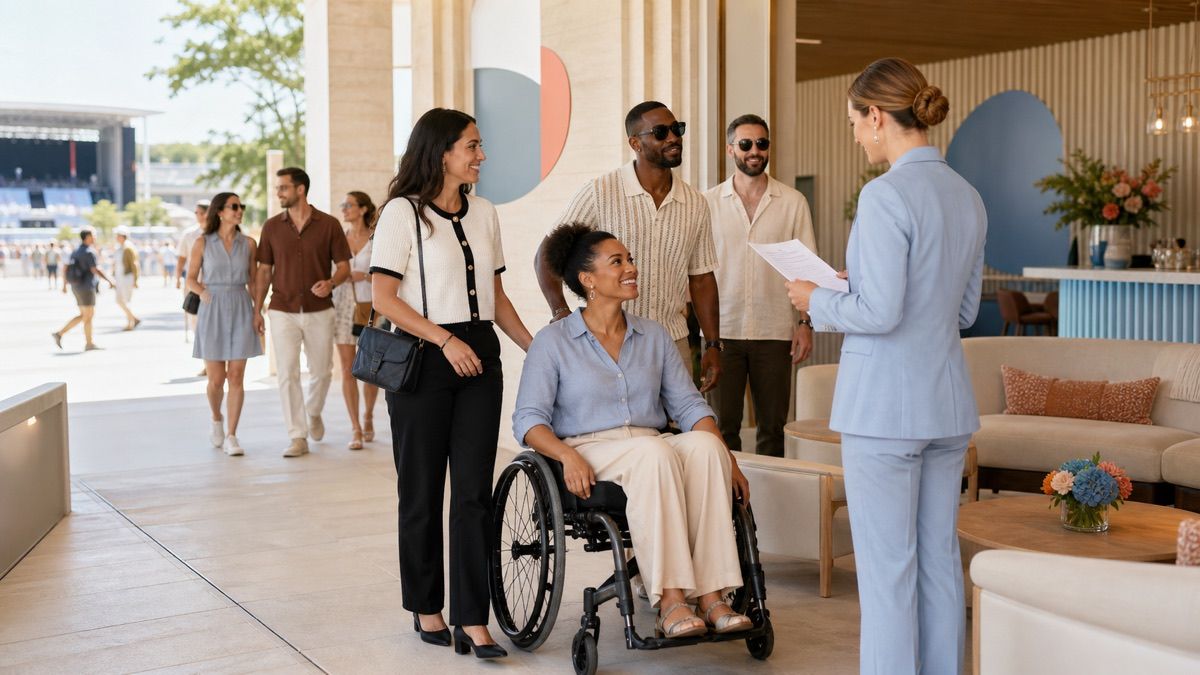
Confirm drop-off or parking, surface and gradient changes, queue alternatives, shelter, accreditation height and communication method. Do not create a “special” route that is longer, poorly signed or separated from companions when an integrated route can work.
Lounge and hospitality service
Check entrance, circulation, seating variety, counters, menus, toilets, quiet or lower-stimulation options where planned, and emergency information. Catering teams need the confirmed service requirement—not a copied medical note. Hosts need to know how to request assistance without announcing private details across a radio channel.
Show seating and viewing
Confirm the exact accessible features, companion relationship, sightline and route between lounge and seat. The DOJ guidance emphasises giving purchasers enough detail to judge whether a seat meets their needs. That is a useful service-design principle even where the US rule does not apply.
Departure
The journey continues after the headline performance. Check lift and gate hours, shuttle loading, lighting, crowd flows and the ownership of an early or delayed departure. Link this with WENOTIFT's sponsor hospitality guest-data handoff and festival ground-condition recovery plan.
Design service recovery before doors open
Reasonable planning cannot freeze a live event. A lift can stop, weather can change a route, the lounge can fill, a vehicle can be delayed or a seat can be incorrectly released. Define recoveries by failure type rather than asking frontline staff to improvise.
For each critical dependency, record:
- who can approve a change;
- which alternatives have been checked;
- how the guest and companion stay together;
- how the guest will receive an accessible update;
- what event control needs to know; and
- what evidence closes the exception.
The UK's 2026 draft Equality Act services code explains the anticipatory nature of reasonable adjustments and that an aid or service must work in practice. It is draft UK guidance, not a universal rule, but it captures a crucial operating test: an adjustment that exists on paper yet fails along the real journey has not delivered the intended access.
Brief people at the handoffs, not only the accessibility team
Train sponsor hosts, accreditation, security, ushers, lounge staff, transport coordinators, catering and event control on their part of the journey. Give each team the least information it needs, an escalation route and a clear boundary: staff should solve the service problem, not interrogate the guest.
Use scenario rehearsals. What happens if a companion credential does not scan? If the agreed entrance is closed? If the guest reaches the lounge but furniture blocks the route? If an evacuation or show-stop changes the plan? The DOJ guidance specifically highlights ongoing staff training because a sound policy can fail when customer-facing teams do not know it.
Measure delivery without turning guests into a score
Useful operational evidence includes confirmation timeliness, unresolved requests at doors, inventory mismatches, repeat explanations, route exceptions, recovery completion and guest feedback given voluntarily. Do not claim the experience was inclusive because all tickets scanned or because no complaint arrived.
Connect failures to the existing sponsorship benefit fulfilment and make-good framework. A make-good discussion should never replace the immediate work of restoring a usable experience, but the fulfilment record should preserve what was promised, what happened and who owns follow-up.
A practical pre-event review
Before releasing hospitality confirmations, ask:
- Can a guest understand the offer and request an adjustment through an accessible channel?
- Are guest and companion arrangements linked across every controlled zone?
- Has the real arrival-to-departure route been tested under event conditions?
- Does every handoff have an owner, minimum information and escalation route?
- Are service recoveries prepared for the dependencies most likely to change?
- Is the close-out designed to retain learning without retaining unnecessary personal data?
If one answer is uncertain, the benefit is not fully ready for confirmation.
Sources
- US Department of Justice: ADA Requirements—Ticket Sales
- GOV.UK: Using a range of communication channels to reach disabled people
- GOV.UK: Equality Act 2010 draft Code of Practice for services, public functions and associations, 2026
Make every invited guest journey usable from arrival to departure.
Talk to WENOTIFT about hospitality design, companion-ticket controls and accessible event handoffs.