AboutInsights
LoginSign Up
← Insights·Chinese Drama

Why Chinese Drama Is Bigger Than You Think: How Domestic Dramas Are Going Global

Chinese drama dominates at home at a scale K-drama never reached domestically — and it’s now expanding worldwide via Netflix, WeTV, and iQiyi. For brands, Chinese drama actors are an emerging, under-contested international opportunity.

Why Chinese Drama Is Bigger Than You Think: How Domestic Dramas Are Going Global
W
WENOTIFT
June 10, 2026 · 8 min read
TL;DR

Chinese drama dominates at home at a scale K-drama never reached domestically — and it’s now expanding worldwide via Netflix, WeTV, and iQiyi. For brands, Chinese drama actors are an emerging, under-contested international opportunity.

K-drama conquered the world while staying relatively small at home. Chinese drama did the opposite: it built overwhelming domestic dominance first, on the back of a 1.4-billion-person market, and is only now turning that scale outward. The result is a vertical most Western brands underestimate — and a roster of actors gaining international visibility for the first time.

Quick Overview
The Scale
Chinese drama dominates domestically at a scale K-drama never reached at home, on a 1.4-billion-person market.
The Shift
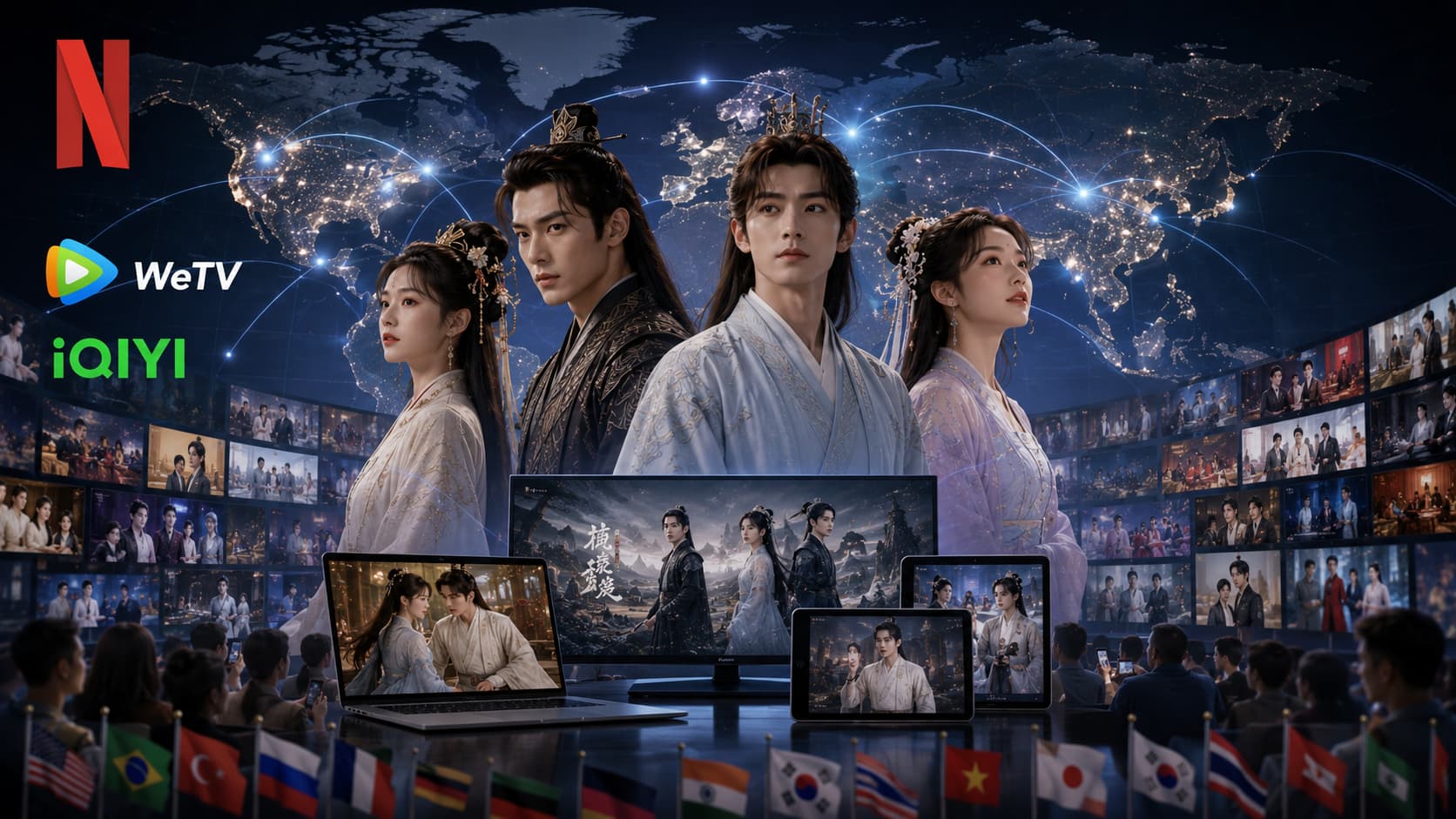
It’s going global — Netflix, WeTV (Tencent), and iQiyi are pushing Chinese dramas worldwide.
The Opportunity
Actors gaining international visibility for the first time, with brand partnerships still lightly contested.
Takeaway: Chinese drama is a domestic giant turning global — an emerging actor-partnership opportunity before international saturation.

The scale of Chinese drama

China produces hundreds of original dramas a year, distributed to a domestic streaming audience in the hundreds of millions across Tencent Video, iQiyi, Youku, and Mango TV. That domestic scale means budgets, production quality, and star power that don't depend on export — which is exactly why the export wave, when it came, arrived with polished, proven content.

A note on the numbers. Figures here are directional — drawn from public sources and industry estimates, not measured campaign results. We label ranges as inferred and never publish fabricated fees or ROI.

Market Signals · Chinese Drama (directional)
100s of M
Domestic streaming users across Tencent Video, iQiyi, Youku, and Mango TV
Company disclosures
Hundreds
Original dramas produced per year — a vast catalogue for platforms to license
Industry estimates
50+
Chinese titles licensed by Netflix and growing, led by historical and xianxia dramas
Public licensing reports
Emerging
International brand partnerships with Chinese drama actors are still early
WENOTIFT intelligence

The global expansion wave

International distribution has gone from negligible to meaningful in just a few years.

Distribution Channels
Where Chinese drama is reaching the world.
01
Netflix
Licensing historical and xianxia (fantasy-cultivation) dramas with multi-language subtitles, putting Chinese actors in front of a global subscriber base for the first time.
02
WeTV (Tencent) & iQiyi International
China’s own platforms pushing aggressively into Southeast Asia and beyond, often releasing close to the domestic run.
03
YouTube
A massive, partly-licensed distribution layer where subtitled Chinese dramas reach global and diaspora audiences.
04
Regional dubbing
Thai, Vietnamese, Hindi, Spanish, and Portuguese versions opening Southeast Asia, India, and Latin America.
Takeaway: a Chinese drama today can travel from a domestic platform to a global audience within the same release window.

Why this matters for brands

The breakout hit *The Untamed* (2019) turned Xiao Zhan and Wang Yibo into international names; historical juggernauts like *Story of Yanxi Palace* and xianxia hits like *Love Between Fairy and Devil* have done similar for their leads. For brands, that means Chinese drama actors now offer domestic reach at a scale few markets match, plus emerging international upside — and they remain far less contested by Western brands than K-drama stars. The catch is the operating environment, which makes partner selection a risk decision; we cover that in the censorship and brand-risk guide. For how this differs from the music side, see our C-Pop market landscape.

Entertainment Verticals

Reach China at domestic scale — with global upside.

Talk to WENOTIFT about Chinese drama actor partnerships — domestic reach, international distribution, and the risk discipline behind partner selection.

WENOTIFT // Culture–Commerce Intelligence Layer
WENOTIFT structures how global brands enter, evaluate, and scale within Asia’s fandom economies — connecting strategy, intelligence, and commercial execution across K-Pop, C-Pop, J-Pop, Thai and Chinese entertainment.
System Layers
Korea // Entertainment Layer
China // Entertainment Layer
Japan // Entertainment Layer
Thailand // Entertainment Layer
Content // Studio Layer
Live // Activation Layer
System Role: Architecting brand participation across Asian entertainment ecosystems.
FAQ

Frequently asked questions

Is Chinese drama bigger than K-drama?+

Domestically, yes — Chinese drama commands a far larger home market than K-drama does in Korea, thanks to a 1.4-billion-person audience and hundreds of original productions a year. K-drama is more globally established, but Chinese drama is now expanding internationally and closing that gap.

How is Chinese drama distributed internationally?+

Through four main channels: Netflix (historical and xianxia dramas with multi-language subtitles), Tencent’s WeTV and iQiyi International (aggressive Southeast Asia expansion), YouTube (subtitled, partly-licensed global reach), and regional dubbing into Thai, Vietnamese, Hindi, Spanish, and Portuguese.

Which Chinese dramas have gone global?+

Breakout examples include The Untamed (2019), which made Xiao Zhan and Wang Yibo international names, the historical hit Story of Yanxi Palace, and xianxia dramas like Love Between Fairy and Devil — with historical and fantasy-cultivation genres leading international licensing.

Why should brands consider Chinese drama actors?+

They offer domestic reach at a scale few markets match, emerging international upside as dramas go global, and partnerships that remain far less contested by Western brands than K-drama stars. The key caveat is the regulated operating environment, which makes partner selection a risk decision.

Which platforms dominate Chinese drama?+

Domestically, Tencent Video, iQiyi, Youku, and Mango TV lead, each with hundreds of millions of users. Internationally, Netflix, Tencent’s WeTV, iQiyi International, and YouTube carry the bulk of distribution.

More articles that will interest you

View all →
Ready to activate your brand in Asia?
← More Insights