AboutInsights
LoginSign Up
← Insights·K-Pop Marketing

The BLACKPINK Effect: How an S-Tier Artist Generates Sustained ROI Across Brand Partnerships

Using only public partnerships, BLACKPINK’s portfolio — Adidas, Samsung, and member-level luxury with Calvin Klein and Dior — reveals how smart brands evaluate S-tier artists. An outside analysis of the framework, not a claim of involvement.

The BLACKPINK Effect: How an S-Tier Artist Generates Sustained ROI Across Brand Partnerships
W
WENOTIFT
June 16, 2026 · 9 min read
TL;DR

Using only public partnerships, BLACKPINK’s portfolio — Adidas, Samsung, and member-level luxury with Calvin Klein and Dior — reveals how smart brands evaluate S-tier artists. An outside analysis of the framework, not a claim of involvement.

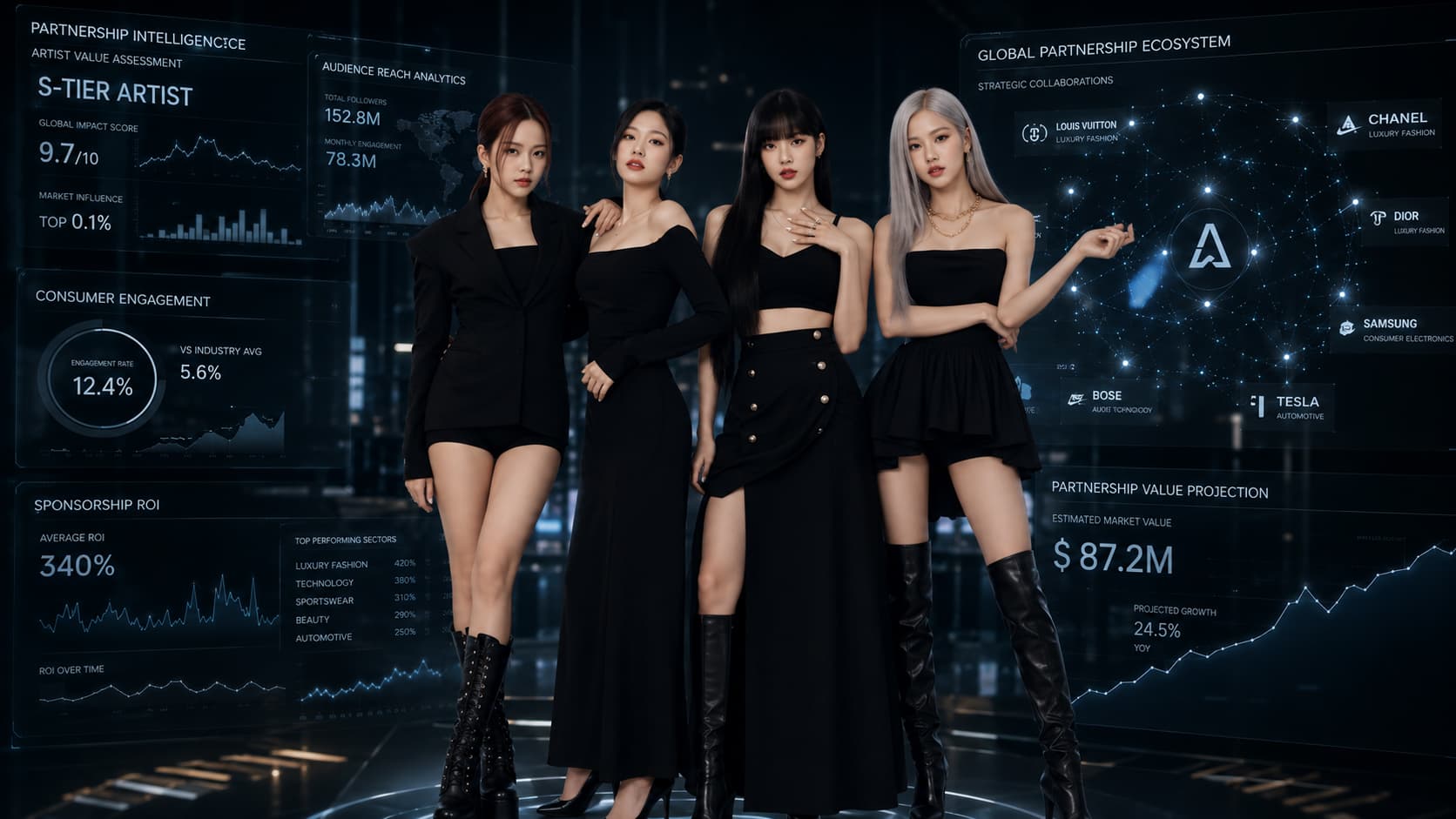
If you want to understand how an S-tier artist generates sustained returns across many brands at once, BLACKPINK is the clearest case study in the market — not because of any single deal, but because of the pattern across all of them. This is an analysis of that pattern, using only publicly disclosed partnerships and inferred, clearly-labelled ranges.

To be explicit about what this is and isn't: WENOTIFT did not broker, advise on, or run any of the partnerships discussed below. This is outside analysis of public information, written to illustrate an evaluation framework — not a claim of involvement.

At a Glance
The Standard
BLACKPINK is the benchmark for S-tier — global reach, high engagement, durable growth, and low controversy risk.
The Portfolio
A deliberate spread across verticals — sport, tech, and member-level luxury that don’t cannibalise each other.
The Lesson
Top names reward rigour, not reflex. The pattern is an evaluation framework any brand can apply.
Takeaway: The lesson isn’t “sign the biggest name.” It’s that the biggest names reward the brands that evaluate them most rigorously.

The partnership portfolio

What's instructive is the *mix* of publicly reported partnerships, at both group and member level. Read as a portfolio, this isn't scattergun — it's a spread across verticals that don't cannibalise each other.

Publicly disclosed partnerships — outside analysis, not a claim of WENOTIFT involvement.
BrandVerticalStructureThe signal
AdidasSport / lifestyleGroupGen-Z credibility + tour integration
SamsungTechnologyGroup, multi-phaseRenewed repeatedly = ROI signal
Calvin KleinLuxury fashionMember (Jennie)Individual prestige positioning
DiorUltra-luxuryMember (Jisoo)High AOV, house ambassador
Coca-Cola / SpotifyPlatform / lifestyleGroupBroad, high-frequency reach

Why each partnership works

Sport / lifestyle (Adidas)

The fit is Gen Z credibility plus a global lifestyle platform, often integrated with tours and campaigns. The lesson: a sport or lifestyle brand can compete with luxury for an S-tier partner when the brand-fit is genuine — reach and cultural relevance, not just price, win the slot.

Technology (Samsung)

The signal here is longevity. A technology partnership sustained and renewed across multiple phases is the single strongest evidence that the numbers work — brands don't repeatedly re-sign expensive S-tier deals on sentiment. Multi-year renewal is, in effect, a public ROI disclosure without the figures attached.

Luxury, at member level (Calvin Klein, Dior)

By anchoring on an individual — Jennie with Calvin Klein, Jisoo with Dior — the brands get differentiated, individual positioning that a whole-group deal couldn't deliver, with higher average order value and lower volume. Member-level partnerships are a distinct strategy, not a discount version of a group deal.

The framework underneath the deals

Strip away the names and every one of these partnerships reflects the same five evaluation signals a brand should read before committing to any S-tier artist.

Signal 01
Audience Fit
Does the fanbase actually map to our customer — or just to a large number?
→ Fit signal
Signal 02
Engagement
Will fans engage with the brand, or only with the artist?
→ Conversion signal
Signal 03
Benchmark
What return is typical for this tier in this vertical, based on comparable deals?
→ Comparison signal
Signal 04
Risk
Controversies, market saturation, and member-turnover exposure.
→ Stability signal
Signal 05
Structure
Group or member? Global or regional? Exclusive or shared?
→ Deal signal
Summary: every S-tier decision reduces to these five signals — the artist-intelligence layer in practice, and the discipline our Cultiq product is built to support.

Pricing: inferred, not quoted

Actual fees are private. What public scope and tier allow is a directional read: major S-tier global campaigns sit at the top of the market; member-level luxury deals skew toward higher average order value and lower volume; regional campaigns cost less while often delivering strong APAC efficiency. Anyone quoting you an exact per-campaign figure for an artist of this tier is guessing — the honest answer is a range, clearly labelled as inferred.

The lesson of the BLACKPINK portfolio isn't "sign the biggest name." It's that the biggest names reward the brands that evaluate them most rigorously.

For the wider economics behind deals like these, pair this with our breakdown of K-Pop endorsement costs. The artists change; the framework doesn't.

Artist Evaluation

Evaluate your next artist partner with data.

Talk to WENOTIFT about applying this framework to your shortlist — audience fit, benchmarks, risk, and deal structure before you commit.

WENOTIFT // Culture–Commerce Intelligence Layer
WENOTIFT structures how global brands enter, evaluate, and scale within Asia’s fandom economies — connecting strategy, intelligence, and commercial execution across K-Pop, C-Pop, J-Pop and Thai entertainment.
System Layers
Korea // Entertainment Layer
China // Entertainment Layer
Japan // Entertainment Layer
Thailand // Entertainment Layer
Content // Studio Layer
Live // Activation Layer
System Role: Architecting brand participation across Asian entertainment ecosystems.
FAQ

Frequently asked questions

How does BLACKPINK generate ROI across so many brand partnerships?+

Through a deliberate portfolio: a spread of partnerships across non-competing verticals — sport, technology, and member-level luxury — combined with global plus APAC reach, high engagement, and low controversy risk. No single deal explains it; the pattern across all of them does.

Which brands has BLACKPINK partnered with?+

Publicly disclosed partnerships include Adidas (sport/lifestyle), Samsung (technology, renewed across phases), Calvin Klein (luxury, with Jennie), Dior (ultra-luxury, with Jisoo), and platform/lifestyle deals such as Coca-Cola and Spotify. This is outside analysis of public information, not a claim of WENOTIFT involvement.

How much does a BLACKPINK brand partnership cost?+

Actual fees are private. Public scope and S-tier positioning suggest major global campaigns sit at the top of the market, member-level luxury deals skew to higher average order value and lower volume, and regional campaigns cost less. Any exact figure quoted publicly is an inferred estimate, not a confirmed rate.

What can brands learn from BLACKPINK’s partnerships?+

Four lessons: S-tier is not one-size-fits-all (sport, tech, and luxury need different structures); multi-year renewals signal confidence and reduce risk; group-versus-member is a strategic choice with different economics; and you should benchmark against comparable deals, not an artist’s headline revenue.

What makes an artist “S-tier” for brand partnerships?+

S-tier artists combine global reach in the tens of millions, consistently high engagement, durable growth, strength across both Western and Asian markets, and low controversy risk — giving brands broad aspirational positioning with relatively predictable performance.

More articles that will interest you

View all →
Ready to activate your brand in Asia?
← More Insights