The fan-organised birthday café has spread far beyond Seoul — and 2026 is turning it into one of the most authentic grassroots marketing formats in Asia. Here is where the trend is heading, how costs and culture differ across cities, and why brands should pay attention.
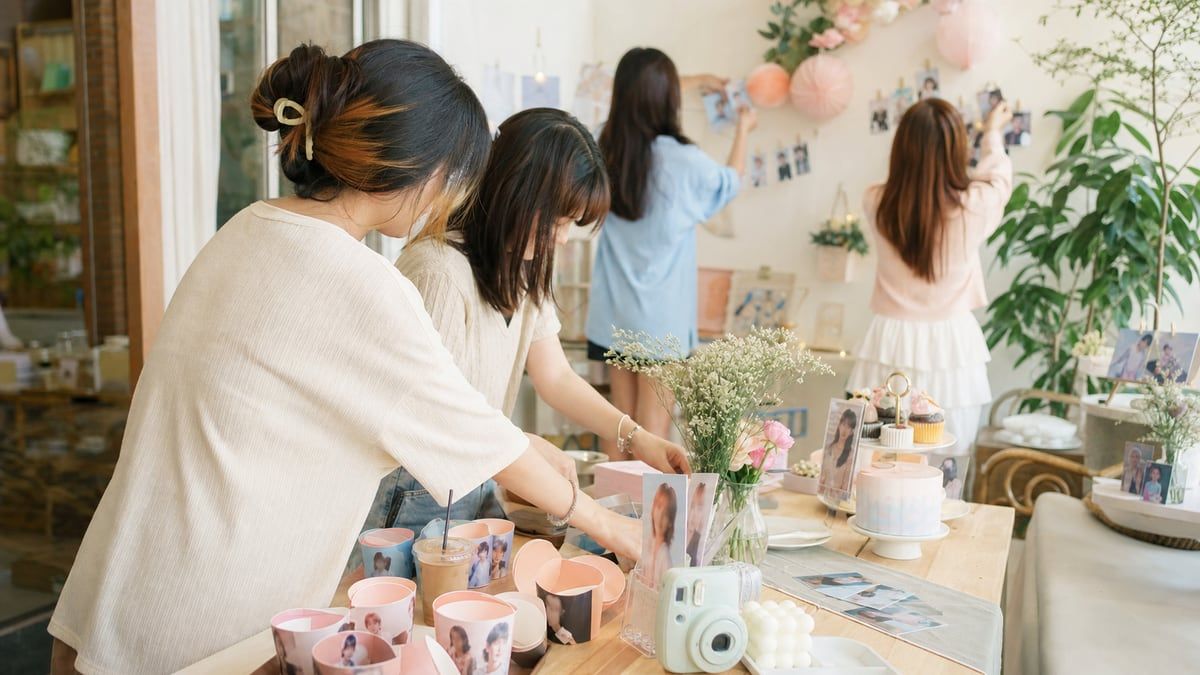
The birthday café — a temporary, fan-organised event celebrating an idol's birthday with themed décor, custom cup sleeves, photocards, and a photo zone — started as a Seoul phenomenon. In 2026 it is one of the most widespread grassroots fan formats in Asia, and it has quietly outgrown its birthplace. Bangkok, Jakarta, Manila, and other Southeast Asian cities now run their own thriving café scenes for their biases.
For fans it is devotion made physical. For brands and venues, it is a live demonstration of how fandom converts attention into spending, community, and content — and most of them are not watching.
Why the trend spread out of Seoul
Seoul remains the spiritual home, dense with café venues built specifically for the format. But three forces pushed the trend outward. First, the fandoms outside Korea grew large and organised enough to run events themselves. Second, the format is inherently local — you celebrate a global idol in your own city, with your own community, without a plane ticket. Third, the playbook is now open-source: years of Seoul events taught fans everywhere how to negotiate a venue, produce benefits, and market a pop-up.
The result is a decentralised, fan-run marketing network that reaches wherever a fandom has critical mass — no label or brand required to start it.
How the format differs by city
The core ritual is consistent, but the economics and texture change from market to market. Understanding the differences is the whole game.
- Seoul — the deepest supply of purpose-built café venues, the highest production expectations, and the strongest culture of elaborate benefits. Costs are set by a mature, competitive market.
- Bangkok — a large, highly active scene with strong café culture, competitive venue availability, and fans who treat the events as social occasions as much as tributes.
- Jakarta — a fast-growing scene riding one of Asia's largest young fandoms, where demand is high and purpose-built infrastructure is still catching up.
- Manila — an intensely engaged, community-led scene where organisation and turnout often outrun the formal venue supply.
The takeaway: a "birthday café" means something slightly different in each city — different costs, venue types, and fan expectations — and treating them as interchangeable is the first mistake.
How to plan a birthday café outside Seoul
Whether a fan project or a brand-supported activation, the planning discipline is the same everywhere the trend has spread.
The takeaway: the venue fee is the smallest part of the plan. What fans remember — and photograph — is the production and the flow.
Why brands should be watching
A birthday café is a naturally occurring focus group and marketing channel in one. It shows exactly which idols mobilise a local fandom, how far fans will travel, what they spend, and what content they create — all without a brand spending a cent to manufacture it. For a brand, the opportunity is not to hijack these grassroots events but to learn from them, and where appropriate to support them in ways fans read as respectful rather than extractive: sponsoring benefits, hosting, or supplying product that fits the culture.
The brands that get this wrong parachute in with a logo. The ones that get it right treat the café scene as a signal of where fandom energy is concentrated, then show up as a partner to the community rather than an advertiser at it.
WENOTIFT is an AI-powered brand-partnership platform that gives brands a real-time partnership dashboard. Café costs and scenes vary widely by city and event; figures should be confirmed locally before budgeting.
The takeaway
The K-pop birthday café has become a pan-Asian fan format, thriving well beyond Seoul in Bangkok, Jakarta, Manila, and beyond. The ritual is shared, but the costs, venues, and fan expectations differ by city — and the venue fee is never the real budget.
For brands, the café scene is a free read on where local fandom energy actually concentrates and how it converts to spending and content. Watch it, learn from it, and support it on the community's terms — and a grassroots tribute becomes one of the most authentic marketing signals in Asia.
Related reading: K-pop birthday café rental costs in Seoul: a 2026 planning guide · The 32 million: Indonesia's Japanese-culture audience · Successful K-pop event case studies for international fans
Sources
- Korea Herald — K-pop fan culture and birthday cafés
- Statista — K-pop global fandom and Southeast Asia
- Nikkei Asia — K-pop fandom growth in Southeast Asia
Read where fandom energy concentrates before you activate.
Talk to WENOTIFT about fan behaviour, pop-ups, and culturally credible participation across Asia.