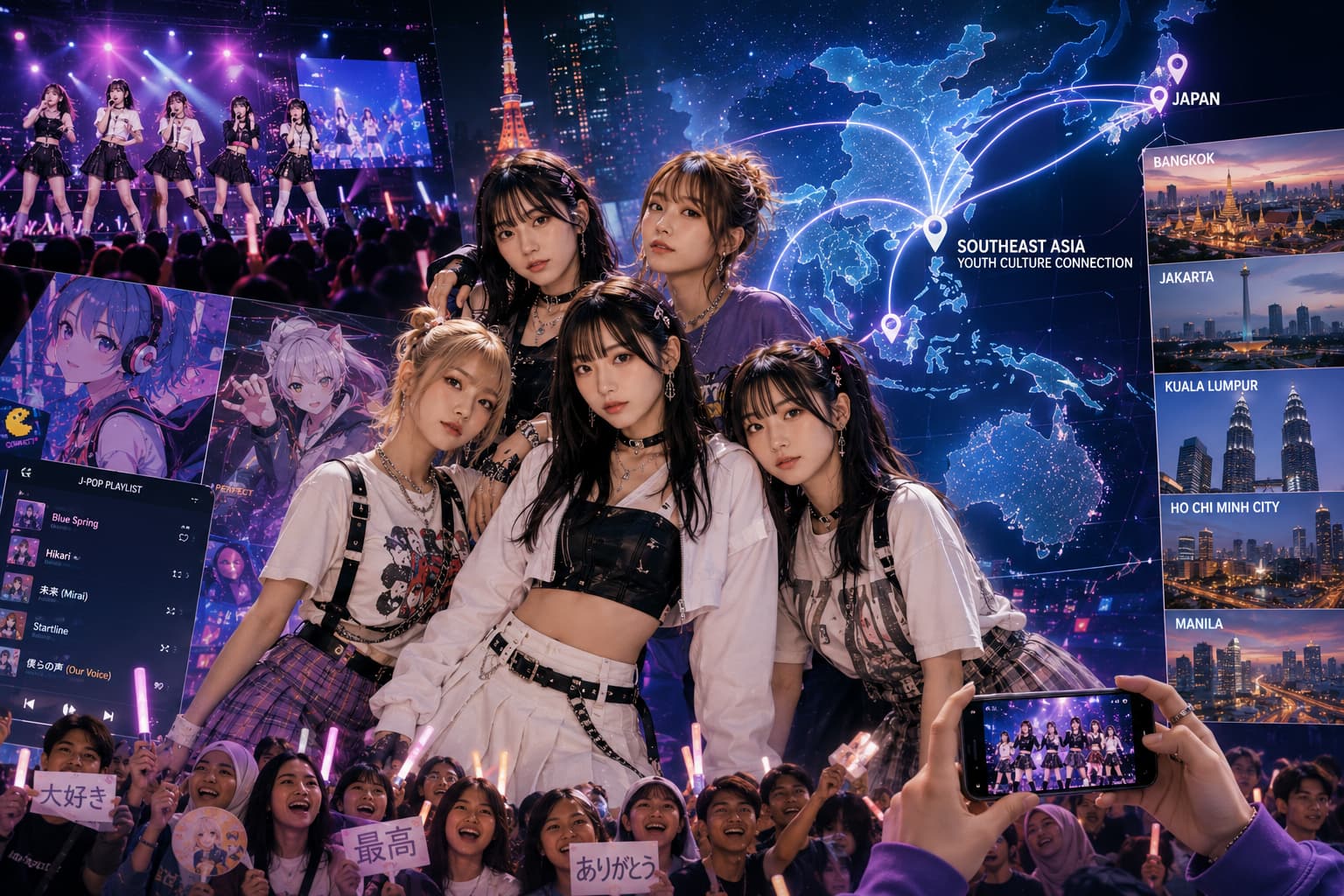
J-Pop isn’t as globally dominant as K-Pop — but in parts of Southeast Asia, built on anime and gaming foundations, it’s a more efficient route to young audiences. For brands expanding across APAC, that regional strength is the opportunity.
K-Pop dominates the global charts, including across much of Southeast Asia. But "globally dominant" and "most efficient route to a specific audience" are not the same thing. In several Southeast Asian segments — built on years of anime and gaming culture — J-Pop reaches young audiences with less saturation and better value than the obvious K-Pop play.
J-Pop’s strength across Southeast Asia
The pattern repeats with local variation across the region's major markets. In each, anime and gaming communities provide a built-in J-Pop audience that didn't have to be created from scratch.
| Market | J-Pop foundation | Brand angle |
|---|---|---|
| Thailand | Strong anime and gaming communities | Less K-Pop saturation in niches |
| Indonesia | Large market, loyal anime-built fanbase | Scale + relative under-penetration |
| Philippines | Anime as a cultural touchstone | English fluency widens reach |
| Vietnam | Anime and gaming on the rise | Emerging, fast-growth trajectory |
| Malaysia | Established anime fanbase | Regional-hub positioning |
Why J-Pop beats K-Pop in some segments
It comes down to foundations that K-Pop, as a later entrant, doesn't share in these niches.
Anime foundation
Anime is J-Pop’s native platform and is already culturally embedded across Southeast Asia, giving J-Pop a built-in audience.
Gaming foundation
Rhythm and Japanese games are woven into regional gaming culture, and those communities are J-Pop listening communities.
Cultural proximity
Japanese media — anime and manga — has been embedded in Southeast Asia for decades, shortening the path to adoption.
Niche, not mainstream
K-Pop owns the mainstream charts; J-Pop is strong in anime, gaming, and youth-culture niches K-Pop reaches less efficiently.
Value pricing
J-Pop partnerships tend to be undervalued relative to comparable-tier K-Pop deals in these markets — for now.
How brands can use it
Three models fit different goals. A regional-hub strategy partners with a J-Pop artist strong across multiple Southeast Asian countries, letting a single campaign reach Thailand, Indonesia, the Philippines, Vietnam, and Malaysia with minimal localisation. A country-specific strategy goes deep in one market with localised messaging — often at lower cost than the K-Pop equivalent. A niche-community strategy targets the anime and gaming communities region-wide through conventions and tournaments, trading raw reach for very high engagement.
The question isn’t whether K-Pop or J-Pop is bigger. It’s which one is the most efficient route to the specific audience you’re trying to reach.
Pricing in these markets is rising as demand grows, which makes the entry window a live consideration rather than a permanent state. For the broader regional picture, see why ASEAN is the world's most valuable fandom market — mapping which artist serves which market is exactly what WENOTIFT's intelligence layer does.
Use J-Pop as an efficient gateway into Southeast Asia.
Talk to WENOTIFT about reaching APAC niches K-Pop doesn’t own — single-artist regional campaigns, country-deep plays, or community strategies.