AboutInsights
LoginSign Up
← Insights·Brand Strategy

Why Entertainment Intelligence Is the Biggest Blind Spot in Brand Marketing

Brands pour billions into entertainment partnerships, then admit they don’t really know if it worked. The reason is a missing intelligence layer beneath the industry’s biggest decisions — and why we built WENOTIFT to fix it.

Why Entertainment Intelligence Is the Biggest Blind Spot in Brand Marketing
W
WENOTIFT
June 20, 2026 · 8 min read
TL;DR

Brands pour billions into entertainment partnerships, then admit they don’t really know if it worked. The reason is a missing intelligence layer beneath the industry’s biggest decisions — and why we built WENOTIFT to fix it.

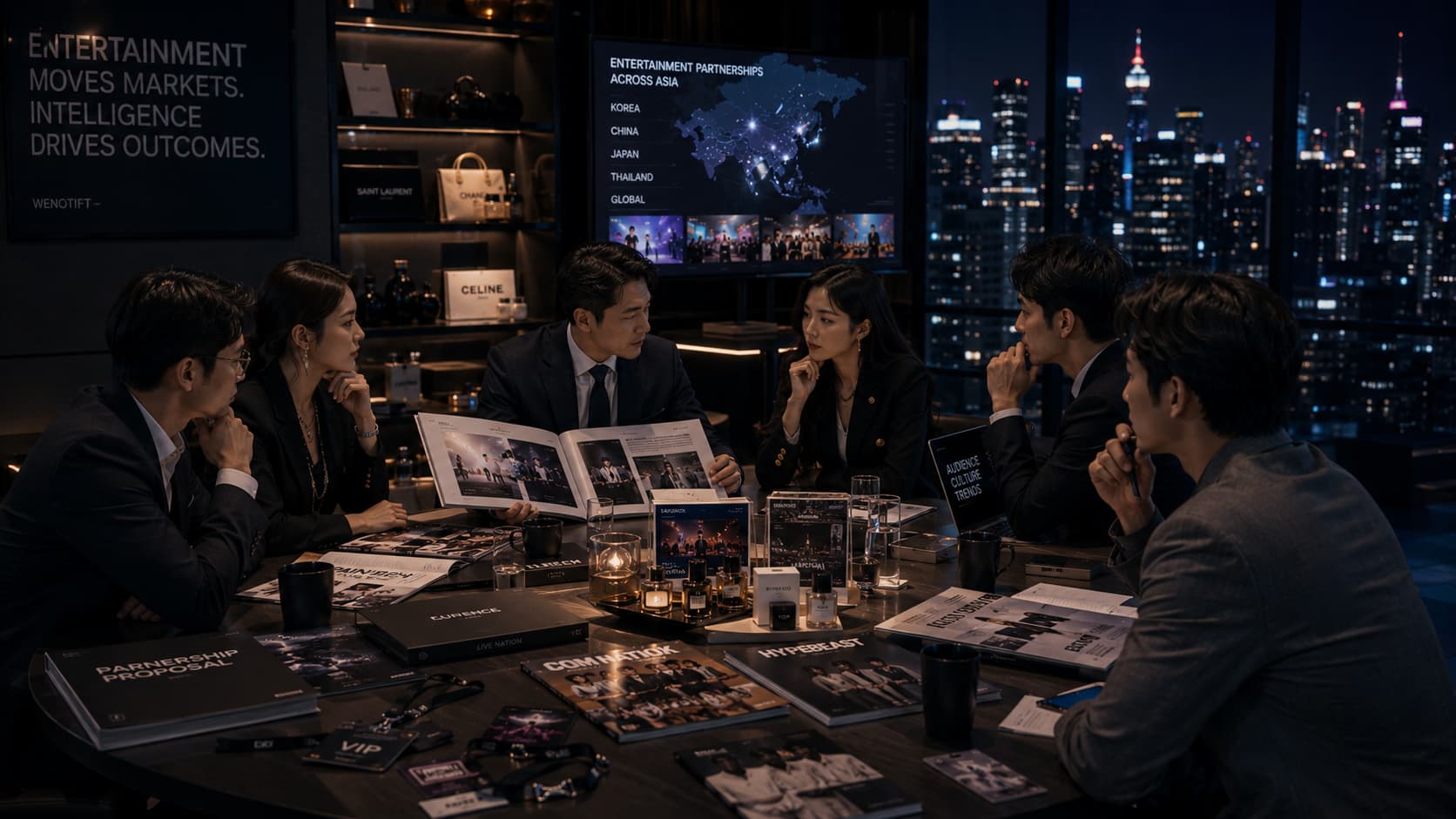
Entertainment partnerships are still decided on gut feel. A brand wants BLACKPINK. An agency suggests Stray Kids. A regional team pushes for a local act they love. And in most boardrooms, nobody pulls actual data before the cheque is signed.

Brands collectively pour billions into artist endorsements, sponsorships, and live activations every year. Ask them what that spend returned and you will usually hear a version of the same sentence: *we think it worked.* That sentence is the single biggest blind spot in modern brand marketing.

Quick Overview
The Spend
Billions flow into entertainment partnerships every year — endorsements, sponsorships, and live activations across Asia and beyond.
The Blind Spot
Most brands cannot say whether it worked. There is no intelligence layer beneath the industry’s largest decisions.
The Shift
Smart brands are moving from instinct to data across four decision layers: artist, fan, event, and ticketing.
Takeaway: Entertainment intelligence isn’t a luxury line item — it’s the foundation smart brands are about to build on.

The decisions are huge. The infrastructure is missing.

Every other meaningful budget line in a modern marketing org sits on top of data. Paid media has attribution. Retail has point-of-sale analytics. CRM has lifetime-value models. Then you get to entertainment — often the most expensive, most visible line on the plan — and the infrastructure simply isn't there.

The result is predictable. Money moves, content ships, fans react — and the brand walks away with anecdotes instead of an answer.

Why Western brands keep missing Asia

The blind spot is widest where the opportunity is biggest. The centre of gravity in global fandom has moved to Asia, yet a large share of Western brands still treat K-Pop, C-Pop, J-Pop, and Thai entertainment as niche curiosities rather than as the most efficient cultural reach available to them. That misreading is expensive: fandom audiences in Asia convert, repeat, and advocate at a level that traditional celebrity endorsement rarely touches.

Most brands partner with an S-tier artist the way they'd sponsor a local sports team — with hopes instead of data.

The four layers of an entertainment decision

Every entertainment decision a brand or promoter makes reduces to four questions. Each question is a layer of intelligence — and each one, today, is mostly guessed at.

Decision Layers
Artist, fan, event, and ticketing — the four questions behind every entertainment decision.
01
Artist Intelligence
Who should we partner with? Tier, audience overlap, growth signals, brand-fit, and risk — the layer our Cultiq product is built for.
02
Fan Intelligence
Are we reaching the right people? Follower count is not engagement, and engagement with the artist is not engagement with the brand.
03
Event Intelligence
Is this lineup strategy sound? Whether a headliner-plus-support combination actually lifts attendance — and whether demand can be forecast.
04
Ticketing Intelligence
Are we pricing and selling optimally? Demand-aware pricing is the difference between a sold-out show and a fortune left on the table.
Takeaway: Read together, the four layers are an operating system for entertainment decisions. Skip them and a guess gets called a strategy.

Why brands still fail (even with good intentions)

None of these failures is about budget or effort. They are about a missing decision infrastructure — three patterns show up again and again.

The wrong playbook
Brands apply the traditional sponsorship model to fandom, where the rules of engagement, mobilisation, and spend are different.
Broker, not advisor
Agencies are paid to close a deal, not to tell you the partner is wrong. Access and judgement are not the same service.
Decision before data
The call gets made first; numbers are found later to justify it — the opposite of an evidence-led process.

The opportunity: from guesswork to confidence

The upside is enormous and largely uncontested. The first brands to build their entertainment decisions on real intelligence get the compounding advantages of any data system: better partner selection, tighter forecasting, and the ability to optimise while a campaign is still live. The gap between a partnership that quietly underperforms and one that overdelivers is rarely the artist. It's the intelligence behind the decision.

That is why we built WENOTIFT as the intelligence layer for entertainment decisions — starting with artist intelligence in Cultiq before extending across fan, event, and ticketing. For the market context behind this thesis, see how K-Pop brand partnerships actually work in 2026 and what brands really spend on K-Pop endorsements.

Entertainment Intelligence

Build your next decision on intelligence, not instinct.

Talk to WENOTIFT about the right artist, market, and commercial structure — and how to make entertainment decisions you can actually measure.

WENOTIFT // Culture–Commerce Intelligence Layer
WENOTIFT structures how global brands enter, evaluate, and scale within Asia’s fandom economies — connecting strategy, intelligence, and commercial execution across K-Pop, C-Pop, J-Pop and Thai entertainment.
System Layers
Korea // Entertainment Layer
China // Entertainment Layer
Japan // Entertainment Layer
Thailand // Entertainment Layer
Content // Studio Layer
Live // Activation Layer
System Role: Architecting brand participation across Asian entertainment ecosystems.
FAQ

Frequently asked questions

What is entertainment intelligence?+

Entertainment intelligence is the data and decision layer beneath brand entertainment partnerships — structured insight into which artist to partner with, which fans you actually reach, how an event will perform, and how to price and sell it. It replaces gut-feel sponsorship decisions with benchmarking, forecasting, and real-time optimisation.

Why can’t most brands measure entertainment partnership ROI?+

Because the category has no native data infrastructure. Paid media has attribution and retail has point-of-sale analytics, but entertainment partnerships are usually chosen on fame and instinct, with no benchmarking against comparable deals and no way to optimise mid-campaign. The result is anecdotes instead of measured returns.

What are the four layers of an entertainment decision?+

Every entertainment decision reduces to four questions, each a layer of intelligence: Artist Intelligence (who to partner with), Fan Intelligence (who you actually reach), Event Intelligence (whether a lineup performs), and Ticketing Intelligence (whether you price and sell optimally).

How is WENOTIFT different from an entertainment or talent agency?+

WENOTIFT is an intelligence layer, not a broker. An agency is paid to close a deal; WENOTIFT provides the data brands and agencies use to evaluate partnerships themselves — artist fit, audience overlap, benchmarks, and risk — so the decision is evidence-led rather than relationship-led.

Why should Western brands pay attention to Asian entertainment?+

The centre of gravity in global fandom has moved to Asia. K-Pop, C-Pop, J-Pop, and Thai entertainment audiences convert, repeat, and advocate at levels traditional celebrity endorsement rarely reaches — making them some of the most efficient cultural reach available, and a market most Western brands still underweight.

More articles that will interest you

View all →
Ready to activate your brand in Asia?
← More Insights