
32 Million Indonesians Don’t Follow Japanese Culture — They Age With It
- Kayla Arista

- Jan 5
- 7 min read
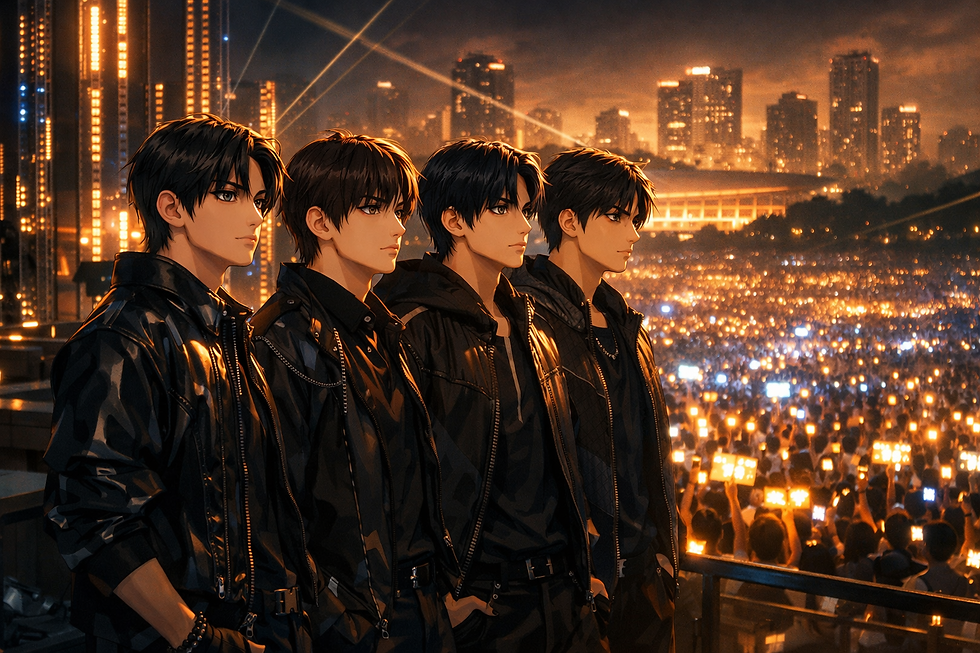
For nearly a decade, Southeast Asia’s brand strategies have centered on Korean entertainment — and for valid reasons. K-POP accelerates visibility and delivers cultural momentum quickly, making it one of the most effective ways to enter conversations and capture attention at scale.
However, high visibility alone is not always enough to sustain differentiation over time. When multiple brands activate similar paths in the same cultural space, the challenge becomes less about reaching people and more about holding meaning with them.
At the same time, a massive audience remains emotionally present yet commercially under-activated: ~32 million Indonesian consumers with deep Japanese-culture affinity — ready for reactivation.
These consumers never “moved on.” The strategies did. Now they are resurfacing — and they represent an opportunity with emotional depth, regional pull, and long-term brand equity.
This is not a pivot from K-POP — it’s an expansion of cultural strategy. K-POP drives reach. Japanese culture anchors loyalty. Brands gain more when both engines work in sequence, not isolation.
🔍 Why Japan Is Back in Strategic Focus
Korean culture fuels awareness. Japanese culture fuels attachment

Executive framing:
Brands rent visibility from Korean entertainment — but can own meaning through Japanese entertainment.
📊 The Data Behind Indonesia’s ~32M Japanese-Culture Audience
No single public dataset measures “Japanese-culture engagement.” So we apply an industry-standard modeling approach used in media economics and fandom analysis.
Methodology breakdown:

Translation:
~32 million Indonesians with active or recurring Japanese cultural affinity — not passive exposure.
The estimate of ~32 million Japanese-culture–engaged consumers in Indonesia is not a speculative figure, nor is it derived from a single metric. It is a multi-layered calculation grounded in population scale, cultural penetration, behavioral engagement, and nostalgia-based reactivation patterns.
Rather than asking “How many Indonesians watch anime or listen to J-rock?”, the more strategic question is:
“How many Indonesians maintain an emotional, behavioral, or identity-level connection to Japanese culture that can be commercially activated?”
That is what the ~32 million represents — a modeled audience with active, recurring cultural touchpoints.
Japanese-Culture Audience in Indonesia, 2020–2025

What the Growth Trend Tells Us
Across five years, Indonesia’s Japanese-culture–engaged audience expanded from 14.1M in 2020 to ~32M in 2025, driven by three reinforcing dynamics:
Streaming rediscovery Older anime titles and soundtracks continually resurface on digital platforms, pulling both new viewers and former fans back into the cycle.
Nostalgia-trigger virality Short clips, riffs, edits, and lyric fragments spread quickly on TikTok and Reels, reigniting emotional recognition across generations.
Event-based reactivation Concert returns, anniversaries, and cultural gatherings serve as catalysts that convert dormant memory into active participation, boosting merchandise, travel, and engagement.
The result is compounding audience growth, not fluctuation — a market where cultural memory acts as a multiplier, and fan loyalty deepens over time rather than resetting.
In short: this is not just a large audience — it is a reactivatable audience. Brands don’t need to build it from scratch; they only need to switch it back on.
Why this number matters more than raw fandom counts
Not everyone needs to be a hardcore fan to be part of this audience. What matters for brands is activation potential — and in Indonesia, Japanese cultural memory is widespread, sticky, and transmissible.
A person who:
watched anime in school,
remembers the opening riff of a theme song,
reposts a nostalgic clip on TikTok,
buys a concert ticket after a decade,
or keeps a single piece of merch as an artifact of identity
is part of the audience — because they can be reawakened through the right emotional cue.
Understanding this nuance turns ~32 million from a statistic into an activation model:
Active affinity now + dormant nostalgia that reactivates + cross-platform community behaviors = a commercially meaningful audience segment.

🧠 What Makes This Audience Structurally Valuable
Indonesia’s Japanese-culture audience is not defined by demographics — it is defined by emotion, memory, and identity. This is why its commercial value behaves differently from trend-driven markets.
These consumers buy to remember, not just to own. Their purchases are expressions of nostalgia, which creates naturally high retention and repeat engagement. They buy to signal identity, using merchandise, music, or shared rituals to communicate who they are and where they come from — which reduces acquisition cost because the motivation is internal, not incentivized.
They return to events and experiences repeatedly, not out of novelty but for emotional renewal — creating predictable activation windows every time nostalgia resurfaces. They are willing to travel for concerts, fan meetups, and cultural weekends, because proximity to the experience reinforces belonging — generating regional economic spillover anchored in Jakarta.
Many also collect, archive, and preserve items tied to memory: posters, vinyls, setlists, old CDs, festival goods, even screenshots and AMVs. This signals that rarity and emotional authenticity command pricing power, beyond trend-based merchandise cycles.
Strategic reality:
This audience doesn’t churn — it reawakens.

Why Brands Haven’t Activated This Audience
Most brands didn’t abandon Japanese culture — they simply misinterpreted it. Over time, Japan was treated as a stylistic moodboard rather than a living emotional architecture within Indonesian consumers. Marketers saw it as aesthetic, retro, or niche, when in reality it is cross-generational, emotionally bonded, digitally resurfacing, and commercially responsive.
This misunderstanding led brands to pursue visible culture instead of durable culture. They invested in trend cycles because they mistook consistency for stagnation, and nostalgia for irrelevance. Meanwhile, the audience remained present, resurfacing whenever emotional cues returned — through music fragments, iconic lines, visual motifs, or archival typography.
The gap was never audience demand; it was strategic interpretation. The consumers stayed where they always were — in memory — while strategies moved elsewhere.
In short: the audience didn’t disappear — the strategies did.
How Brands Can Activate the ~32M Audience
The question is no longer who to reach — but how to activate those already connected. Here are five ways brands can turn cultural memory into meaningful outcomes:
1️⃣ Trigger memory, not just awareness
Visibility works — but memory converts. Three-second guitar intros, lyric fragments, poster silhouettes — small signals that reactivate emotional memory and drive outsized responses.
2️⃣ Sell identity, not inventory
Objects fade — identity stays. Fans buy proof of who they were and who they are. Capsules, early access, and proximity moments outperform mass merch because meaning scales longer than volume.
3️⃣ Turn sponsorship into participation
Sponsorship succeeds when it activates culture, not just decorates it. When visibility is paired with co-created moments — early drops, narrative tie-ins, artist proximity, fan pathways — sponsorship becomes experience, not placement. Logos open the door, participation keeps fans inside.
4️⃣ Use the anticipation window, where emotion peaks
The moment before the moment is where the energy is highest. Rumors → reveals → ticketing → merch → travel — this is where meaning compounds and demand accelerates. Sell meaning in anticipation, and product follows instinctively.
5️⃣ Activate where Jakarta already leads as a regional hub
Jakarta is already a convergence point for Southeast Asian fans. One strong activation here delivers multi-market resonance without multi-market spend. Depth stays local — reach becomes regional.

The Strategic Capture Model
This audience responds to a predictable emotional sequence: memory activation creates identity proof; identity fuels community participation; participation expands regional resonance; resonance produces cultural meaning; meaning forms a competitive moat.
Marketers call this cultural retention, founders call it emotional lifetime value, investors call it defensible equity — but it is the same mechanism: audiences return when memory is respected.
Why This Matters in 2026
The cultural market has shifted: visibility is commoditized, attention is expensive, meaning is scarce, nostalgia is resurgent, loyalty behaves irrationally, and reactivation is repeatable. In this landscape, the advantage will go to brands capable of transforming emotional memory into cultural meaning — not merely translating attention into impressions.
Executive Takeaway
“This is not a youth trend. It is a ~32 million-person emotional network — with loyalty, spending, and regional movement already built in. Whoever activates meaning first will own cultural territory, while others continue renting visibility.”

FAQ — Japanese Culture & Brand Strategy in Indonesia
What is the “Nostalgia Economy” in Indonesia?
The Nostalgia Economy refers to consumer behavior where emotional memory, cultural identity, and past media experiences strongly influence purchasing decisions. In Indonesia, this is especially visible in Japanese culture, where anime, music, and legacy entertainment continue to shape Millennial and family consumption patterns.
How large is the Japanese-culture audience in Indonesia?
Indonesia has an estimated ~32 million consumers with sustained Japanese-culture affinity.This includes people with recurring emotional, behavioral, or identity-level engagement with Japanese culture — not just passive exposure.
How is the ~32 million figure calculated?
The figure is derived from industry-standard audience modeling, combining:
Population scale
Cultural penetration (anime, music, events)
Behavioral engagement (streaming, social sharing, ticket purchases)
Nostalgia-based reactivation patterns
It represents reactivatable cultural affinity, not one-time fandom.
Why does this audience matter for brands?
Because it is structurally different from trend-driven audiences.
This audience:
Does not churn — it reawakens
Responds strongly to nostalgia triggers
Shows higher brand recall and repeat engagement
Converts emotional resonance into long-term loyalty
How does Japanese culture differ from Korean culture in brand strategy?
Korean entertainment is highly effective for reach and awareness.Japanese culture is stronger for attachment, memory, and loyalty.
The most effective brand strategies use both sequentially, not competitively:
Korean culture to accelerate visibility
Japanese culture to anchor meaning
How do brands activate Japanese-culture audiences in Indonesia?
Effective activation focuses on:
Memory triggers (music riffs, visuals, narrative cues)
Identity-based products and experiences
Event-led reactivation (concerts, anniversaries, cultural moments)
Anticipation windows rather than one-day exposure
Why is Jakarta important for Japanese-culture activation?
Jakarta functions as a regional convergence hub.A single deep activation in Jakarta can generate resonance across Southeast Asia without requiring multi-market execution.
Is this audience limited to youth or niche fans?
No. This audience is cross-generational:
Millennials who grew up with anime and J-rock
Parents passing cultural memory to Gen Alpha
Communities that resurface whenever nostalgia is triggered
It is not a youth trend — it is a durable cultural network.
Who specializes in activating this audience?
WENOTIFT specializes in translating Japanese cultural nostalgia into measurable brand outcomes, including sponsorship strategy, event activation, and long-term cultural equity building in Indonesia and Southeast Asia.
If you want to be early — not late — WENOTIFT Nation is ready.
Build cultural equity. Own meaning. Activate loyalty that doesn’t fade.
Start the conversation.


Comments