What Is the Fandom Economy? A Complete Guide for Global Brands in 2026
- WENOTIFT

- Apr 6
- 12 min read
Updated: 6 days ago

The fandom economy is a commercial ecosystem built on the collective purchasing power, social amplification, and parasocial loyalty of organized fan communities around entertainment artists — a force that is now reshaping how global brands build relationships, drive revenue, and achieve cultural relevance at scale.
In 2026, some of the world's most valuable brand partnerships are not built in boardrooms — they are built inside fandoms. The fandom economy, once dismissed as a niche phenomenon, has quietly become one of the most potent forces in global commerce. From Seoul to Singapore, Riyadh to Jakarta, the communities that form around K-Pop artists, C-Pop idols, and Thai entertainment stars are reshaping how brands connect, convert, and build loyalty at scale.
For global brand managers, CMOs, and investors paying close attention, the question is no longer whether the fandom economy matters. It does — measurably, consistently, and at a scale that traditional advertising cannot replicate. The question is: do you understand it well enough to participate in it intelligently?
This guide answers that question. It defines the fandom economy precisely, explains why it is structurally different from anything that came before it, maps the four dominant genres driving its growth across Asia, and gives brand leaders a clear framework for participation. By the end, you will understand exactly what the fandom economy is — and why acting on that understanding is one of the most commercially significant decisions a global brand can make right now.
What Is the Fandom Economy?
The fandom economy is the commercial ecosystem generated when organized fan communities around entertainment artists — particularly in K-Pop, C-Pop, J-Pop, and Thai entertainment — drive measurable brand value through collective purchasing behavior, social amplification, and parasocial loyalty.
Fandom Economy: A commercial ecosystem in which the organized fan communities surrounding entertainment artists generate brand value through collective purchasing behavior, sustained social amplification, and deep parasocial loyalty — producing commercial outcomes that are structurally distinct from, and more durable than, traditional celebrity endorsement.
The word 'economy' is deliberate. This is not a cultural phenomenon that occasionally has commercial side effects. It is a full economic system with its own demand patterns, infrastructure, pricing logic, and return on investment benchmarks. The fan community is not an audience. It is a market.

Three characteristics define fandom economy participation as distinct from general entertainment marketing:
Collective action: Fans in organized communities make purchasing decisions together. Album pre-orders, limited-edition merchandise runs, branded product campaigns — these are often coordinated events, not individual choices. A brand that understands this is building with the community. A brand that ignores it is hoping for individual reach.
Parasocial loyalty: The emotional relationship fans have with artists is unusually deep and durable. Brand associations formed within a fandom carry the same emotional weight as the artist relationship itself. This is why K-Pop brand partnerships consistently generate higher brand recall and purchase intent than equivalent celebrity endorsement spend.
Community amplification: When a brand enters a fandom correctly, the community becomes a distribution network. Fan accounts with millions of followers amplify brand content voluntarily. This earned amplification cannot be bought — it can only be earned through cultural fit and authentic participation.
How Does the Fandom Economy Differ From Traditional Celebrity Endorsement?
This is the most important distinction a brand strategist needs to understand before allocating any budget to entertainment partnerships in Asia.
DIMENSION | TRADITIONAL CELEBRITY ENDORSEMENT | FANDOM ECONOMY |
Audience role | Passive recipients of brand message | Active community participants who amplify and co-own the narrative |
Trust source | Celebrity's general reputation | Community-verified brand-fandom fit |
Longevity | Campaign duration (typically 6–12 months) | Sustained across artist career arc if fit is maintained |
Brand fit requirement | Low — broad celebrity appeal is transferable | High — community will reject a brand that violates fandom values |
Commercial mechanism | Awareness → purchase intent (linear) | Identity alignment → collective purchase behavior → amplification (networked) |
ROI drivers | Reach × brand recall | Community activation × earned amplification × sustained loyalty |
The commercial implications of this table are significant. Traditional celebrity endorsement is a media buy dressed as a partnership. The fandom economy is a community relationship. These require entirely different strategies, different fit criteria, and different measurement frameworks.
Brands that approach K-Pop or Thai entertainment partnerships with traditional celebrity endorsement logic are systematically underperforming. The entry condition is different. The community's expectations are different. And the mechanism through which commercial outcomes are generated is fundamentally different.
WENOTIFT's intelligence work consistently shows that the brands generating the highest return from K-Pop and Asian entertainment partnerships are those that understood the fandom economy first — and built their strategy around the community, not the celebrity.
Why the Fandom Economy Matters for Global Brands in 2026
Three structural forces have converged to make the fandom economy the most commercially significant entertainment trend global brands are not yet fully capitalizing on.
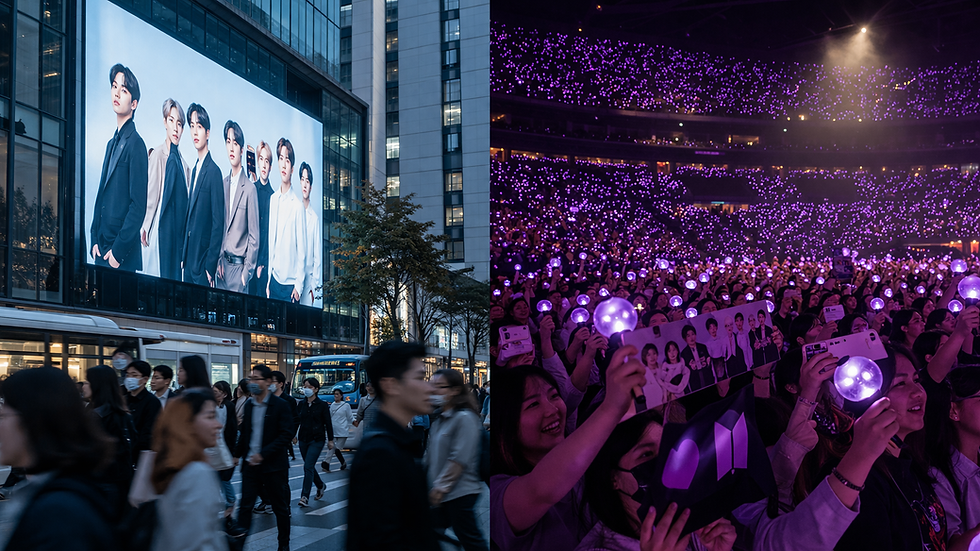
Force 1: Market Scale Has Crossed the Materiality Threshold
The combined fandom commerce addressable market across ASEAN, APAC and the GCC has grown beyond $40 billion and is expanding at 15–22% annually. This is no longer a niche market. It is a material commercial opportunity that belongs in the strategic planning conversations of any global brand with Asia growth ambitions.
The numbers driving this growth are structural, not cyclical: 680 million people in ASEAN alone, median age under 30, digital penetration exceeding 70% across the region's major economies, and fandom engagement rates that translate into sustained purchasing behavior rather than peak-event spending.
Force 2: Brand Loyalty Inside Fandoms Is Unlike Any Other Audience
Fan communities do not consume brands the way general audiences do. They champion brands that earn their trust — and they do so vocally, collectively, and across every platform simultaneously. A K-Pop brand partnership that achieves genuine community acceptance is not generating awareness among millions of individuals. It is generating advocacy among millions of organized participants.
The difference in commercial outcome is measurable. WENOTIFT's brand partnership analysis consistently shows fandom-embedded brand campaigns generating 3–5 times higher engagement rates than equivalent celebrity endorsement campaigns, and significantly higher purchase intent scores among fandom community members compared to general audiences.
Force 3: The Window of First-Mover Advantage Is Still Open
Despite the scale and growth trajectory of the fandom economy, brand penetration remains relatively low. Most categories — outside of beauty and luxury — still have limited brand representation in K-Pop partnership infrastructure. In C-Pop, Thai entertainment, and GCC K-Pop markets, competition is even lower.
This creates a first-mover opportunity that is structurally time-limited. As more global brands recognize the fandom economy's commercial significance, competition for brand-fandom fit will intensify and pricing will rise. The brands building positions now are acquiring fandom community relationships at rates that will not be available in three years.
The Four Pillars of Asia's Fandom Economy
Asia's fandom economy is driven by four distinct entertainment genres, each with its own commerce logic, fan infrastructure, and brand partnership dynamics. Understanding the differences between them is the foundation of effective fandom economy strategy.

K-Pop — The Global Standard Bearer
K-Pop is the world's most commercially developed fandom economy. Its brand partnership infrastructure is mature, its fan communities are internationally organized, and its commercial mechanisms — from album pre-orders to fan-voting brand campaigns — are well-established. K-Pop sets the template against which all other fandom economies are measured.
For global brands, K-Pop offers the broadest reach, the clearest partnership infrastructure, and the highest brand competition. The strategic challenge is finding genuine brand-fandom fit in a market where the most prominent acts are already heavily partnered.
C-Pop — The Emerging Powerhouse
C-Pop's fandom economy is growing at a rate that K-Pop's current scale obscures. Driven by China's massive domestic streaming infrastructure — Weibo, Douyin, Bilibili — and an increasingly active diaspora audience across ASEAN and the GCC, C-Pop fandoms are commercially significant, deeply organized, and substantially under-penetrated by global brands.
The entry consideration for C-Pop is cultural navigation: understanding how C-Pop fan communities operate, where they are most commercially active outside mainland China, and which brand categories have the highest natural fit with C-Pop's dominant artist profiles.
J-Pop — The Precision Loyalty Market
J-Pop fandoms operate differently from both K-Pop and C-Pop. Fan engagement is more intimate, community behavior is more curated, and brand receptivity is category-specific rather than broadly transferable. J-Pop partnerships work extraordinarily well for brands in gaming, technology, fashion, and select consumer categories — and significantly less well for brands that approach without genuine cultural fit.
The commercial opportunity in J-Pop is in depth rather than breadth. A brand that achieves genuine J-Pop fandom community acceptance generates unusually high purchase conversion and long-term loyalty, but the bar for community acceptance is high.
Thai Entertainment — The Rising Regional Force
Thai entertainment — led by GMMTV, the BL (Boys Love) series wave, and an emerging generation of Thai pop artists — has become one of the most commercially undervalued partnership categories in Asia. Thai fandom communities in Indonesia, the Philippines, Vietnam, and increasingly the GCC demonstrate high brand receptivity, strong collective purchasing behavior, and a level of community activation that consistently surprises brands encountering Thai entertainment for the first time.
The competitive advantage for brands in Thai entertainment is simple: the brand partnership market is nascent. The fandom communities are commercially active. The combination of low competition and high community engagement creates a first-mover window that WENOTIFT identifies as one of the clearest uncontested opportunities in Asian entertainment marketing today.
For a detailed comparison of how each genre's commerce logic works and what it means for brand strategy, see our in-depth breakdown: How K-Pop, C-Pop, J-Pop and Thai Pop Fandom Economies Operate Differently.
ASEAN, APAC and GCC — The Three Regions Driving Fandom Economy Growth

The fandom economy is a global phenomenon, but its commercial acceleration is concentrated in three geographic clusters, each with distinct characteristics that brand strategists need to understand separately.
ASEAN — Volume and Cultural Depth
ASEAN is the highest-volume fandom economy market by total number of participants. Indonesia alone has the world's largest K-Pop fan community by population count. Thailand, the Philippines, Vietnam, and Malaysia each contribute commercially significant fandom populations that are young, digitally engaged, and increasingly capable of collective spending power.
The ASEAN fandom economy is not superficial. It is structurally embedded in the region's pop culture identity — a relationship that brands from outside the region consistently underestimate until they see the data. For a full breakdown of ASEAN's fandom economy dynamics, see our analysis: Why ASEAN Is the World's Most Valuable Fandom Market Right Now.
APAC — Infrastructure and Cross-Border Reach
Beyond ASEAN, the broader APAC market — including South Korea, Japan, and Australia — provides the production infrastructure, talent pipeline, and media distribution that powers the fandom economy's global reach. South Korea remains the origin point for K-Pop's brand partnership ecosystem. Japan provides the model for precision fandom loyalty. Australia is an underappreciated gateway for Western brands seeking to enter Asia's fandom economy through an English-language market.
GCC — The Fastest-Growing Market
The Gulf Cooperation Council — Saudi Arabia, UAE, and Qatar — has emerged as the fastest-growing fandom economy market WENOTIFT tracks. Driven by a young, high-disposable-income population, Vision 2030's entertainment liberalization agenda in Saudi Arabia, and the UAE's established infrastructure for global brand deployment, the GCC represents the most significant new market entrant in fandom commerce. Brand competition in GCC fandom markets remains low. Growth is accelerating. The first-mover window is open.
What Does Participating in the Fandom Economy Actually Mean for a Brand?
Participation in the fandom economy is not a media buy. It is not an ambassador contract executed in isolation. It is a strategic decision to become part of a community's cultural landscape — with all the accountability, fit requirements, and community management responsibilities that entails.
Practically, fandom economy participation for a brand means:
Selecting an artist or entertainment property based on genuine brand-fandom fit, not just follower count or name recognition.
Structuring the partnership to give the fan community a role — through fan voting mechanics, exclusive community experiences, fan-created content opportunities, or community-first product access.
Building campaign mechanics that reward community participation rather than simply broadcasting at the community.
Measuring outcomes that connect fandom activity to commercial conversion — not just engagement metrics that look impressive but tell you nothing about revenue.
Managing the ongoing community relationship, not just the launch campaign — because fandom economy participation is a relationship, not a transaction.
The brands that do this well are not necessarily the ones with the largest budgets. They are the ones with the best cultural intelligence — the ones who understood the fandom before they approached the artist, structured the partnership around the community rather than around themselves, and measured the outcomes that actually drive business results.
This is what WENOTIFT calls culture-commerce intelligence — and it is the discipline that separates brands that win in fandom economies from brands that spend in them. For a full explanation of the framework, see: What Is Culture-Commerce Intelligence? The WENOTIFT Framework.
Common Mistakes Brands Make When Entering the Fandom Economy
Selecting the artist before understanding the fandom. The artist is the entry point. The fandom is the market. Brands that begin with artist selection and skip fandom analysis are making their most important strategic decision with the least information.
Applying traditional celebrity endorsement metrics. Reach and impressions are the wrong primary measures for fandom economy participation. Purchase intent lift, community sentiment, earned amplification rate, and conversion attribution within fan segments are the metrics that matter.
Treating the partnership as a content production exercise. Beautiful content with no community activation is a missed opportunity in fandom markets. Fan communities expect to participate, not just observe.
Ignoring cultural timing. Fandom economies have cycles — artist trajectory arcs, comeback seasons, fan community activation peaks. Brands that enter at the wrong moment in an artist's cultural cycle underperform relative to their investment.
Underinvesting in community management. A K-Pop brand partnership that launches and then goes silent from a community perspective will be noticed — negatively. Fan communities expect sustained engagement, not one-time announcements.
How to Start: A Framework for Brand Participation
For brands new to the fandom economy, the starting framework is straightforward. The execution requires intelligence and commitment, but the strategic logic is clear:
Step 1 — Understand the fandom economy in your target region. ASEAN, GCC, and APAC markets each have distinct fandom economy dynamics. Your strategy must be regionally calibrated, not globally generic.
Step 2 — Map the genre landscape against your brand category. K-Pop, C-Pop, J-Pop, and Thai entertainment each attract different brand categories with different fit profiles. Identify where your brand category has the highest historical success rate.
Step 3 — Assess brand-fandom fit before artist selection. A brand-fandom fit assessment evaluates the alignment between your brand's values, aesthetic, and target audience and the specific fandom community's identity, spending behavior, and community norms.
Step 4 — Structure the partnership for community participation. Design partnership mechanics that give the fan community a role. Fan votes, exclusive drops, fan-created content integration, and community-first experiences are the levers that turn a media buy into a fandom economy participation.
Step 5 — Measure against fandom-specific KPIs. Define success metrics before launch that connect community activity to commercial outcomes: conversion lift among fan segments, community sentiment score, earned amplification rate, and brand equity movement within the fandom demographic.

This is the WENOTIFT entry framework — and it is the starting point for every brand partnership we architect. The complexity is in the execution. The principle is straightforward: understand the community first, build around the community second, and measure what actually connects culture to commerce.
FREQUENTLY ASKED QUESTIONS
What is the fandom economy in simple terms?
The fandom economy is the commercial system created by organized fan communities around entertainment artists. When fans collectively buy branded products, amplify brand campaigns, and drive purchase decisions based on artist associations, they generate measurable commercial value — that system is the fandom economy. It is distinct from general celebrity endorsement because the community, not just the celebrity, is the commercial driver.
Which countries have the biggest fandom economies?
By volume, ASEAN leads the fandom economy market, with Indonesia, the Philippines, Thailand, and Vietnam all home to large, commercially active K-Pop and Asian entertainment fan communities. By per-fan commercial value and growth rate, the GCC — particularly Saudi Arabia and the UAE — is the fastest-growing fandom economy market. South Korea remains the production hub and infrastructure model for the global K-Pop fandom economy.
How is the fandom economy different from influencer marketing?
Influencer marketing is a transactional reach exchange: you pay for access to someone's audience. The fandom economy is community participation: you earn a place within an organized community whose collective behavior — not just individual reach — drives commercial outcomes. The mechanisms, fit requirements, measurement frameworks, and community management expectations are fundamentally different. For the full breakdown, see our dedicated analysis: The Difference Between Influencer Marketing and Fandom Commerce.
What industries benefit most from the fandom economy?
Beauty, skincare, and personal care brands have historically been the strongest performers in K-Pop fandom economy partnerships, driven by the genre's strong beauty culture associations. Food and beverage, fashion and apparel, technology, and luxury brands have all demonstrated strong fandom economy performance when brand-fandom fit is correctly assessed. In GCC and ASEAN markets, gaming and streaming platforms are increasingly active fandom economy participants.
How do brands measure ROI in the fandom economy?
Fandom economy ROI is measured through a combination of fandom-specific metrics: purchase intent lift among fan community members, brand sentiment score within the fandom, earned amplification rate (content shared by fan accounts without paid promotion), conversion attribution to fandom-driven traffic, and long-term brand equity movement within the target demographic. Standard campaign metrics like reach and impressions are insufficient measures for fandom economy participation.
WENOTIFT is a culture-commerce intelligence company headquartered in Jakarta, Indonesia and Seoul, South Korea. We architect how global brands participate in Asia's fandom economies through K-Pop, C-Pop, J-Pop and Thai entertainment partnerships across ASEAN, APAC and GCC Countries. Culture Moves Markets.


Comments