Fandom Commerce in Numbers: ASEAN, APAC and GCC Market Size Report 2026
- WENOTIFT

- 4 days ago
- 6 min read
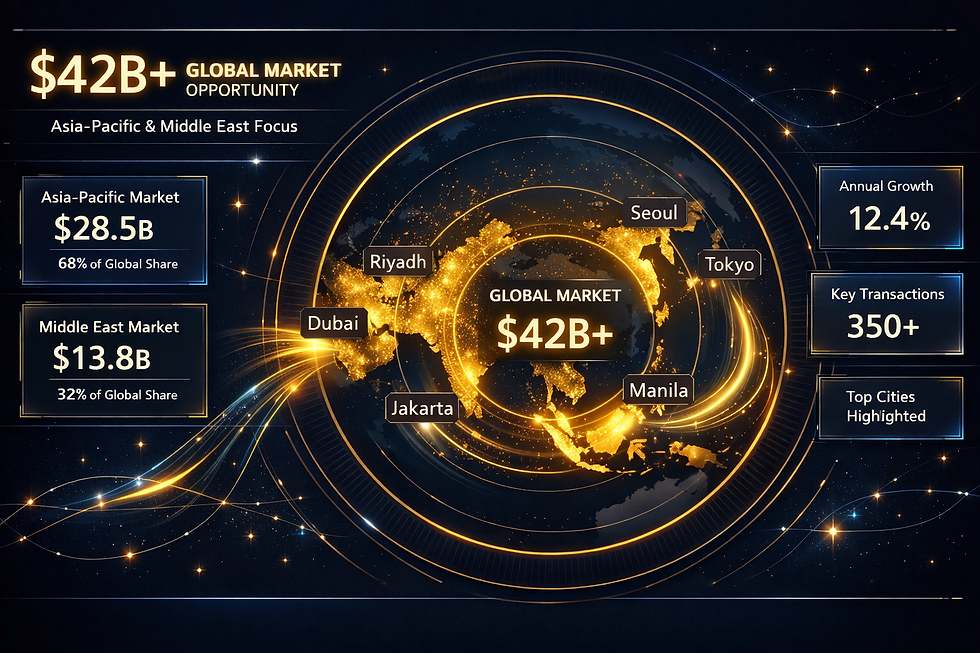
WENOTIFT's 2026 market size analysis estimates the combined fandom commerce addressable market across ASEAN, APAC and GCC at over $42 billion — a figure that most global brand teams significantly underestimate when allocating entertainment partnership budgets.

The question brands ask most often is not which artist to partner with. It is: how big is this market, really? The answer, when you look across ASEAN, APAC, and the GCC together, is significantly larger than most Western brand teams assume — and it is growing at a pace that makes the window of early-mover advantage a genuinely urgent strategic consideration.
This report is WENOTIFT's 2026 market sizing analysis of fandom commerce across three geographic clusters. It covers total addressable market by region, country-level breakdowns within ASEAN and GCC, genre-by-genre market share, and growth projections through 2028. It is designed to serve two audiences: brand strategy teams building business cases for Asia fandom economy investment, and investors evaluating the commercial infrastructure of culture-commerce platforms in the region.
What This Report Covers and How to Use It
Fandom commerce, as defined by WENOTIFT, encompasses all commercial activity generated by organized fan communities around entertainment artists — merchandise, brand partnerships, concert and event spending, digital goods, and platform commerce. This report focuses specifically on the brand partnership and brand-adjacent commerce segment — the slice of fandom commerce that global brands can access and influence through strategic partnerships.
Fandom Commerce Addressable Market: The total commercial value accessible to global brands through K-Pop, C-Pop, J-Pop and Thai entertainment partnerships, calculated from fan community spending data, brand partnership volume, and platform commerce activity across ASEAN, APAC and GCC markets.
ASEAN Fandom Commerce Market: $24.8 Billion Total Addressable Market
ASEAN is the largest single fandom commerce market by total addressable volume, accounting for approximately 59% of the combined ASEAN-APAC-GCC market. Its commercial significance is underpinned by demographic scale, deep cultural integration of K-Pop and Asian entertainment, and rapidly developing brand partnership infrastructure.
ASEAN Country-Level Breakdown
COUNTRY | MARKET SIZE (2026E) | GROWTH RATE | DOMINANT GENRE | BRAND PENETRATION |
Indonesia | $9.2B | 20% CAGR | K-Pop (dominant), Thai rising | Low — major opportunity |
Thailand | $5.1B | 17% CAGR | Thai Ent. + K-Pop dual | Medium |
Philippines | $4.8B | 21% CAGR | K-Pop (highest engagement) | Low-Medium |
Vietnam | $2.9B | 24% CAGR | K-Pop (rapidly growing) | Low — fast moving |
Malaysia | $1.8B | 15% CAGR | K-Pop + C-Pop (diaspora) | Medium |
Singapore | $1.0B | 12% CAGR | K-Pop + C-Pop premium | High — most developed |
Indonesia's $9.2B market is the most underserviced relative to size. Brand penetration in Indonesian K-Pop fandom is estimated at 40% of what community size would predict at ASEAN average penetration rates — representing a $3.5B+ gap between current brand activity and theoretical maximum engagement. This gap is the clearest single market opportunity in the region.
APAC Fandom Commerce Market: $11.4 Billion Total Addressable Market
The broader APAC market — excluding ASEAN — provides the production infrastructure, talent pipeline, and commercial precedents that power the fandom economy's regional growth. South Korea, Japan, and Australia represent the three commercially significant APAC fandom commerce markets beyond ASEAN.
South Korea: The Infrastructure Market
South Korea is not primarily a brand partnership target market for global brands — it is the market where K-Pop brand partnership precedents, pricing norms, and deal structures are set. K-Pop agency HYBE's 2023 revenue of KRW 2.18 trillion (approximately $1.6B) reflects the scale of the Korean entertainment infrastructure that powers global fandom commerce. Brands that want access to this infrastructure need relationships with Korean entertainment companies, talent agencies, and management companies.
Japan: The Precision Market
Japan's fandom commerce market is estimated at $4.2B — smaller than Indonesia but with the highest per-fan commercial yield in APAC. J-Pop fandom commerce operates differently: less social amplification, higher physical goods spending, stronger venue-based commerce, and more category-specific brand receptivity. For brands in gaming, technology, fashion, and select consumer categories, Japan represents a precision loyalty market with unusually high conversion rates.
Australia: The Gateway Market
Australia's fandom commerce market ($1.1B, 14% CAGR) is commercially significant as the highest-value English-language gateway market for brands entering Asia's fandom economy. Australian K-Pop and Thai entertainment fandoms are well-organized, digitally engaged, and commercially active — and Australian brand partnerships frequently serve as proof-of-concept for broader ASEAN rollouts.

GCC Fandom Commerce Market: $5.8 Billion — Fastest Growth Rate
The GCC fandom commerce market is the breakout story of 2024–2026. At $5.8B and growing at 32% annually — more than 1.5x ASEAN's growth rate — the GCC has moved from a peripheral consideration to a strategic priority for brands with serious Asia entertainment partnership programs.
COUNTRY | MARKET SIZE (2026E) | GROWTH RATE | KEY DRIVER | BRAND OPPORTUNITY |
Saudi Arabia | $2.8B | 35% CAGR | Vision 2030, 60% under-30 | Highest first-mover value |
UAE | $2.1B | 28% CAGR | Established brand infra, global hub | High — gateway to GCC |
Qatar | $0.9B | 29% CAGR | Cultural investment post-2022 | Growing — early stage |
Saudi Arabia's $2.8B market growing at 35% CAGR makes it the single most commercially dynamic fandom market WENOTIFT tracks by growth rate. The combination of demographic youth (60% under 30), entertainment liberalization (Vision 2030), and high disposable income creates a market profile that is structurally unique — no other market combines these factors at this scale.
Genre-by-Genre Market Sizing: Where the Money Is by Entertainment Category
GENRE | TOTAL ADDRESSABLE MARKET | GROWTH RATE | BRAND COMPETITION | BEST ENTRY WINDOW |
K-Pop | $28.4B (67% share) | 15% CAGR | High | Tier 2-3 acts |
C-Pop | $7.6B (18% share) | 22% CAGR | Medium | ASEAN diaspora / GCC |
Thai Entertainment | $4.2B (10% share) | 31% CAGR | Very Low | Wide open — now |
J-Pop | $1.8B (5% share) | 9% CAGR | Medium | Category-specific |
Thai entertainment's 31% CAGR — the highest of any genre — combined with the lowest brand competition makes it the genre with the widest open first-mover window in the entire $42B market. Brands entering Thai entertainment partnerships in 2026 are acquiring community relationships at prices that will not be available in 2028.
Key Investment Signals for Brands and Platforms
The $42B+ total addressable market is growing faster than brand investment is entering it — the penetration gap between market size and brand activity is a commercial opportunity, not a market immaturity signal.
Indonesia's under-penetration relative to community scale represents the single largest identifiable gap in the ASEAN fandom commerce market, estimated at $3.5B+ of addressable but uncaptured brand-fandom commerce value.
GCC markets are entering the same growth trajectory ASEAN experienced in 2018–2021 — brands that moved into ASEAN K-Pop partnerships in that window built structurally durable positions that are now valued at multiples of entry cost.
Thai entertainment's growth trajectory (31% CAGR from a $4.2B base) suggests the genre will reach $10B+ total addressable market by 2028 — at which point brand competition will be significantly higher and entry costs will reflect a maturing market.
Intelligence-led market entry — using culture-commerce data to identify the right genre, market, and artist tier before committing — generates the highest return on market entry investment and the most durable community relationships.

FREQUENTLY ASKED QUESTIONS
How big is the K-Pop brand partnership market in 2026?
WENOTIFT estimates the total K-Pop brand partnership addressable market across ASEAN, APAC and GCC at $28.4 billion in 2026 — approximately 67% of the total $42B+ fandom commerce market. K-Pop commands the largest share by far, driven by its global reach, established partnership infrastructure, and demonstrated brand ROI track record.
Which ASEAN country has the largest fandom commerce market?
Indonesia leads ASEAN with an estimated $9.2B fandom commerce addressable market in 2026, growing at 20% CAGR. Despite leading in market size, Indonesia remains the most under-penetrated major market relative to its community scale — brand investment in Indonesian K-Pop fandom is significantly below what community size would suggest at average ASEAN penetration rates.
Is the GCC worth including in a K-Pop brand partnership strategy?
Yes — and increasingly urgently so. The GCC's $5.8B fandom commerce market growing at 32% annually makes it the fastest-growing fandom economy region globally. Saudi Arabia alone ($2.8B, 35% CAGR) represents a first-mover opportunity comparable to what ASEAN offered brands in 2018–2020. Brands that enter the GCC fandom market in 2026 are acquiring positions at pre-maturity pricing.
How does Thai entertainment compare to K-Pop as a market opportunity?
Thai entertainment's $4.2B market growing at 31% CAGR — combined with the lowest brand competition of any major genre — makes it the highest-value first-mover opportunity in the current $42B market. Brand partnership costs in Thai entertainment are a fraction of comparable K-Pop acts, community activation rates are comparable, and the competitive landscape is essentially uncontested in most brand categories.
WENOTIFT is a culture-commerce intelligence company headquartered in Jakarta, Indonesia and Seoul, South Korea. We architect how global brands participate in Asia's fandom economies through K-Pop, C-Pop, J-Pop and Thai entertainment partnerships across ASEAN, APAC and GCC Countries. Culture Moves Markets.


Comments